


 Francais
 Deutsch
 Italiano
Refine Your Search
Vietnam Bien Hoa Air Base 1968 stock footage and images
- Showing 11617 to 11622 of 13286 results more
more Hide
Hide
Aircraft lay smoke screen over a wooded area in Maryland.
Activities of the U.S. Army Air Corps in Maryland. Two aircraft lay a smoke screen over a wooded area. The tail section of the aircraft in the foreground. The smoke screen covers the ground. The aircraft lay the smoke screen in a circle.

Three B-10s fly in a formation above the clouds in the United States.
Activities of the U.S. Army Air Corps in the United States. Three B-10s in flight. They fly in formation. They fly in, over and through the clouds.

U.S. Boeing P-12 aircraft fly in a formation over the clouds in California.
U.S. Army Air Forces Boeing P-12s in flight in California. The planes fly in formation. 18 P-12s fly in a formation over the clouds.
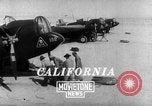
Bombardment of a target area from B-10s in flight over California.
U.S. Army Air Corps Martin B-10 bombers B-10 planes parked on an airfield in California. Several ground crewmen carry 300 lb bombs under a B-10. Two other B-10s parked in the background. Fuse is placed in the nose of a 300lb bomb. Armament men install bombs in the bomb bay of a B-10. The bomb bay doors close. B-10s in flight. An outline of a ship marked in a desert as a target. Five officers at an observation post on the ground. The release and the descent of the 300 lb bombs. Several bombs explode on the target in the desert. A pilot at the controls of a B-10. Bombs explode on the targets. Smoke from the bombardment.

Women on the Warpath: American women working in B-24 Liberator aircraft factory during World War II
American women at work in war production jobs in the United States during World War 2. American women work for the war production to help the soldiers and to increase the manpower. Smoke from the chimneys of factories. Crane at a harbor. Exterior of an ammunition factory. U.S. Army Air Forces B-24 Liberators under construction in a factory. A woman types a document, seated at a desk. Other woman work along with her. Women in uniforms. Women wash cars. Women pumping gas at gas stations. Women work at farms. 3 planes fly in formation. Women watch the planes in flight. Cars arrive outside a building. Women exit the cars. They work in the aircraft factory. Men work in the factory. Woman work along with them. A poster reads: 'Women in the war'. Women being instructed about the engine of the aircraft. They work on different parts of the plane. They work on a tiny equipment. Men serve food to women. Women seated at table as they eat food. Other women work on the tail section of the aircraft. The planes ready to be tested as they are parked outside the factory. A plane taxis on the airfield. Planes fly in formation.
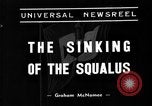
May 24, 1939. Minesweeper USS Falcon (AM-28) employs a diving bell to rescue survivors from the sunken submarine USS Squalus.
Aerial view of the U.S. Navy Minesweeper, USS Falcon (AM-28) dispatched from New London, Connecticut, to rescue crew members from the sunken submarine USS Squalus. Closeup from beside the Falcon as crew members open a diving bell that was sent down 240 feet to the ocean floor for the rescue. Several rescued crew members from the submarine are helped out of the diving bell and climb aboard the Falcon. (A total of 33 crew were saved in four descents of the diving bell). Next, survivors reach a dock. A woman speaks with one of the rescued men as he steps into a car. Views of the Falcon and several support vessels. Scene shifts to 13 July 1939, when the first attempt is made to raise the Squalus. An officer officer manipulates valves to send compressed air down into the hull of the Squalus. Next, foam is generated in the water as the bow of the Squalus emerges clearly showing its number, 192. The submarine remains in that condition, with bow elevated and then sinks again. (Note: several more attempts were made in subsequent months to raise the Squalus, until, finally, on 13 September 1939, the boat was successfully raised and towed to the Portsmouth Navy Yard for repairs. The submarine was renamed USS Sailfish and recommissioned in May 1940.)
CRITICALPAST.COM: About Us | Contact Us | FAQs - How to Order | License Agreement | My Account | My Lightboxes | Shopping Cart | Advanced Search | Featured Collections | Website Terms & Conditions | Privacy Policy ©2026 CriticalPast LLC.
License Agreement |
Terms & Conditions |
Privacy Policy
©2026 CriticalPast LLC.