


 Francais
 Deutsch
 Italiano
Refine Your Search
Vietnam Bien Hoa Air Base 1968 stock footage and images
- Showing 13105 to 13110 of 13286 results more
more Hide
Hide
Kaiser Wilhelm II meets military officials as German forces depart Germany during WWI
The Imperial German Army (“Deutsches Heer” in German) leaves for Belgium and France after the German Empire declares war on Russia and France in World War 1. A steam locomotive train moves past a forest, moving slowly beside a crowd of Imperial German troops. German troops march out after the train has come to a full stop. German Army officials greet each other. German Kaiser Wilhelm II shakes hands with a high-ranking military official. German military officials inspect infantry. Kaiser Wilhelm II shakes hands firmly with a German military officer after raising his clenched fist in the air.
French infantry charging in battle, devastated Verdun in WWI
French infantry charge in the battlefield during the Battle of Verdun in World War 1. Explosion from artillery bombardment during battle. Explosion from bombs throw soil into the air from the ground. Soldiers sitting on uneven battlefield terrain devoid of plants. Soil from explosion falls on two crawling French soldiers in a trench. German helmet partially buried in soil among wreckage and debris. Burned trees and uneven terrain caused by bombardment in the battlefield. French troops clearing up debris from trench.
Royal British Navy fleet sailing, signalman uses semaphore flags (WW1)
A British Royal Navy fleet sails on the Atlantic Ocean in World War 1. A Royal Navy ship sails through rough waters. A British Royal Navy signalman uses his semaphore flags on deck. British Royal Navy warships. A ship’s captain taking notes. A Royal Naval Air Service biplane flies over fleet. A Royal Navy battleship. Naval artillery on deck. A battleship, sailing under the England flag, sails over a bridge. Royal Navy ship sailing through choppy waters.
German Navy SM U-35, commanded by Lothar von Arnauld de la Perière, sinks ship (WW1)
The German SM U-35 U-boat sinks a ship in the Mediterranean Sea during World War 1. The ship’s stern rises high into the air before sinking completely in the sea. The German SM U-35 U-Boat Commander, Lothar von Arnauld de la Perière, gets his logbook and pen from a crewman. Commander Lothar von Arnauld de la Perière marks off the sunken ship in the log book.
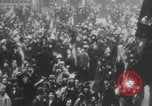
Crowds celebrating Armistice Day 11 November 1918, WW1
People worldwide celebrate Armistice Day on 11 November 1918, then end of WWI. Crowds cheerfully wave with their hats in the streets. Some British flags seen. A truck with soldiers and American flags slowly drives in the middle of a crowded road. People cheerfully wave USA flags and hats to celebrate the November 11, 1918 Armistice, which ended fighting on land, sea and air in World War I between the Allies and Germany, the last remaining Central Power opponent.

United States soldiers bombard La Haye du Puits to capture the town from German forces (WW2)
The capture of La Haye du Puits by United States First Army troops under General Omar Bradley in Normandy (World War 2). An M4 81 mm Mortar Carrier Halftrack vehicle and jeep of the United States First Army driving to La Haye du Puits in Normandy. United States infantry troops travel on foot to capture La Haye du Puits. United States First Army soldiers traversing a meadow, crossing a puddle. United States First Army troops fire artillery under camouflage nets. Soldiers load shells into artillery and fire. United States soldiers fire mortar in a forest outside La Haye du Puits. A soldier fires his rifle through a hedgerow. Soldiers duck while firing mortars. Distant Haye du Puits covered in smoke. A soldier fires a rifle grenade launcher (probably an M7) into the air.
CRITICALPAST.COM: About Us | Contact Us | FAQs - How to Order | License Agreement | My Account | My Lightboxes | Shopping Cart | Advanced Search | Featured Collections | Website Terms & Conditions | Privacy Policy ©2026 CriticalPast LLC.
License Agreement |
Terms & Conditions |
Privacy Policy
©2026 CriticalPast LLC.