


 Francais
 Deutsch
 Italiano
Refine Your Search
Vietnam Bien Hoa Air Base 1968 stock footage and images
- Showing 2767 to 2772 of 13285 results more
more Hide
Hide
U.S. shuttle-bombing of German positions and military installations under Operation Frantic during World War II.
Film title slate indicates "Operation Titanic" but it, in fact, depicts "Operation Frantic" with U.S. shuttle bombing operations over Germany from bases in Great Britain, Italy and Russia during World War II. United States Army Air Force B-17 Flying Fortresses in flight. Aerial view of bombers in flight with several aircraft flying in formation leaving behind contrails. View inside bomber aircraft with bombardier preparing to drop bombs. View of bomb bay door opening and closeup of hand near bomb drop switch. Bombs awawy view as bombs are dropped from American aircraft. German defenses are bombed along the invasion coast of France (just prior to D-Day) on June 2, 1944. Aerial views of B-24 and B-17 bombers also in flight bombing German military installations in German-occupied northwestern Europe. Aerial view of a target area. Smoke rising up from bombardment. Two different U.S. Army Air Force B-17 Liberator aircraft are seen falling from the sky toward crashes after being hit by German enemy fire. One of them has smoke trailing from it, and the other is in a free fall. Railroad and marshaling yards are also bombed over Debrecen, Hungary on June 2, 1944, with aircraft continuing on (shuttle bombing) rather than returning to base. United States Army Air Forces B-24 Liberator flying in formation on June 21, 1944. Aerial view as they bomb the Focke-Wulf Fw 190 engine aircraft factory near Basdorf, Germany. German factories are bombed. B-17 aircraft on the same date are seeing in formation and bomb railway stations, freight yards, and factory targets, along with the Nazi German Ministry of War, Ministry of Propaganda, and Gestapo headquarters in Berlin, Germany. Heavy flak bursts seen in the air near the aircraft. Dogfight scenes as several German airplanes are shot down. Machine gunners aboard U.S. bomber aircraft firing at German fighter aircraft and shooting down 43 of them, according to narrator. Aerial view of ball turret rotating below bomber and firing guns at German fighter aircraft. The B-17s and B-24s bombing the targets. Synthetic oil plants and refineries are bombed at Ruhland Germany, east of Leipzig. Planning for the operation was done on December 7, 1943. A document about the operation is typed. Animated map shows Nazi positions and method of shuttle-bombing, allowing American aircraft to bomb from Soviet bases, and allies broadly to bomb German targets from bases in the United Kingdom, Italy, and Soviet Ukraine.
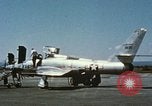
A modified RF-84F Thunderflash being used in flight testing for the F-105 fire control system in the United States.
Development progress report of U.S. Air Force F-105 Thunderchief fighter bomber. A modified RF-84F Thunderflash being used in flight testing the F-105 fire control system. The modified RF-84F with a pointed random nose. The aircraft taxis out on flight line past U.S. Air Force B-29 Superfortress, F-84 Thunderjet and C-47 Skytrain at Eglin Air Force Base. RF-84F takes off from one of the air strips at Eglin Air Force Base. YF-105A performs a wing over and drops away. The data reduction equipment being utilized in the armament system testing at Eglin AFB. A General Electric digital computer in operation. Two technicians test a laboratory model of the AFW-10 automatic flight control system. A civilian points out the AFW-10 automatic flight control system installed in the modified RF-84F. An F-84F in flight. The aircraft does a wingover and drops several hundred feet, then starts a level climb. An Air Force pilot climbs into a cockpit of F-105B. F-105B taxis on the ramp at Edwards Air Force Base, California. Republic personnel grouped around a combination radio telemetry truck and look up in the sky. F-105B takes off and climbs rapidly. F-105B in flight high above a cloud layer. A fuselage of F-105B. F-105B lands on a dry lake bed at Edwards AFB and drag parachute deployed.
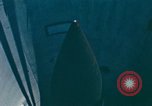
Missile Guardians,SAC's Minuteman Security Police at Missile bases in Montana, N.Dakota, S. Dakota, Wyoming, and Missouri.
Scenes of U.S. Strategic Air Command Minuteman Missile Security Police at work in missile bases at Malmstrom AFB, Great Falls. Montans, Minot AFB, North Dakota, Elsworth AFB, Rapid City, South Dakota, Francis E. Warren AFB. Cheyenne, Wyoming, and Whiteman AFB, Missouri. An armed Air Force Security policeman walks past a parked B-52 bomber. Air Force film "Missile Guardians, SAC's Minutemen Security Police." Animated description of Missile Control Facilities. Missile Combat Officer opens 8 ton blast resistant door of facility. Interior of Launch Center with Officer at duty station. Safe (Red) containing missile launch keys. View of missile location, showing fence and intrusion detection radar antenna. Access cover, above missile, with seismic alarm system and combination lock. Security Police Controller in his office. Security alert team is summoned to respond to intrusion alarm. (Note: Narrated by Kemal Amen "Casey" Kasem)
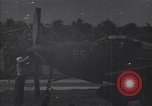
Tents of airmen and parked P-38 airplanes of the U.S. AAir Force at a base in Guadalcanal in Solomon Islands, during World War 2
Air base of the U.S. Army Air Force at Guadalcanal in Solomon Islands, South Pacific during World War II. Airman checking blades of Bell Air cobra P-39 airplane. Other planes (P-38s) parked near side the runway. The tents of the airmen among dense palm trees. View of tents and parked fighter aircraft.
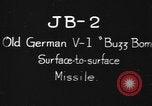
The launching of a JB-2, based on the German V-1 buzz bomb, surface to surface missile at Eglin Field, Florida.
From a review of research and development in guided missiles by the United States Air Force from 1919 to 1948. A JB-2 (Jet Bomb 2) "Loon" based on the German V-1 buzz bomb, surface-to-surface missile. Technicians examine a scale model of the JB-2 missile. Air Force research and development of American type JB-2 missile, the first unmanned guided missile in America's arsenal. A JB-2 is launched from Santa Rosa Island, Florida. A rocket assists in take off. The rocket unit falls away immediately after JB-2 rises into the air. A control aircraft flies overhead showing JB-2 launchings at Eglin Field. JB-2 in flight. The JB-2 was sub-contracted by Republic: Airframe by Willys-Overland; Engine by Ford Motor Company, the IJ-15-1, which copied the German V-1's 900-lb. thrust Argus-Schmidt pulse-jet; Guidance by Jack and Heintz Company; Launch System by Monsanto; Rocket launch sleds by Northrop.. (World War II period).

Independence Day celebrations at the base of Russian Tower of Liberation in Pyongyang (Liberation Day from Japan).
Shows Korean girls arriving at the base of the Russian Tower of Liberation in Pyongyang with flowers and garlands in their hands. Korean bands play and Korean National flag flutters on the tower .Girls put the flowers and garlands at the base of the tower. Russian guards raise their rifles high and fire in air to commemorate the martyred. Koreans gather in numbers with flags and banners. Pictures of Stalin and Kim II Sung can be seen. Thousands of boys and girls march in columns with Korean flags and banners in their hands, celebrating the anniversary of Korea's liberation from the Japanese.
CRITICALPAST.COM: About Us | Contact Us | FAQs - How to Order | License Agreement | My Account | My Lightboxes | Shopping Cart | Advanced Search | Featured Collections | Website Terms & Conditions | Privacy Policy ©2026 CriticalPast LLC.
License Agreement |
Terms & Conditions |
Privacy Policy
©2026 CriticalPast LLC.