


 Francais
 Deutsch
 Italiano
Refine Your Search
Vietnam Bien Hoa Air Base 1968 stock footage and images
- Showing 3517 to 3522 of 13285 results more
more Hide
Hide
Allied medical aid reaches Yugoslavia and battalions train on ammunitions for fight against Nazi invasion during World War II.
Allied airplanes land at a Partisan held base in Yugoslavia with medical and military aid for fighting Nazi invasion during World War II. Men offload material from the transport planes. Another plane unloads wounded prisoners freed from German jails. Wounded men and women at the air field near the planes sit on stretchers. Battalions of Yugoslav Partisan trainee soldiers train on newly received arms and ammunition. Men and women together train themselves. Marshal Tito and other officials review honor guard.
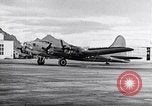
Testing of AZON bomb by United States
United States B-17 bomber aircraft at an air base where AZON bomb is attached to it. An antenna for radio transmitter,compact transmitter and control stick are seen.working on controls. AZON bomb without its tail being attached to the bomber and tail is put after it is shut. Thereafter control stick is moved to check whether the rudders are responding and after this aircraft takes off. Bomb detaches from the aircraft in midair. Bomb drops and strikes an isolated area marked as a big triangle in white. Explosion occurs. (World War II period).
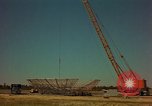
Provisions being made for telemetry and radar tracking of NASA Mercury spacecraft during earth orbits.
Equipment being installed to track NASA Mercury spacecraft during earth orbits. A 60 foot dish being positioned on a pedestal by a crane at Eglin Auxiliary Field no.5 at Eglin air force base in Florida,United States. MPQ-31 antenna rotates.
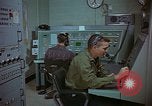
NASA Project Mercury spacecraft tracking facility at Eglin AFB
Operators at work in NASA Project Mercury tracking facility at Eglin Air Force Base, Florida. An FPS-16 operator at control console.Other equipment seen include time signal receiver and time standard equipment. Several technicians are seen, some performing diagnostic testing of equipment.. (Note: The FPS-16 units originally planned for the Project Mercury tracking network did not have adequate displays and controls to reliably acquire the spacecraft during orbit. So NASA had them modified to double their range and also incorporated data-handling equipment to facilitate transmissions from all sites to the Mercury Project computers.)
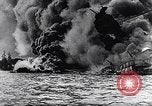
Japanese attack on Pearl Harbor in presaged by a decade of Japanese military aggression in China (WW2)
Opening scene shows the famous image of American battleship USS Arizona as attacked by Japanese forces in Pearl Harbor on December 7, 1941 in World War II. The ship is engulfed in black smoke, and listing. Change of scene to a waterfront in Japan during 1938, where numerous Japanese soldiers board troop ships bound for Manchuria, China. Next, are scenes of Japanese troops marching as they occupy Manchuria. Closeups of some Japanese soldiers. Scene shifts to a train moving on the South Manchurian railway, at a station showing a sign reading,"Chin Hsien." View of steam locomotive pulling a train away from the camera position. (Narrator states that a Japanese train, on the South Manchurian Railway, had been dynamited) This incident triggered a Japanese attack on Mukden, Manchuria. Japanese infantry are seen placing numerous bundles of reeds as a bridge across a wide, shallow, stream and proceeding to cross on their way to invade Mukden. Military supplies are carried on pack animals. In the air, overhead Japanese Mitsubishi G3M Type 96 land-based attack aircraft are seen flying in precision "V" formation. On the ground, Chinese civilians run for cover in the City of Mukden. (The date is September 18, 1931.) Glimpse of Chinese civilians looking at bombing victims on street of Mukden. Brief view of Geneva Switzerland, where League of Nations was housed. A memorial stone monument in that city to Woodrow Wilson, President of the United States and founder of the League of Nations. An entrance to the League of Nations headquarters in the Palais Wilson in Geneva, Switzerland. League delegates in session inside the Palais Wilson. A Japanese Naval Fleet, under command of Admiral Kichisaburō Nomura, is seen steaming toward the Chinese coast and begin a naval bombardment, firing their guns, 15 miles from Shanghai. Japanese Naval biplanes are seen in flight overhead. Japanese troops marching in the streets of Shanghai, as sidewalks of onlookers wave Japanese flags. Next, Japanese troops are seen marching out of Shanghai, at the insistence of the League of Nations. (Narrator states Japan signed a truce with China on May 4th, 1932.) View of Japanese troops entering further, into Mongolia. Japanese soldiers waving flag celebrating formation of the Puppet State of Manchuko in Northeast China and Inner Mongolia, in 1932. Japanese statesmen leaving the League of Nations headquarters, after Japan resigned from the League on February 24, 1933. Japanese infantry moving further into China supported by field artillery fire. Explosions from artillery and damaged buildings, as Japanese troops advance in China. Invaders using tall ladders to scale walls of a damaged fortress in China. Japanese pilots receiving briefing and boarding their Mitsubishi Ki-30 single engine light bomber aircraft at an airfield. View of them taking off and inflight, dropping bombs on Chinese targets. Aerial views of bombs exploding on ground below. Retreating Chinese army marching along the Great Wall of China. Chinese people and military forces moving their military and civilian resources deep into the Chinese interior.
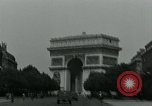
General Dwight Eisenhower and Allied Commanders during liberation of Paris in World War II.
At beginning camera gives shaky view of the Arc de Triomphe in Paris during World War 2. Then it shifts to an American army staff car driving along the Champs Elysee toward the Arch of Triumph. Next, General Dwight D. Eisenhower steps from the staff car, shakes hands with a U.S. army photographer, and walks among French people toward the base of the Arch of Triumph. Camera pans up to top of the arch. Back on the ground, Eisenhower is met by American and French military commanders and surrounded by a crowd of French civilians. He poses for a picture (viewing from left to right) unidentified U.S. Major General; Lieutenant General Omar Bradley, Dwight D. Eisenhower, French General Marie-Pierre Kœnig and British Air Marshal Arthur Tedder. The French Tricolor flies behind them. Camera pans upward to the top of the Arch of Triumph. The Allied commanders and General Eisenhower are surrounded by American soldiers and French civilians as Eisenhower gets into his staff car. View from trailing vehicle of his staff car passing the Place de la Bastille and proceeding through streets of Paris. Eisenhower is seen next, standing on the sidewalk, by his parked car, conversing with General Bradley, General Marie-Pierre Kœnig, and another French General. He shakes hands with a military photographer as he steps into his staff car, and shares a final hand shake with General Marie-Pierre Kœnig. As his car drives away, civilians in the background wave goodbye. Glimpse of American M4 Sherman tanks moving on the street. Eisenhower' car drives away.
CRITICALPAST.COM: About Us | Contact Us | FAQs - How to Order | License Agreement | My Account | My Lightboxes | Shopping Cart | Advanced Search | Featured Collections | Website Terms & Conditions | Privacy Policy ©2026 CriticalPast LLC.
License Agreement |
Terms & Conditions |
Privacy Policy
©2026 CriticalPast LLC.