


 Francais
 Deutsch
 Italiano
Refine Your Search
Vietnam Bien Hoa Air Base 1968 stock footage and images
- Showing 4471 to 4476 of 13285 results more
more Hide
Hide
Squadron of American B-26 bombers takes off from advanced base in France during World War II
Camera follows Martin B-26 Marauder bombers taking off from Denain-Prouvy Airdrome (A-83) France, during World War 2. They are a Squadron of aircraft from the U.S. Army Air Forces 323rd Bombardment Group (displaying white tails of the 323rd). Camera tracks them each as they complete their respective take offs in succession. Afterwards, the aircraft are seen beginning to assemble in formations high overhead.
USAAF Martin B-26 Marauder aircraft drop bombs over targets in Germany and return to base.
United States Army Air Forces Martin B-26 Marauder, a World War II twin-engine medium bomber, drops bombs over targets in Germany near the end of World War II. Captain Browning in a USAAF B-26 Marauder over Germany. POV shots from cockpit. The B-26 bomber drops bombs. B-26 landing gears lower. POV from cockpit as the B-26 lands and taxis along the perimeter strip. Crewmen on the ground directs the B-26 for parking. A Lieutenant plots out flak damage. The crewmen of the B-26 gathered around B-26 and in a jeep. An interrogating officer takes down flight data from the pilot. Crewmen inspect belt of damaged ammunition. A Lieutenant views the damaged ammunition. Note: a small bright object, possibly a foo fighter, is seen moving diagonally and downward across the frame from left to right in the first second or two of this clip.
USAF RC-12lD Picket ship on ramp, men receive outdoor briefing and officers board aircraft at a base in the United States.
The life of crew of a United States Air Force RC-121D Warning Star Picket ship in the United States. A line of six RC-121D Picket ships along the ramp. RC-12lD Picket ship on ramp with engines running. View of the the radar dome. The nose section of the aircraft. A canvas covered truck. Crew members alight from the truck and walk towards the aircraft. Men take stations in front of the aircraft for outdoor briefing. Several views of the men during the briefing. An officer gives the briefing. Men dismissed and they wa1k towards the aircraft. Men climb aerostand and board the aircraft. Officers carry briefcases and board the aircraft.
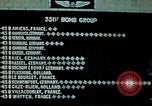
U.S. 351st Bomb Group is briefed before a bombing mission at the RAF base in Polebrook, Northamptonshire, England .
U.S. 351st Bomb Group at RAF Station Polebrook, Northamptonshire, England during World War II. A display board of the U.S. 351st Bomb Group, at RAF Station Polebrook, England, shows 15 principal targets and the number of times they've been struck by B-17s of the Group. The most missions were flown against Schweinfurt, Germany (25 times) and second most, against Hanover, Germany (17 times). Another recent status board records missions against Amiens and Evreux,and Romilly, France; Stuttgart, Germany; and Brussels,Belgium.Swastikas indicate German aircraft shot down during these raids. A C-45 aircraft lands and parks at the field. Major General Ira C. Eaker,Commander 8th Air Force, steps from the plane for a visit with the 351st Bomb Group. He proceeds to the briefing room, in a Quonset hut. Four Officers of the Group pose. View of heavy bombs in the bomb dump. Views of bombs hung wing racks of a B-17 to increase its bomb load. Bombs being transported on motorized dollies. Airmen writing in chalk on a bomb. It reads: "From the boys K of C #92 Jim, MH." Fliers at nighttime in their Quonset hut quarters. One writes a letter. Others trying to sleep, as sounds of aircraft engines are heard. Officer opens door of quarters and wakes crew members, telling them breakfast is at 3AM and briefing at 4AM. Briefing officer asks fliers to guess what the target of the day will be. Several make suggestions. The briefing officer removes a cover from the mission map, revealing target deep in Germany. The fliers respond with good-natured boos. Commander gives final instructions.,
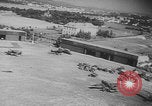
German military use of airport in Bromberg, Poland as a base during World War 2
Long shot aerial view from a low-flying airplane shows airport in Bromberg (Bydgoszcz), Poland. View of many German Air Force planes, as well as various outbuildings. Narrator describes that after the German invasion of Poland during World War II, the Germans took over the airfield to use for their own military aircraft and operations. Bomb craters on ground from German bombing on September 1st, 1939. View from inside a hangar looking outward on destroyed aircraft debris. More shots of debris on the airfield. Several Polish aircraft are shown in various states of ruin. German soldier approaches a Polish biplane with gun damage to the skin of the fuselage.
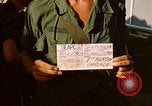
Aircraft, crews, and operations of the U.S. Army First Aviation Brigade at Camp Holloway, Pleiku, Vietnam, during the Vietnam war
View of Camp Holloway, Pleiku in Vietnam, where numerous helicopters of the First Aviation Brigade are seen parked. One rises up from near a revetment, passing the camera and casting a shadow on the ground. View from end of pierced steel plank runway marked "5" in white paint. UH-1 helicopters lined up along both sides of the runway, with their rotors neatly aligned. Closeup of some of them. View from control tower overlooking the field, showing revetments in foreground and parked aircraft and buildings on other side of the runway. Mountains in the background. View from control tower deck, of a UH-1 flying low along the length of the runway. View in different direction from control tower. Closeup of aircrews of 1st Aviation Brigade standing in front of a UH-1, with its door open. They are being briefed by an officer with an elaborate logo painted on the back of his jacket which contains the 1st Aviation Brigade insignia, as part of it. Next, the flight crews gather together to discuss their instructions and mark information on their aerial charts. Some are crouched down on marsden matting. Groups of crew members in discussions. Two brown dogs (obviously mascots) approach one group of crewmen and are welcomed.
CRITICALPAST.COM: About Us | Contact Us | FAQs - How to Order | License Agreement | My Account | My Lightboxes | Shopping Cart | Advanced Search | Featured Collections | Website Terms & Conditions | Privacy Policy ©2026 CriticalPast LLC.
License Agreement |
Terms & Conditions |
Privacy Policy
©2026 CriticalPast LLC.