


 Francais
 Deutsch
 Italiano
Refine Your Search
Vietnam Bien Hoa Air Base 1968 stock footage and images
- Showing 5737 to 5742 of 13286 results more
more Hide
Hide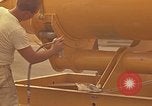
United States Air Force B-58 Hustler with Convair Air Launched Ballistic Missile under its wing taxis and takes off.
Airman sprays yellow and black paint on Convair Air Launched Ballistic Missile. The Air Launched Ballistic Missile on self propelled bomb dolly, being moved under and mated to B-58 Hustler aircraft. The B-58 pilots enter the cockpit. United States Air Force B-58 Hustler with Convair Air Launched Ballistic Missile, taxis and takes off. F-100 D chase plane takes off. B-58 Hustler and F-100 D chase plane in flight.
The German Air Sports Association is absorbed into the Experimental Department of the German Air Guard in 1934
Rolf Engel led a 1933 study group on special problems of liquid fueled rocket engines. Engel and members of the study group are seen at work. Beginning of a standardization and classification for the rocket problems. A diagram showing characteristics of rocket engines with standard nomenclature. A man with standardized rocket engine testing equipment. View of the standardized 6-copy multiple professional device for recording rocket engine performance. The work of Rudolf Nebel on the Rocket field of Berlin-Reinickendorf was continued under the leadership of Fritz Beck of the testing department of the German air guard (LSS) in 1933. But it was canceled in the spring of 1934 when the LSS took over direction of the German Air Sports Association. Letters to the Association noting that lessons of World War One point out the value of the Associations technical capabilities to National defense. They also mention matters of particular interest to the German Air Guard, such as rockets and Rocket torpedoes. An organizational chart showing various components under the Experimental Department of the German Air Guard.
Principal persons involved in Transcontinental Air Transport (TAT) and its combined rail-air operations carrying passengers coast-to-coast in 48 hours
Film titled 'Coast to Coast , in 48 hours' depicts advertisement of coast to coast trip by train and air. General W.W. Atterbury, President, Pennsylvania Railroad; Colonel Charles A. Lindbergh, Chairman, Technical Committee, TAT Maddux Airlines; Clement M. Keys, Chairman of the board, Transcontinental Air Transport incorporation; Daniel M. Sheaffer, Chairman, TAT inc., Executive Committee and Jack Maddux, President, TAT Maddux Airlines sit around a table. Chairman Keys introduces the other executives seated at the table and describes their novel operations carrying passengers across the American continent, from coast-to-coast, in 48 hours, by means of coordinated rail and air operations under the aegis of the Transcontinental Air Transport Company.

United States Air Force officer speaks about the U.S. Air Force Academy and its training programs
United States Air Force Lieutenant Colonel (Senior Pilot) speaks about the basic training of cadets in United States Air Force Academy. High altitude view of the Air Force Academy. United States flag near the officer. A photograph of the cadets placed on a wall in the background. Cadets parade. A cadet holding U.S. flag walks in front. The officer states that the cadets undergo a training in which they have to show excellence in every field to become army officers. Candidates arrive in buses at the academy for the training. They come out of the bus. Various sign boards outside the academy to facilitate them. A woman takes the necessary information from them and writes it down. Various stations at the Air Force Academy. Candidates go through medical check up. The officer states that every cadet has to take a pledge for the Academy in which he promises that he will follow the discipline and work for the best of the nation
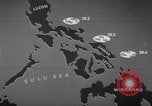
Battle for Leyte Gulf between the Allied Naval Air Forces and the Japanese Naval Air Forces.
Animation shows Allied Naval Air attack over the Philippines island of Leyte during the Battle for Leyte Gulf against the Japanese Naval Air Forces in October 1944. The battle is fought around a chain of islands such as Luzon, Samar, Leyte and Mindanao. Allied 3rd and 7th naval fleet launch a massive attack and cripple the Japanese naval-air support. Results show heavy damage inflicted to Japanese Naval Air Forces. (World War II period).
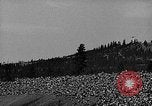
Two A-25s from formation of three collide, crash and explode during U.S. Army Air Force air show in Spokane Washington
U.S. Army Air Force air show in Spokane, Washington. Formation of three U.S. L-6s flying directly over crowd. Formation of three A-25s coming in and flying low across in front of the crowd. Two A-25s collide in mid-air and breakup in pieces. One A-25 hits ground and explodes. Other A-25 falls close by, explodes when it hits ground. Burning area where aircraft crashed. Large clouds of black smoke rise from the area. Air Force crew members killed in this tragedy were: Capt Ford K. Sayre, Lt. George Chrep, Lt. William R. Scott, and Sgt. Joseph M. Revinskas.
CRITICALPAST.COM: About Us | Contact Us | FAQs - How to Order | License Agreement | My Account | My Lightboxes | Shopping Cart | Advanced Search | Featured Collections | Website Terms & Conditions | Privacy Policy ©2026 CriticalPast LLC.
License Agreement |
Terms & Conditions |
Privacy Policy
©2026 CriticalPast LLC.