


 Francais
 Deutsch
 Italiano

Refine Your Search
Vietnam Binh Thuy Air Base 1967 stock footage and images
- Showing 11947 to 11952 of 13521 results more
 Hide
Color Sound
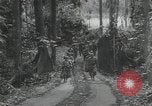
U.S. Marines capture Henderson Field and undertake construction activities on it in Guadalcanal, Solomon Islands.
A film about Allied campaign against the Japanese in Guadalcanal, Solomon Islands during World War II. U.S. Marines march ahead on the island. Henderson Field after being captured by the Marines. The American flag being raised at the field. The Marines salute. Shell crates on the field. A gun emplacement on the field. Rollers and other mechanized equipment are used to level surface and make a runway at the airfield. An aircraft taxis at the field. U.S. Army Air Forces B-17 Flying Fortress aircraft parked at the field.
Wrecked USAAF B-24 Liberator bomber aircraft at Kei Ling airstrip in China during World War II.
Japanese soldiers in China during World War II. Artillery is fired and smoke rises. Wrecked United States Army Air Force and Chinese B-24 Liberator bomber aircraft on Kei Ling airstrip. Wrecked parts of Allied aircraft on a field. A sign reads '12th Service Group Dispensary'. Machine guns and artillery are fired. Smoke rises. Japanese soldiers lying in prone position as they fire at a village.
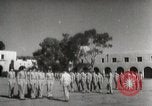
U.S. Marine Corps recruits in training learn drill maneuvers, fixed bayonet combat, and rowing skills to build strength
A film about training of United States Marines in San Diego, California. Recruits learn the details of squad formation as they perform drill manuevers under the instruction of a drill sergeant. The recruits receive fixed bayonet instruction. Two trainers demonstrate the use of bayonet equipped rifles in hand to hand combat. To build varied physical strength the recruits row a whaleboat. The crew of Marines raise their 12 foot oars in the air at the end of their rowing effort.
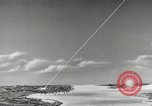
Animation depicts factors that affect accuracy while bombing a target by a dive bomber in the United States.
A film about means of attaining accuracy by dive bombers in the United States. Animation shows the trajectory path of a bomb after being released in mid air. The distance that a bomb would fall short of the target, if not compensated for, is called the "trail." A graph depicts the altitude of release of the bomb and the sight angle. Animation explains the concepts. A pilot sets a lead at a target. Animation depicts the importance of the lead at release altitude. Results are illustrated in animation. Consequences of taking a wrong flight path are explained. A graph depicts the means of computing the release altitude and the sight angle. The effect of wind on a diving aircraft as it affects the flight path.
Donald H Lilienthal and a copilot along with a crew in a P-3C Orion aircraft in flight from Kanagawa Prefecture, Japan
A United States Navy Lockheed P-3C Orion aircraft in flight from Naval Air Facility Atsugi in Kanagawa Prefecture, Japan during a long range navigational test. A runway seen from the aircraft as the aircraft taxis for a take off. The pilot Commander Donald H. Lilienthal and the copilot look at the controls. A navigator at work. He looks down the passageway of the Lockheed P-3C Orion aircraft. Another man approaches him. Two men in the background and a gear in the foreground. The navigator works on a chart. The back view of Commander Donald H. Lilienthal in silhouette at the controls. A member of crew in the aircraft. A member of the crew in deep silhouette. Half moon as seen from the aircraft.

Japanese suicide aircraft attack U.S. battleships and pilots are trained for kamikaze unit in Okinawa, Japan.
A film 'Combating suicide plane attacks' about Japanese suicide aircraft attacks in Okinawa, Japan during World War II. The Japanese suicide aircraft attack U.S. battleships during the Battle of Okinawa. An animation depicts two types of suicide attacks : kamikaze unit and suicide attack party. Pilots are trained for the kamikaze unit. The pilots march. A pilot stands with a sword. The first stage of the training is the spiritual intoxication. A statue of Lord Buddha. A suicide aircraft in flight. Two aircraft in flight. An animation shows the difference between conventional air attacks and suicide aircraft attacks.
CRITICALPAST.COM: About Us | Contact Us | FAQs - How to Order | License Agreement | My Account | My Lightboxes | Shopping Cart | Advanced Search | Featured Collections | Website Terms & Conditions | Privacy Policy ©2026 CriticalPast LLC.
License Agreement |
Terms & Conditions |
Privacy Policy
©2026 CriticalPast LLC.