


 Francais
 Deutsch
 Italiano

Refine Your Search
Vietnam Binh Thuy Air Base 1967 stock footage and images
- Showing 12643 to 12648 of 13521 results more
 Hide

Sailors embrace and kiss their girl friends on pier and board the USS Coral Sea (CVA-43) in San Francisco bay.
USS Coral Sea (CVA-43) leaves the Naval Air Station Alameda in San Francisco bay. Large crowd on the pier near the USS Coral Sea (CVA-43). People look toward the ship. Crowds on the pier next to the USS Coral Sea. Man looks down on the pier. Aircraft parked forward on the flight deck. Large crowd gathered around the after brow. A young sailor and his girl friend. The girl has her arms around the sailor's neck. Other people in the general vicinity. Two sailors with girl friends on the pier. Chief petty officer and his wife standing on the pier. Chief petty officer has his arm around his wife and kisses her. Three sailors and their girl friends sitting on the edge of pier with their backs to the ship. Sailors kiss their girl friends during their last few moments prior to ship's departure for far Pacific. Large crowds on the pier. Guests depart the ship. Sailor carry his infant and with his wife walk alongside. Sailor and his wife embracing on the pier. Personnel board the ship. Dependents are look on. A few sailors are still on the pier. Guests depart from ship over the brow. Large crowd, some around the after brow. Sailor embraces his wife. Large crowd assembled on the pier at the after brow. Mobile crane ready to remove the brows. Mobile crane picks up after brow for removal. Some dependents seen.

Pilots don high altitude suits and fly aircraft in formation in the United States.
Air Maneuvers in the United States. Flyers don high altitude suits. Table electric fans in the room. Pilots get in to aircraft. The aircraft in flight. Aircraft dive one after the other.
Equipment and machinery deployed to protect surrounding area of Exxon Valdez oil spill in Prince William Sound, Alaska.
Exxon Valdez oil spill in Prince William Sound in Valdez, Alaska. Fish in the water. Aerial view of the fish hatcheries. Deflection and barriers booms set up around the fish hatcheries. Skimmer systems are deployed on the bay. Tug boats drag oil containment boom. Oil trapped between the containment boom is transfered over a conveyor assembly on boat. Oil being separated from water on boat. Oil is soaked on a soaking bed. The viscous oil is being vacuum sucked and transfered into a storage tank. Coast guard vessel on the bay. Oil containment boom and mooring systems deployed. Coast guard work on the Oil containment boom and put them in water. A tug boat pulls the oil containment booms. United States Coast guard Cutter USCGC Rush (WHEC-723) as a air traffic control center in the Prince William Sound. Men work inside the ship.
Columbia Command Module of Apollo 11 being recovered at sea and astronauts being welcomed by Richard Nixon along with others
The recovery of the Apollo 11 Columbia Command Module and astronauts welcomed after in Houston Texas. Radar equipment on USS Hornet (CVS-12). A helicopter in flight. The Columbia Command Module of Apollo 11 seen as a white light streaking through the sky as it reenters earth's atmosphere. The Columbia module seen floating in the ocean near the USS Hornet. President of the United States Richard Nixon on the USS Hornet. A helicopter recovers the astronatus from the Columbia Command module in the Pacific Ocean. A man clicks pictures. The astronauts being pulled up to the helicopter from the command module floating in the ocean. The helicopter lands on the carrier. The ramp being pushed to the helicopter. Richard Nixon waving at the astronauts. Astronauts Neil Armstrong, Buzz Aldrin, and Michael Collins disembark in special air-tight suits to applause of the crew, and then immediately enter a Mobile Quarantine Van. The crew of Apollo 11 in quarantine after returning to Earth. People welcome the astronatus in the quarantine van after it has arrived in Houston Texas. The astronauts talk over a red telephone to family and friends gathered in Houston. They wave from the quarantine van where they must remain for 3 weeks. Views of the astronauts on the moon are shown periodically. A scientist opens a collected rock and dust sample from moon using special equipment in a closed chamber. Apollo Lunar Surface Experiments Package placed on the surface. Laser ranging retro reflector placed on the surface of moon. The lunar module (LM) Eagle on moon surface.

The automatic ejector seat is ejected from jet and the dummy descends as the seat separates in New Jersey
The first fully automatic ejector seat is tested in New Jersey. Two men work on the automatic ejector seat. People stand and watch. Jets in flight. The seat and test dummy are ejected out of the aircraft. The seat separates from the dummy. The parachute opens and descends in air. A man collects the parachute.
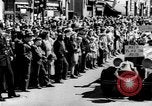
School children and civilians participate in a war time "jalopy parade" to encourage donations of junk cars and other scrap metal in Decatur, Illinois.
Scenes of a a "jalopy and general salvage parade" in an American city during World War 2, to support the war effort. Parade floats that use scrap materials simulate the finished products of war like vehicles and airplanes. Civil Air Patrol airplanes fly over the parade route reminding citizens of the need for scrap metal in manufacturing and producing airplanes for war. Narrator describes need for inclusion of many needed scrap materials in the parade such as tin cans, silk, nylons, fats, greases, etc. and that "jalopies make jeeps." Narrator, on behalf of the United States War Production Board, gives specific instructions of how to hold such a parade in any town in the United States and encourages viewers to hold such parades in their towns all over America to help the home-front war effort. The parade heads down main streets of Decatur, Illinois, with many shops and buildings seen along the route. People stand on roadside to watch the parade. Cars driven at the parade. School children ride on cars, many bearing wartime victory slogans. Man works on a vehicle carried on a truck. A float decorated with papers. School children march. A man pushes a trolley. Girls ride bicycles. Officers address parade attendees as livestock is auctioned off to raise funds for the war effort. Junk yard cars that are candidates for scrap recycling are seen in the backyards of houses. Clip concludes with a message from Mr. Eugene Dunne, District Chief, Scrap Processors Branch, War Production Board, Chicago. Mr. Dunne encourages viewers to hold jalopy parades like the one seen in Decatur, Illinois.
CRITICALPAST.COM: About Us | Contact Us | FAQs - How to Order | License Agreement | My Account | My Lightboxes | Shopping Cart | Advanced Search | Featured Collections | Website Terms & Conditions | Privacy Policy ©2026 CriticalPast LLC.
License Agreement |
Terms & Conditions |
Privacy Policy
©2026 CriticalPast LLC.