


 Francais
 Deutsch
 Italiano

Refine Your Search
Vietnam Binh Thuy Air Base 1967 stock footage and images
- Showing 12895 to 12900 of 13521 results more
 Hide
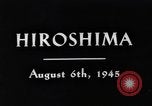
Effects of the atomic bombing of Hiroshima, Japan, in World War II, and early international efforts to control atomic weapons
Film showing city of Hiroshima, Japan, before and after the August 6, 1945 dropping of the atomic bomb over the city in World War 2. Sequence opens on what the narrator says is August 5, 1945, the day before the event (but the footage is likely from before that date). Camera pans over the city of Hiroshima before the atomic bomb destroyed the city. Japanese air raid lookouts are seen on watch for allied bombers. View of atomic bomb detonation as seen from aircraft high overhead (this is actually a view of the Nagasaki blast, not the Hiroshima blast despite narrator's comments). Next, the complete destruction of the city of Hiroshima is seen from camera at low altitude showing the four and one half square miles of the city flattened and burned. A Japanese hospital still functioning, with red cross flag on it. Hospital workers retrieving wounded victims of the bombing. Ambulatory victims clustered in doorways and halls. Shadow image of a large industrial valve wheel burned onto wall behind it. Similar image of a ladder burned onto a wall. The decorative pattern on a woman's dress burned onto skin of her back. Japanese physicians treating victims of thermal and radiation burns. Views of various victims, including some children, and their respective injuries. Scene shifts forward one year, to August 6, 1946. Children are lined up outside a school building, and then seen inside their classroom. Disfiguration and wounds on children resulting from injuries are still evident on the children at their desks. Sequence shifts again, this time to an early United Nations meeting with delegates grappling with the issue of controlling nuclear power and atomic weapons. Closeup view of American delegates, including James F. Byrnes (Secretary of State)and James B. Conant, President of Harvard University in the assembly. Closeups of representatives from South Asian nations. Closeup of USSR delegation, headed by Foreign Minister, Vyacheslav Molotov. Signs identifying delegates from Colombia, Egypt, Iraq, Bolivia, China. Final sequence shows several U.S. atomic scientists in their respective laboratories, including Enrico Fermi and Vannevar Bush. United States representative to the UN, Warren Austin, speaking about the so-called Baruch Plan, for international control of atomic weapons. (Principal author, Bernard Baruch, is standing behind speaker's left shoulder.) USSR delegation, headed by permanent representative, Andrei Gromyko, who is seen presenting the Soviet plan. View of explosion and mushroom cloud during U.S. Operation Crossroads atomic bomb test in the Pacific.
American made automobiles are exported to foreign countries. A Studebaker sedan travels over dirt roads on Catalina Island off California.
Workers in a Studebaker automobile factory move a fully wooden crated new automobile on an overhead hoist. It is labeled "Studebaker Automobiles" on it's side. Views of crated cars bound for different destinations overseas. Seen are those headed to: Buenos Aires, Capetown, Melbourne, and Cairo. Next, a Studebaker sedan car is seen raising lots of dust as it races at high speed over a dirt road on Catalina Island, off the coast of California. The driver is trying to climb a 1500 foot hill over a distance of 3 miles, as fast as he can. His car is seen negotiating hairpin turns during the ascent and finally arriving at the summit.
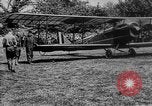
Woodrow Wilson and Mrs. Wilson inspect an airmail airplane as service is opened between Washington and New York, U.S.
U.S. President Woodrow Wilson inaugurates airmail service as it commences in the U.S. A Curtis JN-4 airmail airplane parked on the Polo field, in Washington, DC.. Van of United States Air Mail Service arrives. Mail is loaded into the airplane. Pilots Lieutenant George L. Boyle and Major Reuben H. Fleet standing beside the airplane conferring over a map. U.S. President Woodrow Wilson, Mrs. Wilson, and Post-master General Albert Sidney Burleson inspect the airmail airplane that will carry mail to New York. . A man shows first official piece of airmail. He and his wife greets pilot. Wilson talks with pilot Major Reuben H. Fleet . Pilot George L. Boyle gets into airplane. Airplane takes off. Airmail airplane piloted by lieutenant Webb leaves New York from Belmont Park and takes off. The airplane stops at Philadelphia to pick up more mail. Mail is loaded into the airplane. The airplane takes off. It arrives in Washington. Mail is unloaded from the airplane. Pilot gets out of the airplane.

Landing Ship Tanks (LSTs) and Landing Craft Tanks (LCT) underway offshore Southern France.
Landings of Allied troops for the invasion of Southern France during World War II. A barrage balloon floats in the air. Landing Ship Tanks (LSTs) and Landing Craft Tanks (LCT) head towards a beach.

A Japanese airplane gets hit by anti aircraft guns fired from a ship and crashes in the Pacific Ocean.
Japanese air attack on a United States fleet in the Pacific Ocean during World War II. A fleet underway at sea. Airplanes fly overhead. Ships fire anti aircraft guns at the airplanes. A Japanese airplane gets hit and crashes. A formation of airplane approaches a carrier. A sunset shot: A formation of airplanes passes.
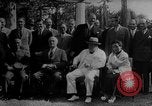
Mixture of scenes from Cairo and Teheran converences with glimpses of Soviet troops on the move and views of bombers and landing craft as well as an atomic test in the Pacific ocean.
Opening scene shows Chinese Generalissimo Chiang Kai-shek seated with U.S. President Franklin D. Roosevelt, British Prime Minister Winston Churchill, and Madam Chiang in their Cairo meeting at a residence of the American Ambassador to Egypt, Alexander Kirk, on November 25, 1943, during World War 2. Foreign ministers of the countries stand behind their leaders. Closeups of the three Country's leaders. Scene jumps to Teheran, with Soviet Leader, Joseph Stalin, President Roosevelt, and Prime Minister Winston Churchill, seated on a veranda of the Soviet Embassy. Suddenly scenes of tanks, trucks, and Soviet troops moving on the Eastern front are seen. Some of the troops move by horse-drawn sleighs through the snow. A line of U.S. Army Air Forces B-17 bombers taxiing on an airfield. View from a B-17 in flight. View f as a cluster of bombs falls from B-17 and explodes on the ground. Animated map illustrating paths of aircraft attacks against the German Atlantic Wall from England. Landing craft underway in an amphibious assault. Brief view from a ship of a post-war test atomic explosion in the Pacific ocean
CRITICALPAST.COM: About Us | Contact Us | FAQs - How to Order | License Agreement | My Account | My Lightboxes | Shopping Cart | Advanced Search | Featured Collections | Website Terms & Conditions | Privacy Policy ©2026 CriticalPast LLC.
License Agreement |
Terms & Conditions |
Privacy Policy
©2026 CriticalPast LLC.