


 Francais
 Deutsch
 Italiano

Refine Your Search
Vietnam Binh Thuy Air Base 1967 stock footage and images
- Showing 2719 to 2724 of 13521 results more
 Hide
Color Sound

Chinese Nationalist F-104B taxies during transfer of F-104 planes to Chinese Nationalist AF at Kuang Kuan AB in Taiwan.
Captain Wang and Captain Battle board Chinese Nationalist F-104B during transfer of F-104 planes to Chinese Nationalist Air Force at Kuang Kuan Air Base in Taiwan. Helmet on windscreen of aircraft and clouds in the background. Chinese Nationalist F-104B ground crewmen climbs down aircraft ladders and removes them from aircraft. C-47 plane parked in the right background. Chinese Nationalist F-104B taxies left on runway. Left wing and nose of C-47 plane. Tail and main fuselage of Chinese Nationalist F-104B aircraft, flying by to left.

Detachment-A, 21st Bomber Command of United States Army Air Force in Japanese island Iwo Jima, during World War II.
United States Army Air Force at their base in the Japanese island of Iwo Jima, during World War II. Personnel at the base of Detachment-A, 21st Bomber Command Provisional Unit. Soldiers eating breakfast at tables near the tents of the base. Volcanic area near the camp. Medical officers and enlisted men digging latrines in volcano ash.

Reenactment of new recruits arriving for training as U.S. Air Forces flying cadets
Reenactment to illustrate how newly recruited civilians might arrive at a base to commence training as U.S. Army Air Forces flying cadets. The recruits, in civilian clothes, arrive in private cars and park in a base parking lot. One group of four arrives in a 1940 Chevrolet Special Deluxe convertible coupe automobile. A large number of recruits in civilian clothes, carrying luggage, walking across a lawn towards a building on the base. Two are seen carrying tennis racquets. The scene is shot at Randolph Field in Texas. It is repeated twice, that is, in two takes.
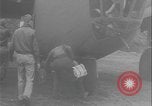
U.S. Army Air Force bombers raid Japanese-held Kiska Island in the Aleutian Islands, Alaska, 1942, during World War 2
U.S. Army Air Force (USAAF) soldiers wearing flight suits board bomber aircraft from a newly established U.S. position in the Aleutian Islands, 1942, during WW2. A soldier pokes his head out a window in the cockpit of one of the aircraft. Bomber aircraft take off from a runway constructed from marston mat (pierced steel planking), mountains in the background. Scenes of the bomber aircraft in the sky, taken from an on-board camera. Close up shots of gunners at their positions. The bombers fly over the foggy islands toward the Japanese base on Kiska Island. A Japanese warship appears in the water far below, one of the U.S. gunners strafes the deck of the ship. Close up of machine gun firing at the boat. Now over Kiska, bomb bays open and American bombs are unloaded. Smoke and explosions far below. A second load of bombs drops toward the Japanese base in slow motion. Wide shot of the target, now covered in streaks of smoke. Shot of the American bomber aircraft in the sky, turning to head back to base.
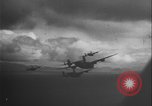
U.S. Army Air Force B-24 bombers return from a raid on Japanese-held Kiska Island in the Aleutian Islands, 1942, during World War 2
U.S. Army Air Force B-24 bombers fly back to base after bombing the Japanese base at Kiska Island, Aleutian Islands, Alaska, in 1942, during WW2. Narrator details the events of the successful mission. Close ups of the B-24 Liberators as they fly over water. Vast mountains of the Aleutian Islands in the background. The aircraft land back at the newly established U.S. base in the Andreanofs of the Aleutian Islands. Close ups of the bombers, now on the ground. U.S. soldiers exit the aircraft, inspect damage taken from Japanese fire on the fuselage. A group of U.S. pilots and crew walk across the airfield. Soldiers circle around and chat. Ending scene of soldier standing with cloudy Aleutian mountain rising in the background.

United States Air Force Strategic Air Command (SAC) Command Post operations
Views inside the Strategic Air Command Headquarters Command and Control Center at Offutt Air Force Base, near Omaha, Nebraska. Six huge display screens cover the wall and controllers at monitoring stations are seen in semi-dark environment. An Air force Senior Master Sergeant stands near one of the control stations, as he calls up various computer-driven displays, which are shown onmonitors depicting the distribution and status of SAC's world wide assets at any moment. An Air Force Colonel occupies the Senior Controller's position on the main floor of the Command Post. Camera focuses on the Colonel, and his "fruit salad" (rows of military ribbons); his Command Pilot's wings; and the eagle's on the shoulders of his uniform. Scene shifts to variety of telephones in different colors. Looking over the shoulder of the Colonel, the camera focuses on a gold phone providing a direct line to the President of the United States; the National Military Command Center in Washington, DC; and to other Major Command Headquarters. Red and Gray phones comprise SACs primary alert system and show numerous connections to sites in the 2nd and 15th Air Forces. Closeup of the red phone control board. Scene shifts to a B-52 bomber in flight, and to pilots in a B-52 cockpit. The SAC Senior Controller, Colonel, on the gray phone, ostensibly talking to the B-52 pilots.
CRITICALPAST.COM: About Us | Contact Us | FAQs - How to Order | License Agreement | My Account | My Lightboxes | Shopping Cart | Advanced Search | Featured Collections | Website Terms & Conditions | Privacy Policy ©2026 CriticalPast LLC.
License Agreement |
Terms & Conditions |
Privacy Policy
©2026 CriticalPast LLC.