


 Francais
 Deutsch
 Italiano

Refine Your Search
Vietnam Binh Thuy Air Base 1967 stock footage and images
- Showing 2809 to 2814 of 13521 results more
 Hide
Color Sound

U.S. Army Training film emphasizing Army Air Forces safety rules of the air for pilots training in PT-17 "Kaydet" aircraft.
Opening scene shows a fuel gauge reading half empty in a U.S. Army Air Forces Stearman Boeing PT-17 “Kaydet” bi-plane trainer aircraft. Closeup of pilot with helmet and goggles in open cockpit of the airplane. Narrator says rules require pilot to return to base immediately. View of the aircraft descending toward the field. Animated diagram showing proper entry into left traffic for the active runway. View of PT-17 on final approach to the runway. Closeup of pilot in the cockpit. He makes a three-point landing on the first third of the runway and rolls without braking. Next, assisted by a wing walker, the pilot taxis to an open slot on a line of aircraft and stops on a parking line. The pilot steps from the cockpit, wearing a seat pack parachute, and begins walking to the field office, when he stops to converse with the narrator. He complains, somewhat about the restrictive rules for pilots in training and expresses desire to fight the Germans and Japanese in World War 2. Narrator defends the rules of safety, first, saying "You can't fight until you can fly." Scene shifts to four pilot trainees who "washed out" of the program for various infractions of the trainin safety rules. They are carrying their belongings in duffle bags and wait at a bus stop for transportation away from the base. Camera focuses on each of the men in turn, as narrator describes their failures to follow rules. Scene shifts to the airdrome where successful student pilots are seen walking toward the camera. Series of scenes showing student pilots performing various preparatory actions before flying their planes. One standing on a wing, checks the "Form One" that contains aircraft maintenance record. Another sitting in his cockpit notes that his gas, oil,cockpit switches, and flight controls all check OK. Another pilot is fastening leg straps of his seat pack parachute and comments about need to keep checking when taxiing down the line for takeoff. Closeups of pilots addressing the camera with admonitions about rules to follow. View of massed parked PT-17 training planes. Views of current war planes in flight, including Bell P-39 Aircobra, Lockheed P-38 Lightning, Republic P-47 Thunderbolt, and Martin B-26 Marauder bombers. Many good views of such airplanes in takeoffs, formations and aerobatic maneuvers. (World War II; WW II; World War 2; World War Two)

Pilots are briefed in a ready room aboard USS Ticonderoga underway in the Gulf of Tonkin.
Reconstruction of activities that took place during the Gulf of Tonkin Incident 2-5 August 1964. USS Ticonderoga underway in the Gulf of Tonkin. Pilots in a ready room aboard the ship. They are being briefed by an officer. U.S. Navy Lieutenant Commander Roy H. Bowling, who is one of the pilots involved in air strike on North Vietnam. U.S. Navy Lieutenant Commander Render Crayton, another pilot involved in the air strike, seated in the ready room during the briefing. Lieutenant Er and Weber also in the ready room during the briefing. The Commanding Officer of the Squadron stands before a map of Vietnam and briefs the pilots.
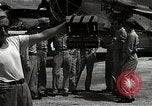
U.S. Military officers at North Field base on Tinian , Marianas Islands, pose in front of the B-29, Enola Gay
Atomic bombing mission in Japan by the United States Army Air Force, during World War II. A U.S. military base in North Field, Tinian Island in Mariana Islands, South Pacific. A group of U.S. Navy and Army Air Force officers stand in front of a B-29 bomber and talk to each other. The name of the B-29 bomber 'Enola Gay' painted on the nose of the bomber.
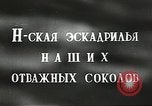
Activities at a Soviet airbase and army base during World War II.
Opening slate in Russian, refers to N-skaya squadron of our brave falcons. View of a rough encampment in a clump of pine trees in the Soviet Union, during World War 2. Closeup of two Soviet aircraft completely hidden by boughs of pine trees. Complete change of scene shows Soviet soldiers assembled in a clearing in a forest, where they are to watch some local performances. View from the rear of soldiers grouped informally around army soldier entertainers. Soviet soldier musicians in a band are seated nearby with instruments, including a balalaika and accordions. The setting is park-like, perhaps at an army base. Next some of the army entertainers begin to dance as the band plays. View of a circle of army spectators watching the entertainers. Closeup of the dancers performing athletic Russian dances in unison. A group of women army soldiers are seated in the grass near other spectators, watching and applauding the performances. View of a Russian solder doing a solo performance. Camera pans over the military spectators. Abrupt change of scene shows an Ilyushin DB-3 bomber that has been partially cleared of its camouflage tree limbs. Soviet troops prepare long belts of machine gun ammunition, running the rounds through a had-cranked device that secures them. They re-box the belt ammunition. A truck carrying soldiers arrives at the Ilyushin DB-3 aircraft. Soldiers get out and unload crated munitions from the back of the truck, which they roll to the aircraft. They open a crate to reveal a bomb inside. Other soldiers carry a crate of belted machine gun ammunition. Next the armorers are seen arming the airplane. Closeup of one atop the aircraft, loading the belt ammunition, while others hoist a bomb through the bomb bay doors. One soldier checks the aircraft machine guns for mobility. Soldiers tending a pile of crated munitions are approached by a Soviet Air Force officer who brings them credentials that they must mark with their fingerprints and sign. The officer congratulates them. Closeup of the Russian officer. Another Air Force officer (a Major) holds a map and speaks to a Soviet radio operator in the field. Soldiers remove the last tree limbs from the Ilyushin bomber aircraft, and aircrew members prepare to board. The aircraft with engines running. The bomber taxis out and takes off raising lots of dust from the rugged airfield. Glimpse of three Soviet bombers in formation above the airfield.

Team of USAF officers in leadership training work on physical problems and tasks at a base in Alabama, United States
A film about leadership training of USAF officer students attending Squadron Officer School at the Air University on Maxwell Air Force Base in Alabama, United States. Team of USAF officers in the field leadership area work on team building exercises, solving physical problems and tasks. Officers perform group activities that require group cooperation, leadership, and problem solving in limited time. They transfer a container over barriers while practicing.
U.S. Army Air Force Douglas C-47 Skytrain transport planes in flight over North Africa (WW2)
U.S. Army Air Force Douglas C-47 Skytrain transport planes in flight over North Africa during World War II. Aerial view of the landscape from the aircraft. Two Skytrains fly next to each other. View of the air base. Several planes parked on the air strip.
CRITICALPAST.COM: About Us | Contact Us | FAQs - How to Order | License Agreement | My Account | My Lightboxes | Shopping Cart | Advanced Search | Featured Collections | Website Terms & Conditions | Privacy Policy ©2026 CriticalPast LLC.
License Agreement |
Terms & Conditions |
Privacy Policy
©2026 CriticalPast LLC.