


 Francais
 Deutsch
 Italiano

Refine Your Search
Vietnam Binh Thuy Air Base 1967 stock footage and images
- Showing 5119 to 5124 of 13521 results more
 Hide
Color Sound
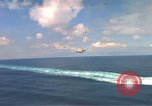
Various U.S. Navy aircraft land aboard USS Coral Sea while underway in the South China Sea during Vietnam War.
USS Coral Sea underway in the Gulf of Tonkin during Vietnam War. USS Coral Sea, an aircraft carrier underway in the Gulf of Tonkin. U.S. Navy A-4E aircraft comes in for landing aboard USS Coral Sea. A-1J aircraft in a landing pattern as it is being recovered aboard. U.S. Navy A-1H aircraft takes a wave off over the deck of the aircraft carrier. U.S. Navy RF-8A aircraft comes in for landing and lands on the deck. U.S. Navy A-1J and C-2A also come in and land one by one. Two U.S. Navy F-4B aircraft land on the deck of the carrier. Aerial view of a destroyer escort underway at sea. A destroyer underway at sea. U.S. Navy KA-3B flies over the wake of USS Coral Sea. Another KA-3B aircraft comes in and lands at the deck.
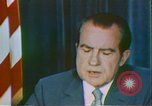
U.S. President Richard Nixon works for peaceful end of Vietnam War, improves domestic conditions and controls drug traffic.
U.S. President Richard Nixon speaks about aftermath of immediate withdrawal from the Vietnam War. U.S. military prisoners of war held by North Vietnam stand before press reporters in Vietnam. President confers with U.S. Secretary of State Dr. Henry Kissinger at his office. Vietnam War draftees being selected by traditional lottery system. Men stand in front of machines that churn out numbered balls for new draft lottery system. Nixon transforms budget expenditure on human needs. Criminals caught by police walk, some covering their faces from the media, as they are led away by police and investigators. Illegal drugs seized by efforts of Nixon administration. View of seized heroin manufacturing equipment. Nixon speaks about the opium farming in Turkey during one of his speeches and mentions agreement with the Turkish government in Ankara to cease all opium poppy production. Customs officers check illegal drug traffic on the border of Mexico and America. Drug enforcement officials search cargo hold of a ship for illegal drugs. Views of drug control officers finding illegal stashed hidden drugs in hiding places in cars and vehicles. Nixon speaks about increased budget to control illegal drug traffic and rehabilitation of drug abusers and drug addicts. He creates the office of Drug Abuse Enforcement and he speaks saying "We must wage what I have called Total War against public enemy number one in the United States: The problem of dangerous drugs." From a pro-Nixon "documentary" called "The Nixon Years: Change Without Chaos" covering President Richard Nixon's first four years in office. Released during his 1972 reelection campaign.
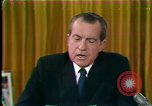
U.S. President Richard Nixon addresses nation about Vietnam War, from White House, Washington DC.
Stand of U.S. President Richard Nixon on Vietnam War. President Nixon addresses the nation about the Vietnam War from White House. He explains what has been described as "The Nixon Doctrine" regarding U.S. involvement in war, foreign policy support, and defense of freedom. He discusses the concept of helping other nations fight wars, rather than fighting wars for them. He illustrates this approach in describing U.S. efforts in Vietnam. He promises that 20% of U.S. combat forces will return by mid December. He notes he will not reveal withdrawal decisions that will compromise efforts at the Paris talks. He indicates he will pursue a path seeking a just peace through a negotiated settlement or through continued vietnamization.
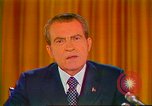
President Richard Nixon address the nation from the White House in Washington DC, United States at the end of the Vietnam War.
Television broadcast of U.S. President Richard Nixon's speech from the White House in Washington DC, United States on withdrawal of the remaining U.S. troops from Vietnam on 29th March 1973 during the Vietnam War. President Nixon speaks about the end of the Vietnam War. He speaks about differences about war which divides a nation. He talks about bringing peace and reducing the burden of armaments. He refers to nations in past which fell at the height of their wealth and strength and assures that it would not happen to the United States. He shares his experience of speaking to an American prisoner who survived in a communist prison during the Vietnam War.
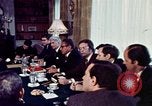
U.S. Secretary of State Kissinger and counterpart, Le Duc tho, of North Vietnam, lead delegations in Paris Peace Talks
During the Vietnam War, representatives from the United States, South Vietnam and North Vietnam meet, in Paris, France, to finalize the Paris Peace Accords ending Vietnam hostilities. Principal negotiators to end the war are U.S. Secretary of State Henry Kissinger, and North Vietnamese counterpart , Le Duc Tho. The delegates are seated at a large rectangular table, with Henry Kissinger at center of one side and Le Duc tho, at center of opposite side. Other delegates occupy seats adjacent to their respective principals. (Location: Majestic Hotel?) Photographers try to take photographs without being obtrusive. The mood of the meeting appears restrained but pleasant.

West Berlin Police restrain student protesters during an Anti-Vietnam War demonstration
Students gather to protest the Vietnam War in Kurfürstendamm, West Berlin. The ruins of Kaiser Wilhelm Memorial Church are seen. Anti-war protesters holding anti-Vietnam-War signs in German, such as "Wir fordern: Amis Raus aus Vietnam." (We demand: Americans out of Vietnam). Some students hold a portrait of Che Guevara. Protesters moving along the boulevard. Altercation between protesters and Berlin Police. Berlin Police attempt to control the crowds. Night time protest scenes where police officers physically restrain an unruly demonstrator, taking him away. A police van driving away from Kurfürstendamm. A truck in front of Café Kranzler (The Barn - Café Kranzler, Kurfürstendamm 22, 10719 Berlin, Germany). Policemen spray water cannons in front of the SAS (Scandinavian Airlines) sales office and Café Sarotti.
CRITICALPAST.COM: About Us | Contact Us | FAQs - How to Order | License Agreement | My Account | My Lightboxes | Shopping Cart | Advanced Search | Featured Collections | Website Terms & Conditions | Privacy Policy ©2026 CriticalPast LLC.
License Agreement |
Terms & Conditions |
Privacy Policy
©2026 CriticalPast LLC.