


 Francais
 Deutsch
 Italiano
Refine Your Search
Walcheren Island Netherlands 1944 stock footage and images
- Showing 7255 to 7260 of 9702 results more
more Hide
Hide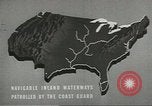
Coast Guard vessels, buoys, lighthouses, helicopters and life saving service stations in the United States.
Opening scene shows an animated map of the United States and its inland waterways. An extremely long barge assembly is seen moving along a waterway, with industrial plant on shore in background. Another view of barges being pushed, View from a ship passing a city skyline. A Coast Guard ship passing an inland passenger ship in icy waters. View from bow of the Coast Guard ship moving through the ice. he U.S. Coast Guard side paddlewheel river tender, "Willow" is seen docked on the Mississippi River. Black smoke is rising from one of her funnels. A team of men works at a river bank, installing an aid to navigation. View of another such aid. A Coast Guard riverboat for installing and maintaining navigation aids, moving on a river. Closeup of a Coastguardsman wearing flotation vest, on deck. A buoy being raised by a crane on the ship. Glimpse of a buoy floating in the water. A new buoy being lowered from the ship into the water. Closeup of two Coast Guard officers watching as the buoy is set in place. View from deck of ship as the buoy is lowered overboard. Aerial view of a lighthouse. View of lighthouse from ground nearby. Glimpse of a Coast Guard station on a sandy shore. A Coast Guard boathouse with three rescue dories visible inside. A pontoon equipped Coast Guard helicopter taking off from a moving ship.
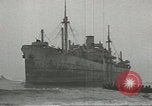
U.S. Coast Guard engaged in International weather and ice patrols on the high seas
A large commercial freighter is seen beached and a long boat, containing a dozen or more Coastguardsmen, is pulling away from it. Next the men are seen running across the sand pulling a line from the ship. Closeup of two Coast Guard officers watching from ashore. . A seaman from the ship is transported via a bosun's chair to the shore. A group of Coastguardsmen weigh the taut rescue line down so the seaman can get out of the rig. View of a Coast Guard navigator at a table with a chart. A pair of dividers and a course plotter (plus his hat) are on the chart, which displays isobars. View from deck of a Coast Guard ship making way in rough seas. An anemometer rotating on the ship. Coast Guard crewman taking barometric pressure and other meteorological readings from instruments on the ship. Another, wearing a headset, monitors a real time chart being created from instruments on the ship. View from bow of Coast Guard ship engaged in International Ice Patrol, which charts and tracks icebergs to warn ships. Coast Guard crew member marking locations on a map. View of an iceberg. .
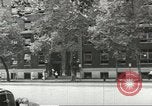
U.S. Coast Guard Commandant Russell Randolph Waesche describes mission of the Coast Guard.
The old Southern Railway Building, 13th Street and Pennsylvania Avenue, N.W., Washington, D.C., housing the U. S. Coast Guard Headquarters during World War 2. Persons are entering the building. Sign identifies the office of the Commandant. The Commandant, Russell Randolph Waesche holds a meeting in the office. Map of the world covers one wall. American and Coast Guard flags are displayed. Commandant Waesche is explaining the mission of the Coast Guard. Closeup of him speaking. Outside, on the street, a contingent of uniformed armed Coastguardsmen stands in formation. Officials reviewing a parade that includes a Coast Guard contingent. Glimpse of ships docked in a port.
U.S. soldiers check tags and place bags in their proper order at Camp Kilmer in New Jersey, United States.
Camp Kilmer in New Jersey, United States. Barracks bags lined up outside wooden barracks. U.S. soldiers check tags and place bags in proper order. The soldiers seated on the barracks bags smoke cigarette. Soldiers are wearing helmets and knitted fatigue caps. (World War II period).
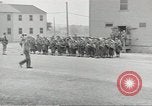
U.S. soldiers carrying full field packs and rifles march get off a train with their bags in New York.
Soldiers bound for war: U.S. troops entrain at the New York port for transportation to the European Theater during World War II. Soldiers carrying full field packs and rifles assemble outside barracks and march forward from Camp Kilmer, New Jersey. Interior of a moving troop transport train. A soldier peels and eats an orange. Other soldiers sleep, rest and look out of a window of the railroad train. The soldiers get off the train with their bags in New York. The New York skyline in the background.
U.S. soldiers toss barracks bags to two sergeants, take back the bags and enter barracks in the United States.
U.S. troops prepare to entrain in New York for transportation to the European Theater during World War II. U.S. soldiers toss barrack bags to two sergeants standing on the top of barrack steps. The soldiers rush up the stairs. They take bags from the sergeants and enter the barracks.
CRITICALPAST.COM: About Us | Contact Us | FAQs - How to Order | License Agreement | My Account | My Lightboxes | Shopping Cart | Advanced Search | Featured Collections | Website Terms & Conditions | Privacy Policy ©2026 CriticalPast LLC.
License Agreement |
Terms & Conditions |
Privacy Policy
©2026 CriticalPast LLC.