


 Francais
 Deutsch
 Italiano
Refine Your Search
Walcheren Island Netherlands 1944 stock footage and images
- Showing 8035 to 8040 of 9701 results more
more Hide
Hide
A crowd looks on as United States soldiers march along a street in Chateau-Thierry, France.
United States soldiers in Chateau-Thierry, France during World War II. United States soldiers stand near a board which reads ' Chateau-Hierry'. A horse driven cart under a tree in a distance. The soldiers enter the town. Children play near a military tank. A soldier washes his hands and a girl stands nearby and watches him. The soldiers walk through streets. A crowd watches the passing soldiers. A soldier points his hand as he stands in a balcony.
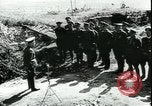
German Atlantic Wall coastal defenses. German forces enter the Crimean Peninsula in World War II.
In opening scene, German Field Marshal Erwin Rommel is giving a "pep talk" to senior officers assembled at the Northern part of the German "Atlantic Wall" defenses in Scandinavia, during World War 2. A German sentry is seen in front of a large coastal fortification bearing the name "Skagerrak." Camera focuses on the barrel of a huge coastal gun. Closeup of the sentry. Troops travel on a small gauge railway carrying canisters of propellant and shells to a unique heavy coastal gun installed , near Kristiansand, Norway, overlooking the Skagerak Strait. (The gun is a 28 cm SK C/34 naval gun, similar to those installed on some battleships. But this one was appropriated from an abandoned German Army super-tank project.) An alarm bell sounds in the fort and soldiers respond. Next, huge coastal gun shells are seen being moved on conveyors to the gun. A team of gun operators recite preparation steps out loud as they adjust range, bearing, and other parameters before firing the weapon. Gunners load a shell into the gun breech, followed by several propellant charges. The breech lowers inside the fort as the gun barrel is raised to desired elevation. The gun is fired. More commands are spoken aloud and another round is fired. Glimpse from outside of gun flash at night. Complete change of scene shows a map of Crimean Peninsula. Anti-aircraft guns are shown at coastal areas. A quad-barreled FlaKvierling 38 gun is seen. German forces entering the Crimea. Infantry walk in and others, ride in open trucks.One soldier mans a light gun mounted on the back of a 6-wheeled truck. German soldiers posted on roads directing incoming traffic of trucks carrying troops. Closeups of German soldiers riding in open trucks. A trio of German Army officers watches the incoming troops. Local refugees carry their belongings as they flee from battle fronts.
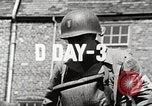
U.S. troops are ferried from Weymouth England, to transport ships in preparation for Normandy invasion in World War II
U.S. army troops board LCVPs (Landing Craft, Vehicle, Personnel) at pier in Weymouth, England, to be ferried out to transport ships anchored offshore, in preparation for the D-Day invasion of Normandy, France, during World War 2. Several large Landing Craft Infantry are seen tied up at the docks, including LCI(L) numbers 84 and 49. Views of Higgins Boats (LCVPs) heading out. Markings on one identify it as belonging to the Attack Transport ship USS Charles Carroll (APA-28). The Higgins Boats come alongside the USS Charles Carroll and troops of the U.S. 29th Infantry Division board her.
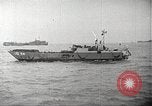
LSTs unload equipment and ammunition Omaha Beach in Normandy, France during World War II.
LCI(L)s approaching the Omaha Beach shore during the D-day invasion of Normandy in World War 2. Among those see is LCI(L)541. Officer calling with a megaphone from ship's deck. The LCIs advance toward the beach. Explosion seen ahead. U.S. troops wade from LCIs under continuous German machine gun fire. Larger Landing Ships Tank, including USS LST-282, waiting out of range of enemy fire. U.S. troops and motorized equipment on shore. Burning U.S. truck. Fallen U.S. soldiers in the sand.M4A1 Sherman tank with bulldozer blade and "DT-7" painted on its side, moving along Utah Beach. LCI(L)88 pulls up to a transport ship to load more troops for transport to the shore. Vehicles being transferred from an LST to a LCT. Larger vehicles, such as tanks, being transferred to "Rhino Ferries" (powered barges) to be taken ashore.Troop reinforcements being landed at the beachhead. Major General Charles H.Corlett, " Cowboy Pete," Commander of XIX Corps,US 1st Army, seen speaking on the radio, after landing on D-Day+4 (June 10th) at Omaha Beach, near Colleville-su-Mer. Army trucks drive ashore in surf. A buldozer moves in the surf.
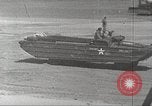
Omaha Beach, after the Allies secured the beachhead, during the invasion of Normandy, France, in World War Ii
Scenes on and around Omaha Beach after it had been secured, following the Allied D-Day amphibious invasion of Normandy in World War 2. Several U.S. soldiers move along the beach in a DUKW amphibious vehicle. A bulldozer seen in the background. About 25 German prisoners of war are seen awaiting evacuation, behind barbed wire on the beach,guarded by a U.S.military policeman. As a shell whines overhead they all instinctively drop to the ground and the shell explodes somewhere out of sight. An 83 ft. U.S. Coast Guard rescue cutter looks for Allied survivors in the water. The British Hospital ship "Prague" and others are seen at anchor, ready to receive patients. Wounded soldiers being carried on stretchers to a landing craft on the beach. A wounded man being transferred from a damaged LCI to another one. Wounded being hoisted in groups of 4 each, from the crippled and sinking LCI(L)85. The are lowered to deck of the USS Samuel Chase (APA-26). Navy Rear Admiral, John L. Hall, Jr., observing the transfer of wounded. Sweeping views of Omaha Beach after the beachhead was secured. Numerous support vessels are seen close offshore. Trucks move along roads; war materiel is stockpiled in open areas; barrage balloons fly aloft; and soldiers move everywhere. Closeup of the LCI(L) 92 ,on the beach,showing the holes blown in her. The LCI(L)553, beached sideways in the sand. Seen beached and damaged, is LCI(L)87, flagship of Coast Guard Captain Miles E. Imlay, deputy commander of the Coast Guard's Omaha Assault Group O-1. Mechanics working to repair the screw from a boat.
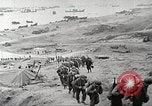
U.S. Army troop reinforcements arriving at Omaha Beachhead during World War II
U.S. Army troop reinforcements arriving at Omaha Beachhead and moving inland, during invasion of Normandy, France, in World War 2, in the days immediately following D-Day. (They are moving along a gradual rise overlooking the beach, that appears to be near Colleville Sur Mer, coordinates WN-62.) U.S. LST-281 discharging cargo of Army vehicles, including trucks and halftracks. A DUKW amphibious vehicle driving out of the surf. Sherman M4 tanks with deep wading kits; one named, "Goldie." Troops unload supplies from a beached Rhino Barge. More landing craft approaching the beach. Coast Guardsmen manning antiaircraft guns. Barrage balloons aloft. Antiaircraft guns firing, at night,from the beachhead, at German bombers, overhead.
CRITICALPAST.COM: About Us | Contact Us | FAQs - How to Order | License Agreement | My Account | My Lightboxes | Shopping Cart | Advanced Search | Featured Collections | Website Terms & Conditions | Privacy Policy ©2026 CriticalPast LLC.
License Agreement |
Terms & Conditions |
Privacy Policy
©2026 CriticalPast LLC.