


 Francais
 Deutsch
 Italiano
Refine Your Search
Walcheren Island Netherlands 1944 stock footage and images
- Showing 8287 to 8292 of 9701 results more
more Hide
Hide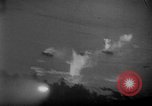
U.S. air attack on Japanese ships and animation depicts plan of attack of both countries in the Pacific Ocean.
Conclusions of the Battle of Leyte Gulf of World War II in the Pacific Ocean. Aerial view of Japanese ships being attacked by a U.S. Task Force. Naval guns being fired from the battleships. A U.S. aircraft takes off from a carrier. The aircraft in flight. Ships underway in the Pacific Ocean. Sailors on the decks of ships look skywards. A sailor looks through binoculars. Animation depicts Japanese plan of attack, division of Japanese and U.S. forces and American plan of attack. Aircraft in flight. Sailors stand by naval guns, ready to fire ,including an African American U.S. Navy sailor. A sailor observes through binoculars. Battleships underway in ocean. Officers study maps and communicate with each other. The battleships underway during the battle.

Workers make and assemble robot bomb parts and undertake bomb testing in Dearborn, Michigan and Toledo, Ohio
American robot bombs, America's answer to the German V-1 buzzbomb, being prepared in Dearborn, Michigan during World War 2. War production workers in armament factory weld bomb casing at Ford robot bomb factory. The workers move long tube like bombs with jet engines. They are known by nickname "Flying Chimney". The flying bombs on wheels. Men with ear protection in a testing area as the engines are fired during testing. Buildings in the background. Flame shooting from the jet engines. Workers including some women assemble the bombs at a plant in Toledo, Ohio, where wings and warheads are also built. A woman war production worker lying inside the body of a robot bomb and working on its assembly. The bombs take off from a launch pad in a gully at an Army Air Force test site. A booster cuts loose from the American Robot Bomb and hits water at a distance as the buzz bomb flies through the air, with an estimate 200 mile range. The bombs in flight. The booster hits water.
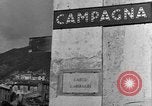
Men clear debris and damaged buildings in Campagna and Eboli, Italy, during World War II.
Wreckage in an area near the Sele River in Eboli, Italy during World War 2. A sign on a wall reads 'Campagna'. A man shovels amongst ruins in the foreground. Men clear debris. A discarded picture of Mussolini lying on a heap of rubble. A bullet ridden sign on a highway reads 'Eboli'. Wrecked city of Eboli.
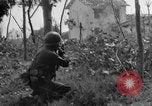
Members of First Special Service Force conducts daylight raid on German position in Anzio, Italy, during World War II
A daylight raid by joint US-Canadian commandos on suspected German operation post in Anzio, Italy during World War 2. Soldiers of the First Special Service Force (called "Black Devils" by the Germans) fire rifle grenades on the building and move towards it. Other "Black Devils" give covering fire with Browning automatic rifles and Johnson machine guns for soldiers moving towards the German position. Troops use a drainage ditch to move towards the operation post. They fire bazookas, .30 caliber rifles and machine guns. A soldier fires a bazooka from behind a fence barrier.
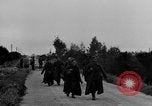
German prisoners walk under guard and carry a wounded on a litter past a burning U.S. M4 tank at Anzio, Italy, in World War II
Elements of Joint US-Canadian First Special Service Force conduct a daylight raid on a German operation post at beach in Anzio, Italy during World War 2. German prisoners walking under guard on a road. The prisoners carry a wounded on a litter past a burning M4 Sherman tank. Burning U.S. tanks, knocked out by German teller mines.
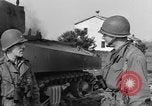
Officers talk near a burning U.S. tank and battle worn U.S. troops walk on a road in Anzio, Italy, during World War II.
A daylight raid by troops of the Joint US-Canadian 1st Special Service Force, on a German operation post at a beach in Anzio, Italy during World War 2. Brigadier General Robert Tryon Frederick, Commander of the First Special Service Forces (Black Devils Brigade) speaks to Commanding Officer 2nd Battalion, 2nd Regiment of 1st Special Service Force, Lieutenant Colonel Robert S. Moore alongside a burning tank. A tank moves on a road. Battle worn troops on a road. The troops cross the Mussolini Canal. An officer near a burning tank. A tank moves past a burning tank. Troops walk in a line. (Note: the U.S. tanks were knocked out by German teller mines.)
CRITICALPAST.COM: About Us | Contact Us | FAQs - How to Order | License Agreement | My Account | My Lightboxes | Shopping Cart | Advanced Search | Featured Collections | Website Terms & Conditions | Privacy Policy ©2026 CriticalPast LLC.
License Agreement |
Terms & Conditions |
Privacy Policy
©2026 CriticalPast LLC.