


 Francais
 Deutsch
 Italiano
Refine Your Search
Walcheren Island Netherlands 1944 stock footage and images
- Showing 8875 to 8880 of 9701 results more
more Hide
Hide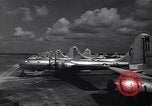
Civilian painters paint U.S. Army Air Force B-29 Superfortress bomber aircraft at an airfield in the U.S. during World War II.
U.S. Army Air Force B-29 Superfortress bombers at an airfield in the United States during World War II. A B-29 that is being protectively sealed in preparation for painting. Fuselage and number 3 engine are sealed. Moveable scaffolding is in place and drums of liquid are on the ground. Painter begins process of sealing an engine nacelle, by taping opening. He then sprays a synthetic "spider web" of material over the opening. Similar material is sprayed into various openings of the aircraft, until a fabric is formed over them. Finally, preformed sheets of fabric are used to seal other sensitive seams on the airframe and trailing edges of wings..
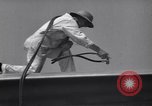
Painting and mothballing B29s and B-17s in the United States
U.S. Army Air Force B-29 Superfortress bomber aircraft at an airfield in United States during World War II. A civilian spray paints the wing of a B-29. A painter uses a roller around the wing insignia. Several civilians using ladders, paint a B-29 Superfortress. Man on forklift empties 55 gallon drum of mastic liquid into power sprayer. Sprayer nozzles are shown. Operator sprays mastic material on fuselage of mothballed B-29, to seal it. B-17 with mastic sprayed on tail section of fuselage. A Wright 3350 radial engine from a B-29, on a stand and series of views as it is gradually mothballed. View of sealed B-29 airframe, with engines removed, and hosing connected to various openings.

Mission and operations of the U.S. Army Service Forces during World War II
Film opens with an explosion at Pearl Harbor, Hawaii, December 7, 1941, during the Japanese attack in World War 2. The USS Arizona sinking. Newspaper headline reading "U.S. Declares War." Relief map globe of the world. Narrator speaks about accomplishments of the U.S. Army Service Forces since the Pearl Harbor attack. Glimpse of two M4 DV early Sherman tanks moving on a road. The famous Uncle Sam recruiting poster. Huge number of massed U.S. Army troops marching toward the camera lined 16 abreast. Army supply service personnel inspecting providers of all manner of supplies needed to feed, clothe, and equip the U.S. Army. Brief views of supply operations underway involving food and fuels. An Army truck and a P-38 lightning airplane (under wraps) being loaded aboard a ship. A warehouse stacked from floor to ceiling with military supplies. Forklifts moving in the aisles. Group of officers sitting around a table. Some wear shoulder patch of Army Service Forces on their uniforms. The processing of millions of volunteers and draftees for military service. Men in recruitment office being guided by staff. Lines of new recruits undergoing physical exams and then arriving in civilian clothes, with their baggage, at a training center. Barracks being constructed at a training camp or base in the United States. Camera pans across a large completed military camp. Soldiers forming up in front of barracks. Sign reads "Dispensary, Recruit Reception Center." Recruits lined up and receiving vaccinations against tropical and other diseases according to the regions to which they are being sent. An Army Sergeant assessing recruit qualifications for various military assignments. New recruits eating in a camp dining hall and also in a chow line at an outdoor field mess. Views of industrial workers picking up tools and assembling military equipment in war plants. A coal burning electric generating plant with 8 smoke stacks. A furnace with hot steel visible. An Army agent and an industrialist or business man signing contract documents. Glimpses of women war production workers placing items on a conveyer; guns being assembled by men in an armory; railroad train carrying freight across rugged U.S. territory; ocean-going ships ready for loading; cargo stacked up at ports; numerous 55 gallon drums ready for loading; rope slings of cargo being loaded for shipment; numerous army trucks ready for shipment to Allies, under "Lend Lease;" a nurse checking medical supplies for shipment; Many U.S. Army M3 tanks ready for shipment. Views of British forces engaged in the North African campaign, before the U.S. entry in World War 2. U.S. soldiers marching along a Camp road past a sign reading: "Headquarters, 725th Railway Operating Battalion" (Located in New Orleans). Rapid glimpses of various supplies, equipment, etc. being loaded for shipment abroad. Women war production workers in plants. Men in outdoor yards filling long lines of jerry cans. Views of clock hands moving. soldiers shooting automatic weapons (including tracer rounds) at a firing range.
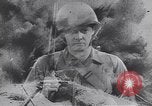
Training and mental preparation of U.S. soldiers for fighting in Europe during World War 2
A film on the logistics and the psychology of war. Primarily shows training exercises, combat simulations, and dramatizations. Images of soldier and explosions. A U.S. sailor firing a Mark 4, 20 mm. anti aircraft. Gun from a ship. A U.S. M3 Stuart light tank heading toward the camera. American soldiers ostensibly falling to enemy explosions and gunfire. A shell exploding where American troops are hunkered down. Artillery batteries firing at night. A soldier cutting barbed wire and triggering a booby trap. . Troops under fire during amphibious assault. Soldiers manning an M1919A4 .30-caliber Light Machine Gun. Troops advancing through forest under fire. Some fall. Staged encounter between U.S. infantrymen and German soldier. The kill each other. Entire battle front erupting in explosions and smoke. Newspaper article by Ernie Pyle about too little training of U.S. troops. New York reporter's article noting that U.S. soldiers in Europe don't understand why they aren't fighting the Japanese who attacked America. Staged hand to hand combat between a German soldier and two American soldiers.
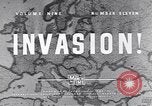
News media military analysts discuss the problems of Allies invading Europe to defeat Germany in World War II
Map of Europe and label "Invasion." Westbrook Van Voorhis leading a panel discussion about the problems arising from the Allied invasion of Europe in World War 2. He introduces panelists: Hanson Baldwin (military editor of the New York Times) Dewitt MacKenzie (Associated Press military analyst), and Paul Schubert (of Mutual Radio Network). He asks Mr. Baldwin about the importance of aerial bombing campaigns. Baldwin also stresses importance of a land invasion of Europe. Relief map of Europe highlighting major German cities. Asked about the merit of invading Italy on the way to Germany, Mr. Schubert cites the problem of the Alps and suggests other more effective invasion routes. Van Voorhis asks Mr. MacKenzie about best route into fortress Germany. He considers the criterion of ease of supply as most important, and suggests the Atlantic coast, near a good port and not far from England. Animated map shows this idea. When asked about this, Mr. Baldwin agrees completely, calling the conflict "a quartermaster's war." He adds, "The problem of victory is the problem of supply."
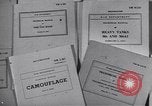
Army Service Forces recruits undergo training in the United States.
images of Army Technical training manuals dealing with gas masks; camouflage; heavy tanks; and machine guns. U.S. Army Service Forces (ASF) recruits rushing down a hillside into waters of a swift river and swimming across. They undergo Live Fire Exercises near \end of their training. The must crawl while trainers fire rounds from a Browning M 1917 machine gun over their heads. An explosive charge goes off as the recruits crawl past. ASF troops are briefed about invasion techniques, by an instructor using a realistic small scale mockup of a port city. Recruits crouch over a model of front line terrain. Model trains operate as a training aid. Students at doorway of the U.S. Army School of Military Government. Numerous student studying in the library. In a classroom, a military officer instructor discusses the mission of governing an occupied country with cooperation of the existing governing officials. Closeups of officers discussing the occupation of Germany, at length. (World War II period).
CRITICALPAST.COM: About Us | Contact Us | FAQs - How to Order | License Agreement | My Account | My Lightboxes | Shopping Cart | Advanced Search | Featured Collections | Website Terms & Conditions | Privacy Policy ©2026 CriticalPast LLC.
License Agreement |
Terms & Conditions |
Privacy Policy
©2026 CriticalPast LLC.