


 Francais
 Deutsch
 Italiano
Refine Your Search
Walcheren Island Netherlands 1944 stock footage and images
- Showing 9475 to 9480 of 9701 results more
more Hide
Hide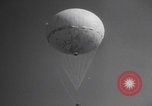
Parts of the so-called Brain Center of a Japanese Fu-Go paper balloon bomb (WW2)
A video explaining the components of the “Brain Center” of the Japanese Fu-Go paper balloon bomb- a weapon launched by Japan to drop bombs on the United States during World War 2. An inflated paper balloon bomb. A man with a pencil points to parts of the “Brain Center” of the balloon such as the electrical source (battery case), demolition block, barometer box, fused jacks, jack switches, blowout plugs, sandbags, and incendiary bombs. Man puts away his pencil. Man pulls back sandbags to show the central payload of the paper balloon bomb. Man demonstrates how ballast falls. Man demonstrates mechanism and release of the pay loads. A sandbag falls. Man attaches sandbag back to the ballast. Man shows a T-hook of the ballast. Man re-attaches a T-hook back in the ballast.
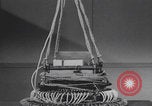
Man demonstrates the parts of the battery and aneroid of a Japanese Fu-Go paper balloon bomb (WW2)
A video explaining the components of the “Brain Center” of the Japanese Fu-Go paper balloon bomb- a weapon launched by Japan to drop bombs on the United States during World War 2. Man holds the ballast of the paper balloon bomb. Man pulls out fuse of demolition block. The plug from the battery to the barometer box is disconnected. Man lifts out the demolition box and battery box from the “Brain Center”. Man demonstrates the battery box and demolition box of the Fu-Go balloon bomb. Man takes out the demolition box. Man opens the battery case. Man takes out the middle box containing a solution of calcium chloride (acting as a thermal overcoat). Man points to a rubber plug in the middle box. Man takes out the battery of the middle box. Man reattaches the battery back to the middle box and returns the middle box to the battery box. Man puts back the lid of the battery box. The barometer (Aneroid) plate is taken out. Man demonstrates the aneroid board of the Fu-Go balloon bomb. Man takes off the lid of the main aneroid. Man points to the aneroid bellows, post, arm, clutch using a pencil. Man demonstrates two aneroid boards. Man points to aneroid before dismantling them. Man touches the contact rod of the aneroid. Man demonstrates pulling a plug on the “Brain Center” of the paper balloon bomb from Japan.
USAAF bombing oil refineries in Ploesti, Romania, Colonel Johnson receives Medal of Honor (WW2)
United States Army Eighth Air Force, Second Air Division B-24 Liberator bombers bomb oil refineries in Ploesti, Romania, during World War 2. A map depicting a flight path from North Africa to Ploesti and Germany. B-24 Liberator aircraft drop bombs over Ploesti. A group of B-24 Liberator bombers in flight. Aerial view of Ploesti. Machine gun aimed at Ploesti. Aerial view of an oil refinery on fire. A group of B-24 Liberator bombers flying low over Romania. An oil refinery on fire in Ploesti. Clouds of thick smoke covers the bombed oil refinery. Oil refinery tanks on fire. Firemen use hoses to put out fire in oil refinery. German and Romanian men rush to burning oil refinery. German soldier uses firehose to put out flames. B-24 Liberator bombers returning to North Africa. People watch a B-24 Liberator bomber land on airfield. B-24 Liberator bomber taxiing after landing. United States Army men gather in airfield. Colonel Leon W. Johnson of the 44th Bombardment Group being awarded the Medal of Honor for leading the attack on the Ploesti oil fields.
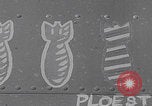
B-24D Liberator “Bomerang” Going-Away party in USAAF Hardwick, East Anglia, UK (WW2)
United States Army Eighth Air Force, Second Air Division celebrate a “Going Away” party for B-24D Liberator “Bomerang” (serial number: #41-23722) (Boomerang) in USAAF Hardwick, East Anglia, United Kingdom during World War 2. B-24 Liberator aircraft named “Bomerang” returns to the United States after completing 53 missions. Graffiti depicting bombs and the word “Ploesti” (referring to the Ploesti oil refinery raid). United States Army soldiers stand in front of a B-24 Liberator with nose art depicting a cartoon kangaroo carrying a bomb in both paws, one held overhead and one held in the kangaroo's pouch and the word “Bomerang”. United States and British pilots gather around a cake in front of B-24 Liberator “Bomerang”. Pilot holding a cake “Bomerang”. A pilot delivers a tribute to B-24 Liberator “Bomerang” in front of a crowd. Crowds cheer after pilot gives his tribute speech. Some pilots are wearing life vests. United States Major General James Pratt Hodges shake hands with pilots. B-24 Liberator “Bomerang” is now covered with written dedications from pilots, maintenance, and combat crews of the “Bomerang”. Men and women write their names, homages, and dedications on the body of B-24 “Bomerang”. B-24 Liberator engines are turned on. “Bomerang”’s pilot, Col. Walter Stewart, looks on. B-24 Liberator “Bomerang” taxiing on the runway on its flight to the United States.
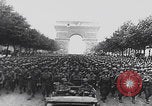
United States General Dwight D. Eisenhower receives recognition after World War 2 victories
Allied troops marching in victory on Avenue Champs Elysees, Paris, France. United States General Dwight D. Eisenhower stands with Marshal Charles de Gaulle on a moving car. Eisenhower on a horse-drawn carriage in London, England during VE parade. Eisenhower with British Prime Minister Winston Churchill. General Eisenhower is welcomed with a ticker tape parade in New York City after WWII victory. Eisenhower raises his hands victoriously during parade. Eisenhower speaks to the crowd from a podium, saying "New York simply can't do this to a Kansas farmer boy and keep its reputation for sophistication.”
Troops boarding invasion craft with materiel and transport before the invasion of Sicily (WW2)
United States and Allied invasion craft massed in Bizerte harbor in Tunisia before the invasion of Sicily (WWII). Assault troops are boarding invasion boats. Crates of materiel on the boats. Soldiers receive equipment such as lifebelts on board. Tractor pulls sledges carrying materiel. A DUKW (Duck) 2 ½ -ton amphibious truck boards a boat. A halftrack with an anti-aircraft gun reverses to board the craft. Soldiers pushing a 3 ¼-ton trailer to craft. Men boarding a tank landing ship. Allied invasion craft approach Sicily. United States troops seaborne landing in southern Sicily.
CRITICALPAST.COM: About Us | Contact Us | FAQs - How to Order | License Agreement | My Account | My Lightboxes | Shopping Cart | Advanced Search | Featured Collections | Website Terms & Conditions | Privacy Policy ©2026 CriticalPast LLC.
License Agreement |
Terms & Conditions |
Privacy Policy
©2026 CriticalPast LLC.