


 Francais
 Deutsch
 Italiano

Refine Your Search
Walcheren Island Netherlands 1944 stock footage and images
- Showing 91 to 96 of 9743 results more
 Hide
Color Sound

Princess Beatrix of Netherlands visits Curacao in Dutch West Indies
Princess Beatrix of the Netherlands visits Curaçao in the Dutch West Indies for a month. Her mother Queen Juliana bids farewell to Princess Beatrix. Princess Beatrix boards a KLM Douglas DC-6 “Prinses Marijke” (PJ-DPM). A huge crowd welcomes Princess Beatrix on the Curaçao International Airport (known at the time as “Dr. Albert Plesman airport”). Princess Beatrix climbs down a KLM airstair. The Governor of the Netherlands Antilles and other leaders welcome her on the airport. Princess Beatrix and Dutch Antilles leaders leave in an open car. Princess Beatrix waves to crowd gathered to welcome her.

German Kaiser Wilhelm II walks outside his manor house, Haus Doorn, in Doorn, Netherlands
German Emperor Wilhelm II in Doorn, Netherlands. A sign reads: 'Doorn'. Exterior of the Emperor's manor house Huis Doorn (Huis Doorn, Langbroekerweg 10, 3941 MT Doorn, Netherlands) where he will live in exile following World War 1. A flag flies at the top of the building. A crowd gathers and greets the Kaiser along the sides of a road. The emperor walks followed by other dignitaries.
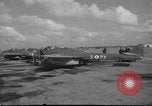
Norwegian air crews and their de Havilland Vampire jet aircraft pose for pictures at an Airfield in the Netherlands
Project Cirrus, in the Netherlands, 1951. Film is devoted to views of Norwegian air crews and their de Havilland Vampire jet aircraft, posing where they are encamped at an airfield in the Netherlands. Camera pans over parked aircraft an shows closeup of markings of Norwegian Squadron 336 on aircraft fuselage. A pilot poses, looking skyward, in opened cockpit of his plane. He wears a helmet with goggles raised atop it and his oxygen mask dangling below it. Closeup of Norwegian airman with "Norway" displayed on his left shoulder patch. He wears glasses and looks skyward. White clouds fill the sky in the background throughout the film. Two Norwegian fliers in flight suits pose looking away from the camera (in profiles). A vampire jet begins a takeoff roll as the film ends.
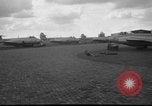
A Gloster Meteor jet of the Royal Netherlands Air Force is fueled at Gilze Rijen air base in Holland
NATO Project Cirrus, Gilze Rijen Air Base, in the Netherlands, 1951. Camera shows a group of parked Gloster Meteor jet aircraft of the Netherlands Royal Air Force. An officer and airman climb about the cockpit of one plane. One aircraft is seen parked in front of a large cylindrical structure. The number "3" is displayed on its nose wheel cover. A portable power unit sits under its left wing. Next scene shows a fuel truck with long boom positioning the fuel hose directly above the fuel port on the aircraft. An airman atop the aircraft handles the refueling hose during the refueling. Closeup of him controlling the hose. Scene shifts to a Meteor aircraft taxiing past parked aircraft. View back to the fuel truck that has now retracted its boom and refueling hose. Next, a pilot wearing flight suit and a seat pack parachute climbs into the cockpit of a Meteor plane. Closeup of him settling into the cockpit and checking the flight instruments and controls. A Meteor aircraft is seen landing in the background.
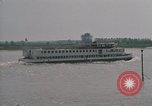
American correspondents visit cemetery in Opijnen, Gelderland, the Netherlands for Memorial Day ceremony honoring U.S. B-17 crew
American correspondents in Netherlands to mark 25th anniversary of Allied invasion of Europe in World War II. A steamer underway in a canal. Views in the village of Opijnen, in Gelderland, the Netherlands. A correspondent and his wife come out of a house. American correspondents near a bus. Houses along a road. An American flag at the walled cemetery in Opijnen, beside its 17th century Dutch Reformed Church, where the crew members of an American B-17 bomber from the 323 Squadron of the 91st Bomb Group (H) of the U.S. 8th Army Air Force are buried; shot down July 30, 1943 by the German Luftwaffe. Gravestones bearing the names of American soldiers who lost their lives when their crippled B-17 was shot down, including: Mike Anthony Perrotta, Hermon Daines Poling, Harold Royce Sparks, Robert Urquhart Duggan, Douglas Victor Blackwood, Americo Cianfichi. U.S. Color Guard marches from a town building toward the cemetery. A woman correspondent takes pictures. An American flag flies at half mast. Men, women and children at the cemetery. Dutch children carry flowers in their hands. The mayor of Opijnen speaks into a microphone. He and a woman place flowered wreaths at the graves of dead American soldiers. Two groups of four U.S. Convair F-102 Delta Dagger aircraft fly overhead followed by four F-104 Starfighters of the Royal Netherlands Airforce. Children walk past the graves. Additional propeller aircraft pass overhead honoring the airmen.
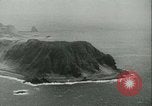
The role of Signal Corps during the Philippines Campaign of World War II.
The role and contribution of the U.S. Army Signal Corps in the Pacific Theater of Operations during World War 2. A beach on the Philippine island of Mindanao. U.S. aircraft in flight over the coastline. Signal Officer Lieutenant Leon Tinnell works at the Signal Headquarters. He talks on the radio receiver. He radios a message to U.S. Army General Douglas MacArthur's headquarters reporting on movement of Japanese troops. U.S. aircraft take off for a mission against the Japanese troops. They drop bombs on Japanese ships. Smoke from fire due to the explosions. A U.S. submarine near a battleship at sea. U.S. Navy sailors aboard the ship and the submarine. Wounded and sick officers and soldiers including Lt. Tinnell are transferred from the submarine onto the ship. Soldiers carry a comrade on a stretcher. Landing crafts approach an island in the Philippines. General MacArthur and Allied troops land at Leyte Island on October 20, 1944. They leave the crafts off shore and wade through the water towards the beach. Signal Corps officers record the event as General MacArthur and the others make their way inland.
CRITICALPAST.COM: About Us | Contact Us | FAQs - How to Order | License Agreement | My Account | My Lightboxes | Shopping Cart | Advanced Search | Featured Collections | Website Terms & Conditions | Privacy Policy ©2026 CriticalPast LLC.
License Agreement |
Terms & Conditions |
Privacy Policy
©2026 CriticalPast LLC.