


 Francais
 Deutsch
 Italiano
Refine Your Search
Walcheren Island Netherlands 1944 stock footage and images
- Showing 1219 to 1224 of 9701 results more
more Hide
Hide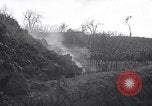
People pray to Mother Mary and demonstrate with the statue and Mount Vesuvius erupts in Naples, Italy.
The eruption of Mount Vesuvius in 1944. Lava in the city. Smoke rises from lava. People pose. Crowd gathers near lava. Civilians kneel in prayer as church services are held before an outdoor shrine. The crowd praying around a Virgin Mary statue. Candles lit in front of statue and priest speaks. Lava flow interrupts services. A man pushes lava rock with a stick. The crowd breaks up and carries the shrine forward. Men carry statue and priest go with them. View of city with cloud of smoke in the background.
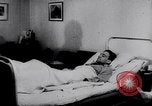
German pilot, Hans-Ulrich Rudel, in hospital recovering from wounds, receives Germany's highest award and is promoted, during World War II
Germany's most famous pilot of Stuka dive bombers (Junkers Ju 87) Hans-Ulrich Rudel, seen in hospital, after being wounded in the thigh, during World War 2. His doctor visits and asks how he is doing. He replies "ausgezeichnet" (excellent). His wife comes to the bedside and speaks with him briefly. Rudel's hospital chart is seen, with his rank shown as Oberst (Colonel).This is notable, when downed in November, he had been a Lieutenant Colonel with Schlachtgeschwader 2 "Immelmann" (Battle Squadron 2 "Immelmann.") Another German officer sits at his bedside and inquires about his experience. Colonel Rüdel explains how he was downed by flak while attacking Soviets tanks on the Eastern Front. He speaks about his comrade fliers. Next, the award of "Knight's Cross with Golden Oak Leaves, Swords and Diamonds"is shown. (This award was created by act of the Reichstag, solely for Rudel, on December 29, 1944. He was also promoted to Colonel, the same day.) The film concludes with additional comments by Colonel Rudel.
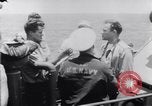
U.S. Navy Task Group led by USS Guadalcanal (CVE-60) tows captured German submarine (U-505) to Bermuda
A Task Group of the U.S. Atlantic Fleet captures and tows a German Submarine (U-505) to Bermuda. Views of captured German crew members being rescued. Destroyer USS Pillsbury passing a line to the U.S. boarding party aboard the U-505, which then collides with the Pillsbury, damaging her hull, and must be cut loose. Because a destroyer appears unable to tow the sea laden submarine, the USS Guadalcanal (CVE-60) does so herself. Views of captured German crew members exercising and bathing on deck of the Guadalcanal. View of the U-505 flying the American flag and entering harbor in Bermuda, on June 19, 1944..
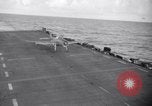
Navy Grumman F4F airplanes in landing incidents on the USS Makassar Strait (CVE-91) during training cruise.
A Navy Grumman F4F makes an inadvertent "touch and go" landing, at sea. It lands long, bounces, and successfully takes off again without further incident, on the USS Makassar Strait (CVE-91) during training cruise off Hawaii, in November, 1944. Two other aircraft make hard landings.
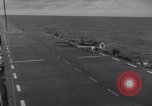
Navy Grumman F4F aircraft in landing incidents on USS Makassar Strait (CVE-91) during training cruise off Hawaii.
Aboard the USS Makassar Strait (CVE-91) during training cruise off Hawaii, in 1944. Views of several landing accidents. A Grumman F4F touches down and veers left , partially falling off the flight deck. Another noses over upon landing. Three make rough landings. Finally, one floats in above the deck, too high, then bounces, and successfully "goes around" (takes off again).
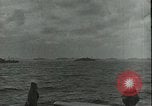
Soldiers of the 1st Infantry Division in England and during the invasion of Normandy and subsequent campaigns toward Germany (WW2)
Soldiers of the 1st Infantry Division training in England under General Clarence R Huebner, in preparation for the D-Day Normandy invasion in World War II. U.S. Navy ships underway at sea. Heavy naval guns bombard the coast of France on D-Day. U.S. Army soldiers seen during assault on Omaha beach with heavy losses on D-Day. U.S. soldiers and tanks encounter heavy German resistance in the "hedge rows." American soldiers digging trenches with shovels and picks and treating wounded comrade. Dead German soldier lying in street as Americans enter the town of Caumont (Caumont l'Eventé). Frenchman civilian pours wine for American soldier after they liberated Caumont l'Eventé from the entrenched German forces. An American helps a French civilian woman to reach a safe place crossing rubble. Damaged French houses along the sides of street. During rest, a soldier gives another a haircut, and another writes a letter. U.S. Air Force B-17s fly overhead and bomb near St. Lo, France on July 25, 1944. Other U.S. Army artillery units, the 4th and 9th Divisions, and General Patton's tanks provided support so the 1st Infantry (First Infantry or Big Red One) could occupy the area. Army combat engineers dig up mines and use construction equipment to clear debris. Wrecked houses and rubble. U.S. soldiers keep advancing through towns and eat and rest as they can. Road sign reads: "Coutances." First Infantry goes through Mortain, Etampes, Meaux, Soissons and across the Belgian border. German prisoners of war walk with their hands raised. German soldier digging out of fox hole. Siegfried Line and dragons teeth. Strong German resistance encountered at Aachen. Tanks fire in the field. House to house fighting in Aachen. Surrender of Aachen. A German flag laying in the street is run over by a U.S. military vehicle. German resistance is heavy during battle scenes in Battle of Hürtgen Forest. German and American artillery are seen in Hurtgen Forest. U.S. wounded treated. The 1st Division is pulled out for rest at the rear, in Belgium.
CRITICALPAST.COM: About Us | Contact Us | FAQs - How to Order | License Agreement | My Account | My Lightboxes | Shopping Cart | Advanced Search | Featured Collections | Website Terms & Conditions | Privacy Policy ©2026 CriticalPast LLC.
License Agreement |
Terms & Conditions |
Privacy Policy
©2026 CriticalPast LLC.