


 Francais
 Deutsch
 Italiano
Refine Your Search
Walcheren Island Netherlands 1944 stock footage and images
- Showing 1405 to 1410 of 9701 results more
more Hide
Hide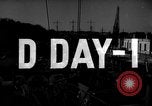
Montage of scenes from the day before the invasion of Normandy in World War II
D-day minus 1 (June 5, 1944) during World War 2. U.S. soldiers eat a meal while seated on the deck of a Large Landing Craft Infantry LCI(L) number 88, docked in Weymouth, England. (This ship would be the first LCI(L) to carry troops to the Easy Red landing zone during the second wave of landings at Omaha beach, on D-Day. Among troops landing there would be the 16th Regiment, 1st Infantry Division, with support from 7th Field Artillery Battalion;1st Engineer Combat Battalion; 1st Medical Battalion; 741st Tank Battalion (DD); 62d Armored Field Artillery Battalion; and 20th Engineer Combat Battalion.) A Captain and a field grade officer sit next to each other on the ship's deck. One soldier looks through his binoculars at an English woman standing outside her back door, looking back at him through her binoculars. Wash is drying on her line. The soldier tries to call out to her, but stops, realizing it is futile. Several of his buddies are amused by the whole event. Scene shifts to U.S. Army Air Forces B-26 bombers flying in formation, and then to aerial views from an aircraft, of bombs exploding on the ground in a city below. Next, a formation of B-17 bombers is seen, escorted by P-47 fighters. Scene shifts back to Weymouth harbor again, where American troops attend a Roman Catholic mass on the pier, adminstered by a military chaplain, wearing traditional clerical garb. LCL(L)s number 89 and 93 are seen tied up in the background. Coast Guardsmen gather around one of their ship's officers who briefs them on the operation.
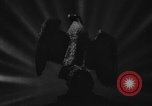
Funeral for German General Günther Korten, victim of plot to kill Hitler, during World War II
Military funeral at the Tannenberg Memorial, in World War 2, for German General Günther Korten, Chief of the General Staff of the Luftwaffe, who died from injuries suffered in the assassination attempt on Adolf Hitler in July 1944. the Tannenberg Memorial. German troops form an honor guard. The casket is flanked by 6 pallbearers, and covered in the German War ensign flag. Two of the pallbearers hold displays of Korten's numerous miiitary decorations. Large German crosses decorate the structures of the memorial, but no swastikas. Hermann Goering walks to pay condolences to Korten's widow and family members. The plaintive war song melody of, "Ich hatt' einen Kameraden," is heard throughout the film. Marshal Goering delivers a eulogy from a podium. The top military leadership is represented, including Field Marshal Wilhelm Keitel, Grand Admiral Karl Dönitz, and others. Closeup of the widow and gentleman relative. Goering, representing Adolf Hitler, salutes with his Marshal's baton and places a large wreath at the foot of the coffin. A sword, scabbard and helmet, are place atop the coffin. All present, stand and salute. Pallbearers carry the coffin at shoulder height following the wreath carried ahead. The coffin is placed in a crypt,
Hitler visits officers injured in the July 20th bomb plot and meets with Nazi officials, in World War II
Adolf Hitler visits German Army officers, who were injured, in the July 20th assassination attempt against him. They are being treated at a military hospital, in Rastenburg, during World War 2. Among the victims he visits are: Major General Walter Scherff; Navy Captain Heinz Assmann; Rear Admiral Karl-Jesco von Puttkamer; and General Walther Buhle. Hitler is seen with a small bandage in his right ear due to a ruptured ear drum from the explosion. He takes time and speaks with each of the wounded officers. As he leaves, women nurses, assembled outside, render Nazi salutes, and cheer him. Change of scene shows Hitler, at the Wolf's Lair compound, near Rastenburg, East Prussia (now Poland). He greets Walther Funk, Reich Minister for Economic Affairs; a local Gauleiter; Reich Minister Albert Speer; a Dr. Sauer; and Reich Minister Hans Heinrich Lammers, President of the Reich Cabinet. Next scene shows Heinrich Himmler, chief of the Nazi Gestapo, speaking with General (Generaloberst) Ferdinand Schörner. Hitler strolls with Hermann Goering, and is then seen, from behind, as he greets Reich Minister of Propaganda, Joseph Goebbels and General (Generaloberst) Heinz Wilhelm Guderian, Chief of Staff of the Army. Beside him is Hermann Fegelein. The Nazi top leaders stand and converse. Goebbels speaks with Martin Bormann and General Alfred Jodl, whose head is bandaged. (He was injured during the July 20, 1944 assassination plot against Hitler.)
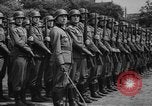
German Major Remer, who foiled plotters after July 20th attempt to kill Hitler, reviews his Battalion, during World War II
German Army Major, Otto-Ernst Remer, who foiled the plotters, followng the July 20, 1944 attempt on Adolf Hitler's life in World War 2, reviews the Battalion under his command in Berlin. The troops are drawn up in formation. Two light field artillery pieces are parked in the foreground. Remer marches past his troops, holding a Nazi salute. He then stands at a microphone in front of a German War Ensign and gives the troops a stern message about their duty.
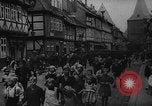
Patriotic ceremony and parade for Home Guards in Braunschweig, Germany, during World War II
Older men and youth, formed by the Nazis into a Home Guard (Volkssturm),late in World War 2, parade with regular army and SS units in Braunsweig, Germany. Young school children walk along a cobblestone steet and sidewalk in the historic district of the city, ahead of the marchers. Medieval style structures line the street. (This is shortly before the devastating bombing of the city, by the RAF, in October, 1944.) Nazi Gauleiter (who is also SS Gruppenführer) Hartmann Lauterbacher, reviews the marchers. Citizens line the sidewalks and render the Nazi salute. Some of the home guard march shouldering axes. Guards flank a banner with swastika in the center and the words: "Germany Awake." The banner pole is topped by a swastika, in a metal wreath and a plaque bearing the word,"Harz." Camera pans upward to Gauleiter Lauterbacher speaking to the assemblage from behind a wall overlooking the scene. Closeup of old men with white armbands reading:"Country Awake." Views of helmeted soldiers.
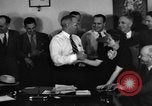
Senator Harry Truman being congratulated upon his nomination as candidate for Vice-President
U.S. Senator Harry S. Truman is standing by a table, surrounded by members of his staff and friends, who congratulate him on his selection as Vice Presidential candidate, by the Democratic National Convention in 1944. Among those seen are Mildred Lee Dryden,his personal Secretary, and U.S. Postmaster General Frank C. Walker. After shaking hands with all present, he sits down at the table, refers to some papers, and makes some remarks. Scene shifts to Truman seated at the table along with Postmaster Walker. Staff and friends are standing around them. They shake hands and Truman rises to start shaking hands all around. This is immediately repeated in another take, in which Postmaster Walker is laughing. After repeating the handshakes, Truman and Walker sit down again at the table.
CRITICALPAST.COM: About Us | Contact Us | FAQs - How to Order | License Agreement | My Account | My Lightboxes | Shopping Cart | Advanced Search | Featured Collections | Website Terms & Conditions | Privacy Policy ©2026 CriticalPast LLC.
License Agreement |
Terms & Conditions |
Privacy Policy
©2026 CriticalPast LLC.