


 Francais
 Deutsch
 Italiano
Refine Your Search
Walcheren Island Netherlands 1944 stock footage and images
- Showing 1465 to 1470 of 9701 results more
more Hide
Hide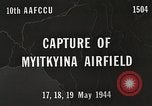
U.S. Waco CG-4 gliders unload airborne engineers to secure Myitkyina airfield after its capture during World War II.
Capture of Myitkyina airfield by Allied Forces during Burma Campaign of World War II. Animated map highlights Myitkyina airfield in North Burma which is captured by Allied ground forces on 17th of May, 1944. USAAF (United States Army Air Forces) Waco CG-4 gliders parked at Shingbwiyang airfield. USAAF officer inspects a map. Airbase engineering equipment are loaded aboard gliders. Tow rope of glider is hooked up with USAAF C-47 Skytrain transport plane. Airborne engineers board the glider. C-47 tows CG-4. CG-4 makes a landing at Myitkyina airfield under Japanese machine gun fire. Another glider makes a crash landing. Airborne engineers exit the gliders on field. A pilot and an engineer of crashed glider are given plasma and first aid. Wounded men are evacuated. Bulldozers level the airfield. Chinese soldiers search for hidden Japanese snipers in area.
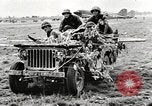
A wounded Japanese prisoner is questioned by U.S. intelligence officer at Myitkyina airfield during World War II.
Securing the capture of Myitkyina airfield on May 19th ,1944 by Allied Forces during Burma Campaign of World War II. U.S. soldiers bring a wounded Japanese prisoner in jeep at Myitkyina airfield. Wounded soldiers on bamboo stretcher is lowered from jeep. Wounded Japanese prisoner is questioned by an intelligence officer using a map. Dead body of a Japanese sniper lying on ground near strip. U.S. soldiers sleep under shelter halves protected by blankets at airfield. Wounded Allied soldiers treated at mobile clinic. Dr. Gordon Seagrave operates a patient. U.S. Army Air Forces fighters overhead. Burmese nurses giving medical treatment and blood transfusion to patients.
U.S. Army airborne infantry training before and after World War II
U.S. Airborne forces in World War 2. U.S. Army Air Forces C-47 aircraft, painted in invasion stripes, take off as darkness falls, on June 5, 1944 (night before D-Day) and assemble in large formation headed toward France. Airborne troops seated inside cabin of a C-47. Some smoke cigarettes. One has "Rocky" stenciled on his helmet. One smokes a cigar. An officer stands in doorway of plane and then jumps, followed by his "stick" of troopers. View from ground of parachutes filling the sky overhead. Momentary view of troopers on the ground in Normandy. German troops, taken prisoners of war, marching in a town under guard, with their hands on their heads. Scene changes to post war training of U.S. Army airborne troops. They are seen practicing how to hit the ground. They practice use of static lines in wooden mockups of aircraft; and jump from towers, and engage in actual airborne exercises, at Fort Benning, Georgia. View of war materiel being airdropped from rear of an aircraft. Special parachutes being used to drop jeeps and artillery pieces.
A Japanese Mitsubishi A6M3 Type 32 Zero fighter plane being tested at Wright Field, Ohio, during World War II
Army Air Forces records describe this as flight tests conducted at Wright Field on a Japanese Mitsubishi Type 0 MK2-SSF Hamp fighter plane, Army Air Forces (AAF) No. EB-201. (Recognized later, as a variant of the Zero, these Mitsubishi A6M3 Type 32 planes were renamed "Zeke 32.") Flight tests were made from January 9th to March 10th, 1944, to compare this aircraft with AAF fighters and to verify tests made in Australia by the Special Duties and Performance Flight of T.S.-7, Directorate of Technical Services, Melbourne. Test pilot in the cockpit with engine running. Closeup of pilot (possibly Captain Ralph C. Hoewing, who became first Commandant of the AAF Test Pilot School). He takes off from the airfield. and is seen in flight. Various aerial views of the Zero are seen including: flying overhead and from above as it flies over Ohio farmland. The pilot enters a shallow climb; and is seen from above and behind. He performs a slow descending roll. Finally, he buzzes the airfield at low altitude and high speed, and then brings the aircraft in for a smooth landing. (Note: This aircraft was rebuilt by the Allied Technical Air Intelligence Unit in Hangar 7 at Eagle Farm Airfield, Brisbane, Australia, from the wrecks of five Mitsubishi A6M3 Type 32 Zeke's captured at Buna, New Guinea, during the war.) [ Ref. WWW. hangar7.org.au ]
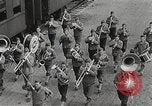
US Army soldiers and heavy equipment transported by railroad trains in the United States, bound for war front in World War 2
Activities of the United States Army in the United States during World War II. A U.S. Army band from the 407th Engineer Battalion playing musical instruments and marching. U.S. Army soldiers board railroad trains at a railroad station for transportation toward the war front. A railway steam locomotive pulling train cars. M4 Sherman tanks are seen on them as well as M2A4 (Mae West) tanks sitting partially turned with their guns out of sight away from the direction of travel.Browning M1919 .30 caliber machine guns are seen in their extra turrets. Army trucks and other military vehicles are also aboard the supply trains. The supply train moves through American countryside. Two women seated under hair dryers converse about the war in a beauty shop or beauty parlor. U.S. troops on troop transport railroad trains at night. Interior of a train car. American soldiers read books, sleep, and some play dice. An African American porter watches the game. A chaplain speaks to the soldiers. Civilians buy newspapers at a news stand. Headline on newspaper reads "London Expects Invasion of Europe at Any Hour" (before the upcoming Normandy Invasion of France in June 1944.)
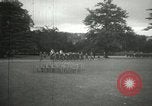
8th Air Force airmen assemble at Wycombe Abbey for a War Bond rally and Glenn Miller concert , during World War II.
Victory Squadron War Bond Rally at 8th Air Force Headquarters (Codenamed PINETREE) at Wycombe Abbey, High Wycombe, England, on July 29th 1944, during World War 2. U.S. Army military band plays the National Emblem March, as they march across a parade field lawn. They stop behind a parked flat bed tractor trailer on which Major Glenn Miller and his Army Air Forces band is seated. While the military band plays, U.S. 8th Air Force airmen march onto the field and take up positions in a large formation at its center. Spectators are gathered around the lawn, outside the airmens' formation, and military policemen are posted inside the circle of spectators.
CRITICALPAST.COM: About Us | Contact Us | FAQs - How to Order | License Agreement | My Account | My Lightboxes | Shopping Cart | Advanced Search | Featured Collections | Website Terms & Conditions | Privacy Policy ©2026 CriticalPast LLC.
License Agreement |
Terms & Conditions |
Privacy Policy
©2026 CriticalPast LLC.