


 Francais
 Deutsch
 Italiano
Refine Your Search
Walcheren Island Netherlands 1944 stock footage and images
- Showing 211 to 216 of 9704 results more
more Hide
Hide
The Battle of Netherlands and the invasion of Belgium by the Germans during World War II.
The first phase of German assault on France and the Low Countries during World War II. An animated map depicts the German campaign to capture Liege (Luttich) and Fort Eben-Emael in Belgium. German troops invade Holland. Soldiers in trucks. Germans cross the Meuse (Maas) in boats. A collapsed bridge over the river. Armed German soldiers on bicycles cycle through a village. Soldiers drag a boat on the road. The Germans capture Fort Eben-Emael using flamethrowers. Soldiers fire guns during street fights. A soldier wades through shallow water while others cross a field amidst explosions. Bomb explosions and bomb damaged buildings. Soldiers take cover in a field. German troops cross the Albert Canal in Belgium. Troops in boats make their way across. They advance with tanks. Soldiers dig fox holes and eat. Soldiers man tanks and fire artillery. German aircraft bomb Allied positions. Massive explosion at Werk 4 fortification bunker of Fort Eben-Emael. Bomb damaged buildings and ruins. Black smoke arises due to explosions. German soldiers march Belgian and Dutch prisoners of war on a street.
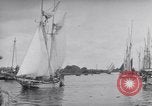
Scenes in Sunda Kelapa Harbor, Indonesia. Perahu Mayang cargo boats under sail. Netherlands Line ship
Wooden Perahu Mayang cargo boats of various indigenous designs operating under sail close to wharf in Sunda Kelapa harbor, Jakarta, Indonesia. Indonesian men on small boats. Masts on Perahu Mayang boat. Crane unloads goods from ship at dock. Passengers undergoing customs inspections at the port. Indonesian Customs officers inspect baggage.
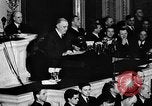
U.S. President Franklin D Roosevelt addresses the Congress in Washington D.C as he condemns Nazi invasion on Netherlands.
U.S. President Franklin D. Roosevelt addresses the Congress in Washington D.C. President Roosevelt strongly condemns the Nazi invasion of Holland and Belgium. He tells the 8th American Scientific Congress that the Americans are shocked by Hitler's attack. He talks about the Germans surrendering. Members of the Congress clap during President's speech. President Roosevelt promises aid to Belgium and Holland. (World War II period).
The first American military cemetery at Colleville-sur-Mer, France, established on June 8, 1944, in World War II
View from a 4-engine airplane in flight over altocumulus clouds. Setting sun creates pink colors. Scene changes abruptly to views, inland from Omaha Beach, at Colleville-sur-Mer, France, of the temporary military battlefield cemetery established by the U.S. First Army, on June 8, 1944, right after the Allied invasion of Normandy, in World War 2. Simple wooden crosses mark the graves of the fallen Americans, each identified by one of their dog tags fastened to the marker.
German occupation of Paris in June 1940 and the city's liberation by Allies in 1944. Also Includes some D-Day scenes.
The occupation and liberation of Paris during World War II. Germany occupies Paris in June 1940. A Nazi flag on the Eiffel Tower. Adolf Hitler with Nazi officers. Germans unfurl the Nazi flag on the Alsace-Lorraine Memorial. Hitler and his officers driven through the Place de la Concorde and past the Arc de Triomphe. Parisians close their shops. A man removes a Vichy poster and scribbles on a wall. Parisians listen to U.S. General Dwight Eisenhower's broadcast from London on June 6, 1944: The Allied task forces advance towards France on D-Day. Naval guns shell Normandy. Allied troops land on the beachhead and advance inland. Some fall to German gunfire. Headquarters of the Paris Underground. Members of the French Forces of the Interior (FFI) discuss, plan, document, prepare grenades, check guns, and wear badges of freedom with the FFI symbol. The French underground barricade streets. Men, women and children build barricades using various material. They inspect their guns and take their positions behind sand bag barricades on sidewalks. FFI soldiers honored. Burning vehicles on the roads. Street fighting between the FFI and the Germans. Corpses on the street. FFI men holding flags. Medics carry a wounded on stretcher. German tanks roam the streets. Wrecked vehicles and war equipment. FFI soldiers fire at German tanks. German snipers fire while French forces equipped by the U.S. are liberating the city. Explosions on the street. Civilians take cover. FFI fighters inspect a German soldier's corpse. They take German prisoners. French troops and military vehicles close in on Paris. Civilians watch and cheer as they enter the city. Barriers built by the FFI are pulled aside to let the troops pass. French forces in American tanks pass the Eiffel Tower. Explosions and machine gun fire during the street fighting. French soldiers fire at Germans hiding in buildings. Several German prisoners. German officers and soldiers surrender. Parisians watch as they are herded to prisons. Prisoners clean street.
Destruction in Saarlautern (Saarlouis) Germany, the day after Christmas, 1944, during World War II
Slate indicates the area shown is occupied by the U.S. 3rd Army, 95th Infantry Division. Bombed out buildings are seen with rubble piled at side of road, in Saarlautern (Saarlouis) Germany, the day after Christmas, 1944, during World War 2. View of apartment buildings and shops across from a park. Another street of shops. No people or vehicles are seen. An American soldier carrying a large camera, walks past an antique French 155mm gun, circa 1877, on display in a public Square. A view of the seemingly undamaged Catholic Church of St. Ludwig (Katholische Kirche St. Ludwig) on Kavalleriestrasse. A jeep drives past it. A U.S. soldier rides a bicycle past destroyed buildings
CRITICALPAST.COM: About Us | Contact Us | FAQs - How to Order | License Agreement | My Account | My Lightboxes | Shopping Cart | Advanced Search | Featured Collections | Website Terms & Conditions | Privacy Policy ©2026 CriticalPast LLC.
License Agreement |
Terms & Conditions |
Privacy Policy
©2026 CriticalPast LLC.