


 Francais
 Deutsch
 Italiano
Refine Your Search
Walcheren Island Netherlands 1944 stock footage and images
- Showing 2275 to 2280 of 9701 results more
more Hide
Hide
U.S. Army General Wade Haislip presents Congressional Medal of Honor to Technical Sergeant Charles Coolidge in Darmstadt.
Decoration of a technical sergeant of U.S. Army in Darmstadt, Olm Area soon after end of World War II in Europe. Soldiers lined up. An aircraft taxiing on a field. Commanding-General of 7th U.S. Army General Wade Haislip presents Congressional Medal of Honor to T/Sgt (Technical Sergeant) Charles H. Coolidge of Signal Mountain, Tennessee for outstanding duty with 141st Infantry, 36th Division the "Lost Battalion" in October 1944. Troops and Honor Guard parade along field.
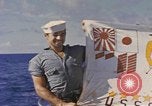
Crew members of Submarine, USS Crevalle, display a commemorative flag in World War II
The USS Crevalle (SS-291) on war patrols in East China Sea and Sea of Japan in final days of World War II. Crew members hold a flag they made depicting their engagements with Japanese shipping. It shows Japanese Navy Rising Sun flag with marks below for five Japanese Navy ships. It also shows the Japanese Red Ball flag and fourteen marks for other Japanese ships. As the film continues, it reveals more of the flag, showing more encounters with enemy shipping. A Landing Craft Infantry (LCI) passing by. Sailors standing on deck in bright sunlight with breeze blowing. One of the sailors is drinking from a mug. Sailor Robert Schwarz has grown a notable full beard and smokes a pipe. Toward the end of the film, the boat's Captain, Navy Captain Everett Hartwell Steinmetz, is seen from the back and in profile, standing on deck. Another aircraft passes overhead. (Note: Sailors holding flag in opening frames has been identified as James A. Katchis who served on the boat beginning as a Seaman 1st Class in August 1944 and Robert Schwarz of St. Louis, MO)
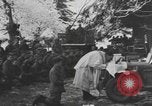
Supplies being dropped from airplanes and gliders landing on a snow covered area in Bastogne, Belgium.
A film depicts the Battle of the Bulge in the area of Bastogne, Belgium by U.S. troops during World War II. Belgian civilians are evacuated from an area. Civilians and soldiers in an area. Guns on a field. U.S. aircraft flying in formation to deliver supplies, ammunition, and food to U.S. Army forces including 101st Airborne Infantry soldiers fighting in the battle of the Bulge. Soldiers watching the airplanes through binoculars. Point of view shot from inside a glider hooked via a tow rope to an aircraft in flight, preparing to cut loose for glide to the ground. Aerial view of the target area. The airplanes in flight overhead. Supplies are being dropped via parachutes. View inside supply aircraft as troops push supplies out of doors. Gliders loaded with supplies and equipment landing in a snow covered area in time for Christmas 1944. Combat in the snow with a night artillery barrage by American soldiers firing at the Germans. U.S. soldiers using flame throwers at night directed at Germans. Dead bodies of German soldiers lying on the snow covered battlefield the next day. German prisoners of war standing under the guard of the U.S. soldiers, some of German prisoners found wearing civilian clothing or wearing pieces of U.S. uniforms. The 101st Airborne Infantry soldiers march in a victory celebration in town. A board reads: "Bastogne Bastion of the Battered Bastards of the 101st."
USAF Lieutenant General Ira Eaker speaks about his experiences in the U.S. Air Force in the United States.
An interview of United States Air Force Lieutenant General Ira Eaker conducted by Dr. Maurer in the United States. Dr Maurer and General Eaker seated at a desk. Dr Maurer talks about the work and the contribution of General Eaker in the U.S. Air Force. He says that General Eaker was the Commander of the 8th Air Force. In 1944, he became the Commander in Chief of the Mediterranean Allied Air Force. Then from 1945 until his retirement in 1947, he was the deputy commander of the Army Air Forces and chief of the Air Staff. General Eaker talks about his experiences. He talks about the first airplane flight he saw. He further speaks that he was sent to a training camp in 1917. A man came in the camp looking for some fliers. He was already selected for an examination of regular army. He says that in November 1917, he was on a parade grounds. An airplane was in flight overhead. The aircraft landed and he looked at the engine of the aircraft.

German spectators attend ice show in bomb damaged Berlin Sportpalast (WW2)
Nazi German administration organized an ice show for the war weary populace in the Berlin Sports Palace or Sportpalast (Ehemaliger Standort Sportpalast Berlin, Potsdamer Str. 172B, 10783 Berlin, Germany) in World War II. A woman ice skater is seen figure skating on the large ice rink of the Berliner Sportpalast. The stadium is roofless from bomb Allied bombing since January 1944. The narrator calls it "burned out." The steel skeleton of the roof supports is visible. The stadium seating is filled with spectators dressed in warm clothing. Some also use blankets. The audience includes many German soldiers in uniform, on whom the camera focuses during the film. German figure skater Lydia Veicht performs some spins to complete her performance, as the audience applauds enthusiastically. The audience clapping their hands. A man and woman perform next, dancing together on the ice. Finally, a troupe of women skaters perform on ice.
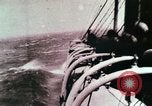
Europeans go through immigration processing at Ellis Island in the early 1900s
Mix of period footage circa 1910, retrospective interviews in 1975, and some still images. European immigration in bad travel conditions to America. View from rail on deck of a ship in heavy seas. An elderly European immigrant recalls his experiences of the journey on ship to America. Ship in Atlantic Ocean. Picture of European immigrants on ship deck. Statue of Liberty and Ellis Island. Early 1900s period footage of immigrants arriving at Ellis Island and disembarking from ship, then walking with luggage for processing at Ellis Island. Some immigrants peer across New York Harbor at the skyline of New York city. Scene change to 1975 and views of interiors of a no longer used building in Ellis Island. Names of persons carved on walls. A man shares his experience as an immigrant passing through Ellis Island, and then as an immigration inspector reviewing new immigrants as they arrived.
CRITICALPAST.COM: About Us | Contact Us | FAQs - How to Order | License Agreement | My Account | My Lightboxes | Shopping Cart | Advanced Search | Featured Collections | Website Terms & Conditions | Privacy Policy ©2026 CriticalPast LLC.
License Agreement |
Terms & Conditions |
Privacy Policy
©2026 CriticalPast LLC.