


 Francais
 Deutsch
 Italiano
Refine Your Search
Walcheren Island Netherlands 1944 stock footage and images
- Showing 2827 to 2832 of 9701 results more
more Hide
Hide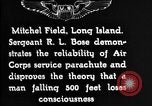
Sergeant R. L. Bose demonstrates reliability of Air Service parachutes at Mitchel Field on Long Island, New York.
Sergeant R. L. Bose demonstrates reliability of Air Service parachutes and disproves a theory that a man falling 500 feet or more loses consciousness. Civilians and military spectators watch the demonstration. Views from the airplane as Sergeant Bose free-falls from 3000 feet, delaying his chute opening until 1500 feet. Some of his free fall in slow motion. He makes a routine parachute landing. Spectators and an ambulance come as a precaution to his landing point.
Animated map of Tarawa and factors that played a key role in planning for the Battle of Tarawa during World War II.
A training film titled 'Tarawa operations' about Allied invasion of Tarawa during World War II. A map of the Pacific region depicts the location of the Gilbert Islands. A map of the Gilbert Islands including Tarawa. Animated map of Tarawa depicts the area of the atoll. A map of Betio island depicts its area. Animation depicts wind direction that helps in anchoring of landing crafts.
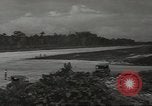
Damaged airplanes parts are brought to a service center and are repaired in the European Theater.
Role of Air Service Command in repairing and salvaging damaged airplanes and equipment in the European Theater during World War II. Air Service Command personnel, a jeep and damaged aircraft in an open field. The personnel inspect the damaged aircraft. They dig mud and make a ditch. A truck with a flat trailer pulls the aircraft out of the ditch. A DUKW drives down a water stream. It delivers tools and damaged section of the aircraft to an air service center. The service center personnel checks harnesses of parachutes in a parachute shop. Experts replace the damaged bearings of the propellers. A personnel hands over a generator to a sergeant. An ordnance personnel checks guns. The sergeant tests the points on the generator. Engine experts repair the gear of an engine. A welder welds heavy parts. A personnel gets off from a vehicle and enters into an air conditioned trailer shop. In this shop defective instruments of aircraft are put in a vacuum chamber. A repaired aircraft takes off. A ship burns and smoke rises. The damaged ship. A personnel types on a typing machine. Aircraft in the background. The Air Service Command personnel get into a boat. The boat underway along a ship. The personnel climb onto a ship. They see an island. They move towards the island as they get into a barge. They find damaged parts of aircraft on the island. They inspect fuselage, wings, guns and shells of the aircraft. Damaged aircraft and its parts are taken to the air service center.

U.S. Marines using flame throwers against Japanese, Chinese troops during Sino-Japanese War, aftermath mass suicide of Japanese
A film titled 'The San Jose Project' gives an introduction of chemical warfare tests carried out by U.S. Army on San Jose Island, Panama during World War II. Film opens with scenes of U.S. troops battling Japanese on Pacific islands during World War II. Tank mounted flamethrower being used to burn Japanese from caves. Backpack style handheld flamethrower being used by U.S. Marine at mouth of a cave. A Japanese soldier emerges from a cave and is shot by American soldiers. Scene changes to China, where Chinese troops march near fields during the Sino-Japanese War before World War II. A wounded soldier carried by Chinese troops. Scene changes again to Mariana Islands during World War 2. Piles of bodies of Japanese civilians and soldiers at base of a cliff from which they jumped to commit suicide rather than be captured or killed by American forces. A Japanese civilian jumping off of a cliff. Japanese civilians at waters edge jumping into water.
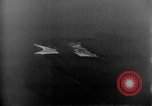
Thick smoke rises from burning oil storage tanks and a refinery on fire as B-17s drop bombs on Hamburg, Germany.
U.S. Army Air Force Boeing B-17 Flying Fortresses bomb Hamburg, Germany during World War II. View of Heligoland island and its coastline. The B-17s in flight. Aerial views of target island. On Hamburg: Thick smoke rises from burning oil storage tanks and a refinery on fire. Coastal installations on islands. Smoke and fire from a coastal oil depot.
Interview of Capt. William S. Parsons, U.S. Navy, crew member on Enola Gay, after the Hiroshima atomic bombing mission
Setting: North Field, Tinian Island in Mariana Islands, South Pacific, almost a week after the atomic bomb was dropped on Hiroshima Japan, August 8, 1945, during World War II. Public Relations Officer, Major John F. Moynahan (not seen) is interviewing members of the Crew of the B-29, Enola Gay, from which the bomb was dropped. Here he interviews Captain William Sterling "Deke" Parsons of the U.S. Navy who was weaponeer aboard the Enola Gay, during the mission. and who now serves as Scientific Head of the Atomic Bomb Project in the Pacific Theater. Captain Parsons describes the events of the mission from their early morning departure through the actual bombing. He notes that the actual bombing went smoother than earlier practice missions.
CRITICALPAST.COM: About Us | Contact Us | FAQs - How to Order | License Agreement | My Account | My Lightboxes | Shopping Cart | Advanced Search | Featured Collections | Website Terms & Conditions | Privacy Policy ©2026 CriticalPast LLC.
License Agreement |
Terms & Conditions |
Privacy Policy
©2026 CriticalPast LLC.