


 Francais
 Deutsch
 Italiano
Refine Your Search
Walcheren Island Netherlands 1944 stock footage and images
- Showing 2947 to 2952 of 9701 results more
more Hide
Hide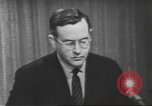
Vice President Nixon and Senator Kennedy debate over Quemoy and Matsu issue prior to presidential elections in the U.S.
The fourth presidential election debate held between Democratic nominee Senator John F. Kennedy and Republican nominee U.S. Vice President Richard Nixon in New York, United States on 21st October 1960. ABC News correspondent Quincy Howe speaks during the debate and allows NBC correspondent John Chancellor to pose a question to Richard Nixon a . Correspondent Chancellor asks a question about Quemoy and Matsu issue. Vice President Nixon points out inconsistency of Senator Kennedy. He further explains it by saying that Senator Kennedy signed a resolution in 1955 which gave the president the power to use United States forces to defend Formosa (Taiwan) and offshore islands. But he also voted for an amendment which was lost, an amendment which would have drawn a line and left out those islands. Vice President Nixon supports President Eisenhower's position. Correspondent Howe asks Senator Kennedy to comment on the topic. He speaks about President Eisenhower sending a mission to persuade Chiang Kai-shek in the spring of 1955 to withdraw from Quemoy and Matsu because they were exposed. The President was unsuccessful. He refers to the fact that in 1958, as a member of the Senate Foreign Relations Committee, he was very familiar with the position that the United States took in negotiating with Communist China (PRC) on these two islands. He further that the U.S. was unable to persuade China's Chiang Kai-Shek to withdraw and thus it was decided by the U.S. to defend the islands.
Allied aircraft lay mines in Pacific Theater during World War II.
'Aerial mine laying blockades Japanese shipping' depicts Allied preparations and Operations of the 21st Bomber Command, for aerial dropping of mines in the Pacific ocean to thwart Japanese shipping in World War 2. . Rows of stacked bombs are shown in a munitions dump at Tinian Air Base in the Mariana Islands. Camera focuses on a 2000 pound MK25 mine. Men demonstrate hydrostatic safety devices on the mine, including an extender that holds the detonator away from the booster charge until sufficiently immersed, and a clock delay mechanism. MK 25 transported to B-29 aircraft named Flak Alley Sally. (This is B-29 Number 42-24878 of the 40th Bomb Squadron, 6th Bomb Group, 313th Bomb Wing.) Airmen attach a parachute to the end of the mine. Another inserts the detonator and its extender plus the timer device into the side of the mine. Soluble washers are then placed in arming device ports. Scene shifts to Army and Navy planners working with maps, dividers, and a Weems plotter to mark the target location and mine laying pattern. 313th Bombardment Wing Group Commanders are seen being briefed in a war room. Next, engines are seen starting on a B-29, that then takes off and is seen in flight.(Narrator notes that missions are flown at night, but this one is photographed in the day to show how it is done. View of B-29 cruising above clouds. View from inside the aircraft, of bomb bay slowly opening. View of the target area below. The parachute of a mine opens by a static line as it falls from the bomb bay. Scene shifts to water level closeup of a mine striking the water. ('Presumably a demonstration inserted here.) Final scene shows a Navy Grumman TBF/TBM Avenger torpedo bomber dropping a parachute equipped mine. in the same location.
Views of U.S. Forces in the Pacific and European theaters of operation during World War II
U.S. Troops in the Solomon Islands during World War II, load munitions and supplies aboard landing craft to be carried to the troopship, USS Frederick Funston (APA-89), sitting offshore. The equipment and troops are bound for Bougainville, New Guinea, to reinforce marines there. Next, the troops themselves, in full battle gear, enter Higgins boats, to be ferried to the troopship. Closeup of troops boarding one of the landing craft. View from a landing craft heading to the Frederick Funston, seen ahead. View from the Higgins boat approaching the troopship, and then of troops climbing aboard via a rope net. Closeup of soldiers climbing the net. Change of scene shows U.S. Field Artillery unit changing position on New Georgia. They employ caterpillar tractors to move the guns. One is seen bogging down in the soft earth, so another tractor assists by pushing on the gun (possibly damaging its barrel). After arriving at the new position, they are ordered to move again, because of movements of the Japanese forces. This time, the troops pitch in and use sheer manpower to move a howitzer. Scene shifts again, to Italy, where U.S. troops attempt to ford a river on the road from, Benevento, to Caserta, after German forces destroyed all bridges along it. A truck is seen successfully crossing after combat engineers created a path for it. Trucks and jeeps move through muddy paths. The last image shows a jeep equipped with a tall bumper-mounted wire cutter.
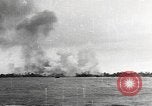
Allied troops land on a beach and administer first aid to wounded in Palau during World War II.
Allied invasion of Palau Islands during World War II. A coast under bombardment as smoke rises. Shells splash among landing crafts near a beach. Allied troops aboard a Landing Craft Vehicle wait for a signal. Medics administer blood plasma to a wounded on the beach. Wounded soldiers being carried on litters. A corpsman administers first aid and records information.
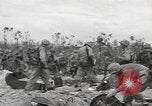
U.S. Marines rest on a beach in Palau during World War II.
Allied invasion of Palau Islands during World War II. Marines on a beach. A Marine strings a wire in the foreground at the beach. The Marines march towards the front. They rest on a beach. A 40 mm anti aircraft gun placed behind a sandbag mound. A Landing Vehicle Tracked in shallow waters after being knocked out in Japanese firing.
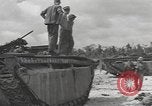
U.S. Marines load wounded onto an LVT for evacuation in Palau during World War II.
Allied invasion of Palau Islands during World War II. A Marine helps a wounded as they move past a tank. A wounded Marine on a litter being carried away. Litter wounded being loaded aboard a Landing Vehicle Tracked ( LVT ). The Marines load ammunition in the LVT for transfer to the front. A Marine arms a tank. A Marine digs in for the night.
CRITICALPAST.COM: About Us | Contact Us | FAQs - How to Order | License Agreement | My Account | My Lightboxes | Shopping Cart | Advanced Search | Featured Collections | Website Terms & Conditions | Privacy Policy ©2026 CriticalPast LLC.
License Agreement |
Terms & Conditions |
Privacy Policy
©2026 CriticalPast LLC.