


 Francais
 Deutsch
 Italiano
Refine Your Search
Walcheren Island Netherlands 1944 stock footage and images
- Showing 3067 to 3072 of 9701 results more
more Hide
Hide
Story of the U.S. Navy Seabees (Fighting construction men). History, recruitment, training, and deployment of the Seabees.
History and story of the Seabees. Admiral Moreell, chief of the U.S. Navy's Bureau of Yards and Docks speaks in his office in Washington, DC. A view of the U.S. Capitol building through his window. He gives a brief history of the Seabees and introduces the film. Retrospective footage shows a formation of Japanese warplanes. Views of Honolulu, Hawaii, Midway, Taviti, and Wake Islands. U.S. civilian construction workers. Hickam and Wheeler fields, in Hawaii, being bombed by Japanese airplanes during attack on December 7, 1941. U.S. Navy ships in Pearl Harbor burning. U.S. casualties on stretchers. American soldiers raising the flag with fire and smoke behind them. Seebee recruitment poster. Volunteers going to enlist. Navy Seabee trainees learning military and construction skills. Practicing methods of rapid construction for combat zones. Trainees negotiating obstacle courses. Amphibious assault training. Seabee units parading in dress whites, followed by Seabees in some of their combat vehicles: DUKWs, construction graders, and bulldozers. U.S. Navy sailors loading onto railroad train cars as a newly trained battalion of Seabees leaving training camp by train. A band plays seeing them off. Seabees loading up at a port of embarkation. A troop ship seen. The troop ship moving away from the wharf, with help from tugboat. (World War II period).
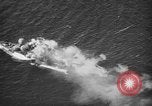
U.S. troops fire artillery guns, rockets and grenades to take out enemies hidden behind pillboxes in Garapan on Saipan.
The joint force assault by the American Army, Navy, Marines and Air Force against Japanese on Garapan, the capital city of Saipan in the Mariana Islands, during World War 2. U.S. artillery guns are fired at Japanese forces. U.S. troops carry their injured men under cover of a tank. Rockets are fired to take down enemy snipers. Incendiary grenades are fired to smoke the enemies out of their pillboxes. A Japanese soldier is taken as prisoner.
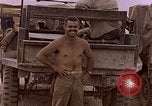
U.S. marines on Saipan after securing it during World War II
U.S. Marines on Saipan, Mariana Islands during World War 2. A shirtless U.S. marine poses in front of a truck. A wounded marine carried on a litter to a dock. Marines and vehicles seen at base of so-called "Suicide Cliff" on Saipan. Marines gathered on and around a U.S. M3 Gun Motor Carriage (75mm). Two marines carry a fallen comrade (completely covered on a litter). View of marines gathered on the beach, around several Japanese prisoners seated beneath some sort of Japanese structure supporting a scale.
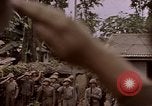
U.S. forces raise American flag over Saipan and senior U.S. officers converse afterwards, during World War II
Scene opens showing American troops assenbled in a clearing on Saipan for a formal flag raising ceremony, following the defeat of Japanese forces defending the island in World War 2. Camera pans over the assembled officers and troops. All salute as the flag is raised by military police. View of the American flag atop the flag pole. After the ceremony, Some of the senior American officers present stand about conversing. Admiral Raymond Spruance, Commander of the U.S. 5th Fleet, is seen wearing a pith helmet. Close to him is Lieutenant General Holland M. Smith, Commander, V Amphibious Corps. Also seen, in fatigues, is Major General Sanderford Jarman, Commanding General, U.S. Army 27th Infantry Division. The remainder of the film shows them and other senior officers mingling and conversing with one another.
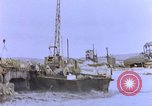
Glimpse of U.S. Navy Seabees at Saipan port, after the U.S. defeat of Japanese forces there in World War II
Glimpse of Amercan Navy Seabees, in a boat backing away from a dock at waterfront, in Saipan, after defeat of Japanese on the island during World War 2. A mobile derrick stands behind the boat. The area contains damaged and destroyed facilities.
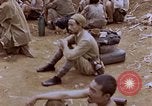
U.S. forces plan airbase construction after the battle of Saipan during World War II
America forces begin preparing Saipan as an advance base in the Pacific campaign against Japan in World War 2. Japanese military prisoners as well as civilian women and children are seated on the ground, shaded by a tree on a coastal plain in Saipan. American officers review a map laid out on the hood of a jeep. They converse in a group as they stand near a rudimentary small gauge railroad track in the sand. Sheer cliffs are close behind them and the ocean is nearby. A jeep is seen parked and another moves along a bumpy path. Officers and soldiers stand on and near the small gauge rail line. Several jeeps are parked. Camera pans over sheer cliffs behind. (Some contain openings that housed Japanese fortifications.) Camera pans over wide flat area where the Japanese were building an airfield near Marpi Point on the northern end of the island of Saipan. Construction materials cover the area and several jeeps travel through it. Final scene shows more Japanese civilians in a group where several American soldiers are attending to their needs.
CRITICALPAST.COM: About Us | Contact Us | FAQs - How to Order | License Agreement | My Account | My Lightboxes | Shopping Cart | Advanced Search | Featured Collections | Website Terms & Conditions | Privacy Policy ©2026 CriticalPast LLC.
License Agreement |
Terms & Conditions |
Privacy Policy
©2026 CriticalPast LLC.