


 Francais
 Deutsch
 Italiano
Refine Your Search
Walcheren Island Netherlands 1944 stock footage and images
- Showing 313 to 318 of 9701 results more
more Hide
Hide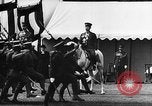
Actions of Axis and Allied powers on brink of World War II in period 1937-1939.
Japanese troops parade for Emperor Hirohito, mounted upon a white horse. Italian troops goosestep and German troops goosestep on parade. View of an Austrian town with snow-covered Alps mountains in background as German troops enter Austria on March 13, 1938 during the Anschluss. Local citizens welcome them, displaying swastika flags and giving Nazi straight arm salutes. Troops, military vehicles, tanks, motorcycles, and horse-drawn artillery comprise the German invading force. Shifts to Spain, where war torn buildings reflect effects of German and Italian intervention during the Spanish Civil War. A donkey standing near field artillery piece. Artillery being fired from an urban park in Spain. Artilleryman using a range finder. German gun crew with heavy artillery piece. Soldiers wearing Adrian steel helmets, firing a two-wheeled water-cooled machine gun. Spanish carrying wounded on stretcher. Spanish civilians inadvertently slain during civil war conflict. Starving dog walking in street. Huge poster of Francisco Franco and view of him on reviewing stand saluting marching Nationalist troops. Repeat of Hirohito reviewing troops and Italian and German troops goosestep. Adolf Hitler and Benito Mussolini stand together in open car heading to Fuhrerbau in Munich, Germany, for signing of Agreement between Germany, Italy, Britain, and France in 1938. Neville Chamberlain, and Edouard Daladier riding in car to Fuhrerbau. Views of the principals signing the accords. First is Adolf Hitler, followed by Prime Minister Neville Chamberlain, Benito Mussolini, and Edouard Daladier. After the signing, the principals, plus Hermann Goering, mingle and converse. Change of scene to nighttime in Rome, Italy, where Benito Mussolini addresses a huge throng gathered near the Victor Emmanuel Memorial to cheer him after his return from Munich. Next, German troops are seen entering Sudetenland (Czechoslovakia) greeted by joyous ethnic German inhabitants. Banners are stretched across a street. One gives thanks to the Fuhrer. Several scenes of cheering population. A woman strews flowers in a roadway. Hitler arrives, standing in an open car, and is met with cheers of adulation. A military brass band plays from the open beds of two moving army trucks. Signpost points to Prag (Prague), Eger (Cheb), Joachimstal (Jáchymov), and Komotau (Chomutov) after German annexation. Scene shifts to Prague, where German troops are seen occupying the city. High ranking German officers in a car are seen coming through the gateway from the Court d´honneur of the Prague Castle into the Hradčany Square. The next sequence shows an Italian Freccia-Class destroyer in the Albanian Port of Durrës. An Italian L3/35 Tankette is driven off a large cargo ship. Italian troops on bicycles ride in a city street. A German 88mm antiaircraft (flak) gun is shown, mounted at a fort overlooking a river and city. Final scene shows Adolf Hitler addressing a meeting of the Bundestag in the Kroll Opera House (alternate meeting place after burning of the Reichstag). He reads, contemptuously from an April 14, 1939 letter sent to him by U.S. President Roosevelt, asking him to give "assurance that your armed forces will not attack or invade the territory or possessions of the following independent nations: Finland, Estonia, Latvia, Lithuania, Sweden, Norway, Denmark, The Netherlands, Belgium, Great Britain and Ireland, France, Portugal, Spain, Switzerland, Liechtenstein, Luxembourg, Poland, Hungary, Rumania, Yugoslavia, Russia, Bulgaria, Greece, Turkey, Iraq, the Arabias, Syria, Palestine, Egypt and Iran." As Hitler reads through the litany of nations, the Bundestag erupts in laughter.
U.S. President Franklin D. Roosevelt addresses the Congress in Washington D.C. on U.S. strategy in war crises.
U.S. President Roosevelt discusses U.S. stance as World War II expands in Europe. U.S. President Franklin D. Roosevelt addresses the Pan American Congress in Washington D.C. He decries the invasion of 3 more independent nations by force of arms: Belgium, Netherlands, Luxembourg. President Roosevelt states that America is shocked by the German attack. State Department and cabinet officials arriving at the White House to discuss U.S. strategy in war crises. Officials converse with each other outside the White House.
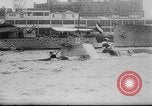
German ships underway and a Dutch dive bomber drops torpedoes on ships
German ships underway at a sea in the European Theater. Dutch dive bombers drop torpedoes. Splashes in water. German ships in the background. A flag of Netherlands in the foreground. A submarine and ships underway. Large buildings in the background.
Dutch Princess Juliana with her children at their Canadian refuge (WW2)
The Dutch royal family in Montebello during their exile in Canada (World War 2). Dutch Princess Juliana with her children in Château Montebello (392 Rue Notre Dame, Montebello, QC J0V 1L0, Canada). The Dutch royal family fled the Netherlands after Nazi German invasion. Princess Juliana and her children later left England for Ottawa, Canada. Children, Princess Beatrix and an unidentified girl playing near a waterway. Princess Irene inside a playpen. Princess Juliana pushes her two children sitting together on a swing. Princess Beatrix falls off-balance from the swing while Juliana is holding the infant Princess Irene.
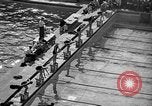
Womens 100 meter freestyle swimming event at Berlin Olympics, Germany in 1936
100 meter freestyle womens swimming event during the 1936 Olympic games in Berlin, Germany. Swimmers dive into the pool as crowd cheers them loudly. Audio commentary in Italian describing the race. Gold medal won by Rie Mastenbroek of the Netherlands. Silver won by Jeannette Campbell of Argentina, Bronze won by Gisela Jacob-Arendt of Germany.
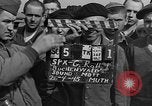
A Jewish internee of Buchenwald concentration camp interviewed in Germany.
Internees at a concentration camp in Buchenwald, Germany. Serge Kaplan, a Jewish internee from Netherlands speaks about the difficult conditions at various concentration camps which made life difficult for the internees and also led to death of many people. He expresses his joy on being set free by the American Army.
CRITICALPAST.COM: About Us | Contact Us | FAQs - How to Order | License Agreement | My Account | My Lightboxes | Shopping Cart | Advanced Search | Featured Collections | Website Terms & Conditions | Privacy Policy ©2026 CriticalPast LLC.
License Agreement |
Terms & Conditions |
Privacy Policy
©2026 CriticalPast LLC.