


 Francais
 Deutsch
 Italiano
Refine Your Search
Walcheren Island Netherlands 1944 stock footage and images
- Showing 3427 to 3432 of 9701 results more
more Hide
Hide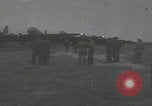
Preparation and night take off followed by D-Day bombings (WW2)
United States Army 8th Air Force bombers lined at an airstrip in England the night before D-Day in World War II. U.S. General Brereton gives a signal for take-off. The bombers take off one by one in the night. Soldiers wave to bid them good luck. 8th Air Force Martin B-26 Marauder bombers in flight. A formation of bombers flying towards France. Gun turret inside a bomber. Allied invasion fleet sails closer to the coast of France at dawn. 8th Air Force fighters fly over the Channel Islands and the French shoreline. Allied bombers bombing the coast of Normandy prior to the ground forces landing there. Bombers release bombs over enemy shore batteries. Bombs hitting German controlled targets and smoke rising from bomb sites.
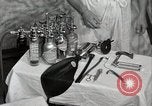
1st U.S.Marine Corps Medical Battalion surgeon attends to wounded U.S. Marine in tent, Bougainville, Papua New Guinea.
Physician of the 1st United States Marine Corps Medical Battalion performs surgery on a wounded U.S. Marine in a tent at Bougainville, Papua New Guinea, within the Solomon Islands archipelago. Surgeon prepares instruments for operation. Patient is given anesthesia via inhalation. His back shows large cut swabbed with antiseptic. The patient is given intravenous injection. Surgeon performs a thoracotomy incision on patient's chest to remove shrapnel from his thoracic cavity. The lung is visible in the wound as a retractor is placed to expose the inside of the chest. The surgeon removes the shrapnel and places it on piece of cloth. Surgeon reapproximates the ribs using wire suture. Chest tube is inserted. Doctors dress the wound with gauze. Attending medical staff wipe face of patient and doctor with clean cloths. X-Ray of the patient shows pieces of shrapnel in his chest.
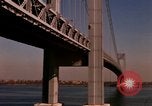
Vessels pass under the Verrazzano Narrows Bridge in New York. Views of the Verrazzano Narrows Bridge from Fort Wadsworth
Boats and ships in the "The Narrows" (tidal strait for Hudson River between Upper and Lower New York Bay) in New York. They pass under The Verrazzano Narrows Bridge. Ground Level views of the Verrazzano Narrows Bridge from Fort Wadsworth on Staten Island.

Charles Lindbergh takes off from Roosevelt Field for his famous solo flight from New York to Paris.
People gathered early on a misty morning at Roosevelt Field, Long Island, New York, to watch as Charles Lindbergh attempts to make a solo flight across the Atlantic Ocean in his airplane, The Spirit of St. Louis. The plane starts its takeoff role between groups of spectators, raising dust. The spectators move to get a better view as the plane continues, out of sight in the fog and mist. It is not clear where the plane is, although engine sound has changed. Spectators strain to see it through the mist. Then, some cheers are raised when the crowd realizes that Lindbergh has successfully taken off in his heavily laden airplane. The opening caption refers to Curtiss Field, where the Spirit of St. Louis was test flown and reportedly maintained in Hanger 16. there, from May 12th through the 20th. However, for the Paris flight, the plane was towed a mile to Roosevelt Field where, heavily loaded with fuel, it could take advantage of the longer runway for takeoff. (Note: Both fields were originally part of the old Hempstead Plains Field renamed Hazlehurst Field when taken over by the U.S. Army in 1917. U.S. Geological survey maps of 1918 show three areas named, respectively, Hazelhurst Aviation Field No. 1; Aviation Field No. 2; and Camp Albert L. Mills, abutting it. Field No. 2 was renamed Mitchel Field on July 16, 1918. The eastern part of Field No. 1 was dedicated as Roosevelt Field, on September 24, 1918. After the war, the western part of Field No. 1 became known as Curtiss Field, associated, as it was, with the Curtiss Aeroplane & Motor Company located there.)
Women, children and hostesses walk on a canopied gangplank on ship USNS Barrett (T-AP-196) in New York.
Sailors and people on United States Navy Ship Barrett (T-AP-196) in Staten Island, New York. Empty bunks in a troop compartment. Dependent women and children walk. Hostesses walk on a canopied gangplank. Some children are assisted by sailors. .
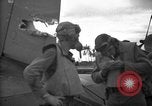
U.S. Marine Lieutenant Marshall, with his severely battle-damaged F4U Corsair at Torokina Air Strip in World War II
Flight operations at Torokina Air Strip on Bougainville Island during World War 2. U.S. Marine First Lieutenant Marshall, and another airman stand and smoke by the tail of the bullet-riddled F4U Corsair aircraft that he just landed on Torokina airfield. The aircraft, Corsair number 25 (BuNo 17736) is from Lieutenant Marshall's unit, VMF-216. They examine the damage on the aircraft. Lt. Marshall, who suffered head injury from cockpit shrapnel is being given first aid in an army tent. Views of damage to the aircraft, including tattered wing, flaps shot up, holes in the fuselage, and huge pieces shot out of the rudder. ( This mission took place on 19 Dec 1943. After flying cover for B-24 bombers over Rabaul, Three U.S. Marine Corps F4Us flown by Capt. Lawrence 'Cloudy" Faulkner, and First Lieutenants Marshal and Guv Kemper, were surprised and engaged by 20-30 Japanese Zekes (Zeros) diving from behind clouds . Lieutenant Marshal was the sole survivor of the encounter.)
CRITICALPAST.COM: About Us | Contact Us | FAQs - How to Order | License Agreement | My Account | My Lightboxes | Shopping Cart | Advanced Search | Featured Collections | Website Terms & Conditions | Privacy Policy ©2026 CriticalPast LLC.
License Agreement |
Terms & Conditions |
Privacy Policy
©2026 CriticalPast LLC.