


 Francais
 Deutsch
 Italiano
Refine Your Search
Walcheren Island Netherlands 1944 stock footage and images
- Showing 343 to 348 of 9701 results more
more Hide
Hide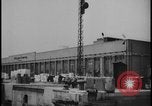
Film showing Ford Motor Company factories and Ford cars operating in various countries of the world
Film begins showing a waterfront Ford Motor Company factory viewed from a boat (unseen) moving past it A large freighter ship is seen nearby, with the name "Runstroom" on her bow. Closeup of waterfront crane and nearby flag labeled "Ford." Scene shifts to factory with sign on top in Dutch reading: "Nederlandsche Ford Automobiel fabriek" (Netherlands Ford automobile factory). Location shifts to cars driving on the Champs-Élysées in Paris, near the Arc de Triomphe de l'Étoile. One appears to be a 1932 Ford Roadster. heading toward the camera. Scene shifts to a large barge on a river, viewed from an overlooking domed structure. The next scene shows a European farmyard and horses with sheep circling around a Ford roadster. The remainder of the film shows Ford plants in the U.S. and abroad.
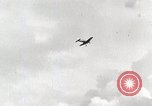
United States 1st Marine Division troops bomb Peleliu Island, Palau.
U.S. 1st Marine Division operations on Peleliu, during World War 2. U.S. F4U Corsair aircraft, flying low and slow, with gear down, drop napalm incendiary bombs on Japanese troops dug in on a ridge. Huge explosions seen. A C-47 transport airplane taxis on airfield. F4U Corsairs are seen parked and tents are pitched nearby.Several C-47s are parked on a ramp. Three F4Us taxi past them headed to the runway. F4Us take off and one is seen bombing Japanese positions on the ridge. Slate notes 1st Marine Division and D+24. Major General William Henry Rupertus,kneels on one knee, in sand, as another officer (shirtless) briefs him. They briefly discuss tactics and then walk away. Marine rifleman firing into burning wreckage of a Japanese position. Marine firing grenade from his rifle. Two Marines stand on beach with LVT (landing vehicle tracked) on the sand, nearby. They point at large ship offshore. Views of the Peleliu beachhead, with numerous ships and landing craft beached, including the second USS Seaward (LST 278) that collided with LST-129 and suffered considerable damage, On October 2, 1944. (LST-129 may be the LST seen next to LST-278.)
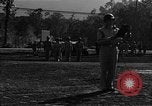
Major General O. W. Griswold decorates soldiers of the 182nd Infantry Regiment in ceremony, Bougainville, Solomon Islands
The men of the 182nd Infantry Regiment stand at "Present Arms" in a formal ceremony held on Bougainville in 1944. U.S. Major General O.W. Griswold speaks into a microphone in a field and troops line up in the background. The Major General decorates solders as he pins medals onto their uniforms, in recognition of their defense of Hill 260, redubbed 'Bunker Hill' in honor of the 182nd Army Division, whose history can be traced back to the Battle of Bunker Hill. Major General speaks into the microphone. Troops march in parade. Allied band and troops with color guard pass in review. Soldiers unveil a poster that reads ' Bunker Hill Road' depicting an eagle flying in front of the Japanese 'rising sun' flag. A band plays at the ceremony. Those awarded for defending Hill 260 include, amongst many others, Sgt Edward Monahan, Sgt William Joyce, Sgt Daniel Ramsey, and Private First Class John P. Correggio. (World War II period).
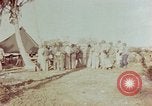
Admiral Nimitz and his party inspect island and move around on Kwajalein Island, Marshall Islands.
U.S. Navy Fleet Admiral Chester William Nimitz on inspection of Kwajalein Island, Marshall Islands. Admiral Nimitz and his party on Kwajalein Island. Tent and palm trees in the background. The party in jeep. Admiral Nimitz and his party move around and inspect the island. They inspect debris and damaged flag. Views of sea, U.S. Navy PB2YCoronado taxis on water surface.
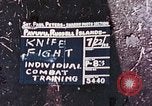
U.S. Marine Corp 5th Regiment practice individual knife fighting at Pavuvu Island, Russell Islands, Solomon Islands
United States Marine Corps of 5th Marine Regiment undergo individual combat training in Russell Islands, Solomon Islands, during World War II in Pacific theater. Group of Marines practice individual knife fighting. They demonstrate different types of holds during the practice.
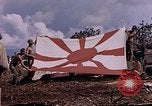
Aftermath of Japanese Banzai charge on Saipan, Mariana Islands during WWII
Americans display (holding it upside down) a huge Japanese rising sun Vice Admiral rank flag , captured after a desperate "banzai" attack by Japanese forces on Saipan, during World War 2. A photograpner takes a picture. Ammunition left on the ground from the battle. Two knocked-out Japanese Type 95 Ha-Go tanks. Destroyed defensive positions and buildings. Americans examine remains of buildings and defensive positions. Several local civilians walk into the center of the scene of death and destruction. Dead Japanese soldiers are seen everywhere, throughout the sequence. (Note: Aftermath of the "Tanapag Plain banzai attack" on July 6th and 7th, 1944. Americans engaged included units of the 105th Infantry; 165th Infantry; 23rd Marines; 24th Marines; 25th Marines; 20th Marines; and 10th Marines.)
CRITICALPAST.COM: About Us | Contact Us | FAQs - How to Order | License Agreement | My Account | My Lightboxes | Shopping Cart | Advanced Search | Featured Collections | Website Terms & Conditions | Privacy Policy ©2026 CriticalPast LLC.
License Agreement |
Terms & Conditions |
Privacy Policy
©2026 CriticalPast LLC.