


 Francais
 Deutsch
 Italiano

Refine Your Search
Walcheren Island Netherlands 1944 stock footage and images
- Showing 385 to 390 of 9743 results more
 Hide
Color Sound

Allied assaults against the German Gustav Line at Monte Cassino, Italy during World War II
Opening scene shows peaceful Italian mountains, including one snow-capped, in Spring, 1944, during World War 2. Camera focuses on the town of Monte Cassino and its historic Monastery, on a mountain above the town. (German forces held the Rapido-Gari, Liri and Garigliano valleys and some of the surrounding peaks and ridges that formed the heavily defended Gustav Line.) Animated relief map shows where, by mid January, 1944, American, Polish, and British forces had cleared the enemy from mountains east of Cassino and drawn up on the east side of the Rapido valley. Map shows progress of subsequent Allied attacks that finally reached Mount Castellone and then up Abbey Hill at Monte cassino, itself. Image of German soldier is superimposed on the scene, using binoculars on Abbey hilltop to observe Allied forces. (Narrator states: On February 9th, 75 yards from the abbey, we were stuck.") U.S. Army Air Forces Douglas A-20 Havoc aircraft are seen starting engines. Closeup of Fifth Army leaflet warning the local people to leave the Monte Cassino Abbey to avoid shelling and bombing. View of U.S. troops packing the leaflets into thin-skinned shells to deliver the warning by artillery fire. Next, 105 howitzer guns are seen under camouflage netting, firing bombardments of warning shells. Formation of A-20 aircraft taking off. Aerial view from high above, of B-25 bomber formation in flight. Formations of B-17s, B-24s, B-26s in flight enroute to bomb Monte Cassino. Bombs dropping from B-25 Mitchell bombers. Bombs exploding on Monte Cassino and the Abbey. Batteries of 155 mm guns firing. Formation of 6 B-25 bombers in formation. More bombs bursting on Monte Cassino. Animated map shows German forces taking up their earlier defenses again following the Allied artillery and air attacks. It also shows supplies streaming in to the German Green Devils Parachute Division (Luftwaffe’s 1st Fallschirmjaeger [Parachute-Hunter] division.) The map illustrates all the locations in the town that they occupied and would defend to the last man. Map also illustrates circling positions of Allied artillery batteries. Camera focuses on Polish troops and M4 Sherman tanks moving forward in an offensive. Glimpse of U.S. Army Air Forces mechanics working on a Douglas bomber engine. M4 prime movers towing 155mm howitzer guns. Gun crews camouflaging their positions with netting. Various views of A 240mm howitzer being put in place by a crane. Soldiers deploy detector microphones to locate enemy gunfire sources. They test them, and then enclose them in water-proof containers, bury and cover them. Sound from the microphones being recorded on film at a machine in the Command Post. The data being plotted on a map and corresponding grid locations phoned to Battalion headquarters. View of bombers resuming attacks again, on March 15, 1944. Formations of Douglas bombers, followed by B-25s, seen dropping bombs that explode in the town of Monte Cassino. Artillery firing. Formation of B-24 Liberator bombers in flight. Formation of B-17s dropping bombs. String of bombs exploding in a line on the town. More views of artillery barrages. More lines of bombs exploding. Allied forces storming the shattered town found German soldiers using destroyed structures as shelters to fire from and rubble obstructing the movements of Allied tanks, so the Allied advance was again stopped. Later, a newspaper headline reports resumption of Allied offensive.
Strafing and attacking ground targets, ME-109 and FW-190, European Theater.
The 8th Fighter Command Operations, European Theater. 27-May-1944; Lieutenant R L Baker of 82nd squadron 78th fighter group flies the aircraft. Attacking the ground targets as seen via gun camera footage. Strafing of two flak towers. A decoy aircraft in flight. 29-May-1944; Captain B L McGratten of 335th squadron 4th fighter group flies the aircraft. Attacking ME-109 and FE-190. Aircraft fly fighter protection for formation of B-17's. Chasing and hitting of FW-190. 30-May-1944; Lieutenant J R Cook of 360th squadron 356 fighter group flies the plane. Strafing of large freighter, schooner and two small targets. (World War II period).
U.S. Army Air Force (USAAF) VIII Fighter Command aerial pursuit and strafing of ground targets during World War 2
Shot of aircraft flying ahead, high above fields, taken from mounted camera of 359th Fighter Group, on August 16, 1944, in Europe, during WW2. Scene changes to gun camera footage from a different plane, as it approaches an aircraft, August 16, 1944. The aircraft in pursuit peels off. New scene from August 18, 1944, taken from aircraft of 4th Fighter Group as it makes multiple low passes to attack ground targets. The aircraft strafes enemy German vehicles and other roadway targets.
Troops advance along Camouflage Island on Kwajalein Atoll in the Marshall Islands.
A training film on operations of U.S. forces on Kwajalein Atoll in the Marshall Islands during World War II. 24th Marines advance along a beach at the north end of the island. Medium tanks advance along with the troops. Firing and bombardment in the area. Aircraft in flight overhead, bombing the area. Smoke rises from the bombing. Heavy columns of black smoke rise. The troops advance, firing rifles. Debris in the area. Camouflage Island is secured by the troops.
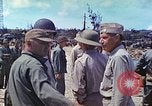
U.S. Fleet Admiral Ernest King and Admiral Richmond Turner tour the island after the capture of Saipan, Mariana Islands.
U.S. officers tour the island after the capture of Saipan, Mariana Islands during World War II. U.S. Fleet Admiral Ernest King and other officers tour the island. U.S. Admiral Richmond Turner talks to U.S. soldiers. Officers and men at quarters. The officers and the soldiers attend flag raising ceremonies.
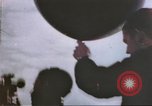
B-25 Mitchell bombers take off one by one from Adak Island, Aleutian Islands, Alaska during the Aleutian Islands Camp.
The Aleutian Islands Campaign of World War II. Two soldiers make a last minute weather observation on Adak Island in the Aleutian Islands, Alaska. Aerial cameras are taken inside a U.S. Army Air Forces B-25 Mitchell bomber. Pilots make a final meeting. A pilot gets inside an aircraft. The aircraft take off one by one.
CRITICALPAST.COM: About Us | Contact Us | FAQs - How to Order | License Agreement | My Account | My Lightboxes | Shopping Cart | Advanced Search | Featured Collections | Website Terms & Conditions | Privacy Policy ©2026 CriticalPast LLC.
License Agreement |
Terms & Conditions |
Privacy Policy
©2026 CriticalPast LLC.