


 Francais
 Deutsch
 Italiano
Refine Your Search
Walcheren Island Netherlands 1944 stock footage and images
- Showing 427 to 432 of 9701 results more
more Hide
Hide
United States Army Air Corps film "The Truth About Ploesti."
Formations of B-24 Liberator bombers are seen in flight, headed for Ploesti, Romania, on August 1, 1943, during World War 2. Next, vertical columns of bombs are seen falling from the planes. Animated map of Europe shows Romania and Ploesti. It show paths of oil from the Ploesti oil fields to Germany. (Narrator states Ploesti provides 30% of Axis oil.) Map show path of 9th Air Force bombers from Libya to the Ploesti oil fields. Scenes shift to captured German films from 1944, showing the fires and destruction resulting from the constant B-24 raids. Huge black clouds rise from the area. Firefighters rush to combat flames. They direct streams of water on the conflagrations. (Commenter states: "Delayed action bombs prevented firefighters from rushing in, until too late.") Nighttime views of large fires and heavy smoke from 6 of Ploesti's 7 refineries ripped wide open. Film advances to August, 1944, showing Ploesti with the fires out, following Rumania's capitulation. Next, with some fires still burning, King Michael I of Romania, tours the site with military officers. They walk amidst the debris. Smoke rising near a rail marshaling yard. Against a background of dense smoke rising, a Slate is displayed showing the cost to the United States of the Ploesti raids, as 300 bombers and 3000 American airmen were lost.
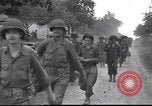
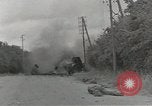
Troops return to a rest area, dig fox holes and a burning USAAF P-51 aircraft in France during World War II.
The United States Army in France during World War II. On 5th August, 1944 : soldiers of 35th Infantry Division, 137th Infantry Regiment, 3rd Battalion walk in columns while returning to a rest area near Le Mesnil-Robert. On 8th August, 1944 : an officer of 28th Division, 109th Infantry Regiment, 3rd Battalion shows replacements where to dig foxholes in Gathemo. The soldiers dig the foxholes. A United States Army Air Force ( USAAF ) P-51 Mustang burns after a crash landing near Vire. Ammunition in the aircraft exploding. The rescued pilot talks to two soldiers.
United States 1st Infantry Division soldiers advance into French cities and fight for Aachen during World War II.
The role of United States 1st Infantry Division (Big Red One) in various campaigns in Europe during World War II. United States 1st Infantry Division men fight in France as they advance further inland into the country. Soldiers relax, get a haircut and write a letter back home to their families. On July 25th , 1944 German aircraft launch an air attack. Infantrymen fight in the streets of a city in France. Combat engineers plant land mines. 1st Infantry Division soldiers enter Coutance, Mortain, Etampes, Meaux and Soissons. Soldiers around a monument at the Belgium border. 1st Infantry soldiers advance towards Aachen. Tanks fire as soldiers fight against the Germans in Aachen. Men on a machine gun. On October 25th 1944 Aachen surrenders to the Allies. U.S. Army armored vehicle drives over Nazi flag lying in a street.
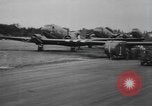
U.S. Paratroopers preparing, and then departing from England, to airdrop over Normandy during World War II
An airfield in England, filled with Waco CG-4A Gliders and their C-47 tow planes, in readiness for the invasion of Normandy, France, in World War 2. U.S. Army Air Forces intelligence officer briefing C-47 and Glider pilots and crews about conditions expected in the drop zones of Normandy before D-Day in World War 2. Brigadier General James Gavin,Commander of the 82nd Airborne Division, giving a final briefing to his paratroopers. A military chaplain holding final religious services for troops. General Dwight D. Eisenhower, visiting paratroopers of the 101st Airborne Division, as they prepare to depart on the night of June 5, 1944. U.S.Army paratroopers boarding their C-47 aircraft to depart for Normandy on June 5, 1944. Several are seen tying parapacks of heavy equipment to the aircraft for separate release. Paratroopers of 101st Airborne Division, loading equipment aboard a CG-4A Glider, and getting final briefing from their pilot. Other 101st Airborne troopers don personal equipment on the ramp near their C-47 airplane, which displays paint-striped wings and fuselage. Jumpmaster makes final check of his troopers. The paratroopers boarding their aircraft with heavy loads of equipment. C-47 aircraft take off towing their gliders.
Allied troops aboard ships and gliders head for Normandy, France for the D-day invasion during World War II.
Allied invasion of Normandy, France during World War II. U.S. General Joseph McNarney, Deputy Chief of Staff at a desk as he outlines the importance of June 6, 1944 the day Allied forces attacked the Germans in Normandy. He speaks about the decision to knock down the Nazis first and then the Japanese during the World War. He says that the invasion of Normandy was planned in November 1943. He also states how General Dwight D. Eisenhower, Supreme Commander of the Allied forces in Europe, planned and executed the invasion. He also speaks about how the U.S. Army Air Forces and the Royal Air Forces aircraft bombarded the coasts of Normandy prior to the D Day invasion. Past events show American soldiers getting onto landing crafts in England as they leave for the invasion. The soldiers aboard the ships in the English Channel. The soldiers read the Bible and comics, sleep and cook aboard the ships. On June 5th , 1944 the ships head towards Normandy for the invasion. In England gliders carrying paratroopers take off from an airfield to bombard the German positions in Normandy. British soldiers receive ration and work on motorbikes. TNT (trinitrotoluene) charges being prepared by soldiers tasked with demolition duties. British soldiers check their guns and other weapons prior to the invasion. Jeep and artillery being loaded onto aircraft.
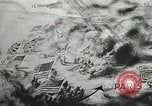
Allied Forces advance and French Army takes Paris in World War II.
Animated map shows American forces advancing toward Paris. Views of German troops disorganized and making their way individually among burning and destroyed military tanks and vehicles. A U.S. Army colonel confers with U.S. Armored unit officers, using hood of jeep as a table. U.S. Sherman tanks and tank destroyers moving along dirt roads toward Paris, at high speed and passing beyond the Orleans region. They move rapidly through groups of cheering French citizens in a French town. American armored units moving to bypass Paris. U.S. Army Air Force airplanes dropping maps to the armored units by parachute, because they were moving too fast to be supplied by ground. French forces, armed with American tanks, vehicles, and arms, are ordered to advance and take Paris. As they proceed, U.S. Army Air Forces support them from the air. Formations of P-51 fighter and B-26 bombers are seen. The French forces advance at rate of 25km per day. They are joyously welcomed as they pass through French towns on their way. Scenes of Paris. Local residents in line at a shop. German occupiers are seen beginning to leave Paris. A line of horse-drawn wagons is seen in the street. On August 14, 1944, Paris Police go on strike. They are seen drawn up in formation. August 15, 1944, the Gestapo left Paris. French citizens and police open fire on German Army vehicle. Parisians begin to hang the tricolor from their windows. French resistance fighters seen running in streets of Paris and firing weapons as they work to find remaining German forces. A doctor and several nurses run for cover. Parisians begin to fill the streets during liberation of Paris as elements of the French Army enter Paris. General Charles de Gaulle walking along a street in Paris.
CRITICALPAST.COM: About Us | Contact Us | FAQs - How to Order | License Agreement | My Account | My Lightboxes | Shopping Cart | Advanced Search | Featured Collections | Website Terms & Conditions | Privacy Policy ©2026 CriticalPast LLC.
License Agreement |
Terms & Conditions |
Privacy Policy
©2026 CriticalPast LLC.