


 Francais
 Deutsch
 Italiano
Refine Your Search
Walcheren Island Netherlands 1944 stock footage and images
- Showing 505 to 510 of 9701 results more
more Hide
Hide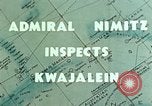
Admiral Chester Nimitrz visits the flagship, USS Rocky Mount and Kwajaleln Island during World War II
Admiral Chester William Nimitz , Commander in Chief of Pacific Ocean Areas, visits flagship USS Rocky Mount and Kwajalein Island during World War 2. View from the USS Rocky Mount (AGC-3) as a U.S. Navy PB2Y Coronado seaplane approaches, lands in the water. and taxis toward it. An officer stands above steps leading aboard the ship. An unidentified small transport ship and small boat are in the background. two small launches are tied to the Rocky Mount. Admiral Chester Nimitz, Pacific fleet commander, is seen from the Rocky Mount as he ascends ladder to the ship's deck. View is looking downward from behind a Navy cinematographer. Admiral Nimitz is greeted by officers aboard the ship. Boarding the USS Rocky Mount, immediately behind Admiral Nimitz, is Lieutenant General Robert C. Richardson Jr., Commanding General of all Army personnel in the Pacific. He is also greeted by the officers on deck. Next, Rear Admiral Richmond Turner is seen boarding the Rocky Mount. (The Rocky Mount served as his flagship when he directed operations against Kwajalein.) Various views of the officers mingling and conversing on the deck. Scene shifts to Admiral Nimitz and accompanying officers posing for a photograph on the Kwajalein Island. He and members of his party are all wearing steel helmets. In one scene they are surrounded by military photographers as Admiral Turner (in garrison cap) points out areas of interest to Admiral Nimitz. Ensuing scenes show the officers examining the remains of Japanese fortifications and weapons on the island. Admiral Nimitz converses with three soldiers who have been bathing on the shore. More views of the group amidst debris on the island. They board three waiting jeeps
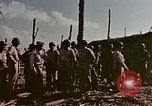
Admiral Nimitz and his party move around and inspect the Kwajalein Island.
U.S. Navy Fleet Admiral Chester William Nimitz on inspection of Kwajalein Island, Marshall Islands. Admiral Nimitz and his party on Kwajalein Island. Palm trees in the background. A soldier sits on driving seat of jeep. Admiral Nimitz and his party move around and inspect the island. Jeeps in the background. The party board jeeps. (World War II period).
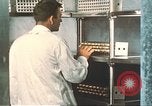
Research animals herded in research building at the Plum Island Animal Disease Center in Long Island, New York.
A film based on the Plum Island Animal Disease Center in Long Island, New York which is dedicated to study of foreign animal diseases. A technician works with bacteriological incubators to grow tissue cultures. Technicians inoculate a culture with foot and mouth disease virus of animal. The technicians carry out this procedure in a safety hood. Cattle are used as research animals and are held in quarantine for two weeks. Animals enter a research building after the quarantine period is over. The animals are herded through different doors in the building. A man dumps food for the animals in a chute. The cattle feed is processed in a hammer mill. Air passes through filters. Glass block openings in the research building. A guard patrols the area in a radio equipped vehicle. A fisherman's boat goes away from Plum Island coast. Two wire fences to isolate the area. A technician handles supplies.
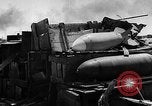
Principal factors and benefits of plan of execution of Flintlock Operations on Kwajalein Atoll in the Marshall Islands.
A training film on operations of U.S. forces on Kwajalein Atoll in the Marshall Islands during World War II. Wrecked guns and shells on the island. Burlesque and Camouflage Islands shown on a map. There are two principal factors of the plan of execution of Carillon Island. The seizure of weakly defended islands and the use of three islands for emplacement of artillery to support principal landings. This is depicted with the help of animation. Heavy gun fire and aerial bombardment on all the principle islands. Coordination between land, naval and aerial forces helped in the accomplishment of objectives. A map of Carillon Atoll. A map of the Marshall Islands. Major benefits of Flintlock Operations and how it was effective in achieving victory are explained.
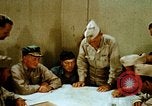
U.S. Navy fighter and bomber aircraft from USS Yorktown strafe Japanese bases and positions on the Truk Islands.
USS Yorktown CV-10 in the Pacific Theater during World War 2. U.S. Naval officers and sailors discuss over a map on a table. Animated map depicts Japanese fleet positions on the Truk Atoll of Islands. USS Yorktown Navy flier squadron and squadrons from other carriers take off for combat over the Truk Islands. Sailors talk over the radio aboard USS Yorktown. A map shows the heavily fortified islands surrounded by air strips, and naval anchorages among the islands. Crewmen aboard Yorktown prepare the planes for take off. Machine gun fire from the planes over the Truk Islands. They dive bomb the island. The aircraft are hit and descend to the ground. A plane drops into the ocean. U.S. airplanes bomb Japanese planes on fighter strips, bomb bases and sea plane ranches. Smoke due to heavy bombardment. Planes dive and drop bombs. Fire due to bombing of a fast fleet tanker hiding in a sheltered cove. U.S. bombers and fighter planes strafe other fleet auxiliaries including rice boats, transports and ammunition ships. They are set on fire with 50 caliber incendiaries and armor piercing plugs. The ships on fire sink into the ocean.
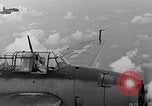
TBF and F4F aircraft, from USS Marcus Island, in practice maneuvers while en route to Peleliu, Palau Islands in World War II
Navy Task Force engaged in practice maneuvers while headed for Peleliu, Palau Islands in World War 2. Closeups of Grumman TBF Avenger aircraft, with canopies open, flying in formation,as viewed from one of the aircraft in the formation. Several of the TBFs skim the water surface in simulated torpedo runs. Two Grumman F4F Wildcat aircraft in flight. A flight of three F4Fs. Close view of TBFs on downwind leg in landing pattern,abeam the Escort Carrier USS Marcus Island (CVE-77), with landing gear down and tail hooks extended.
CRITICALPAST.COM: About Us | Contact Us | FAQs - How to Order | License Agreement | My Account | My Lightboxes | Shopping Cart | Advanced Search | Featured Collections | Website Terms & Conditions | Privacy Policy ©2026 CriticalPast LLC.
License Agreement |
Terms & Conditions |
Privacy Policy
©2026 CriticalPast LLC.