


 Francais
 Deutsch
 Italiano
Refine Your Search
Walcheren Island Netherlands 1944 stock footage and images
- Showing 553 to 558 of 9701 results more
more Hide
Hide
U.S. 7th Army Air Force P-47s first napalm fire bomb and rocket fire tests conducted during the Pacific campaign in Saipan Island.
A film titled 'Mariana Thunderbolts' shows the Pacific campaign of World War II fought on the Island of Saipan, Mariana Islands. The first 7th AAF (Army Air Forces) P-47s catapulted from naval carriers. The first combat tests of napalm incendiary bombs by the P-47s. P-47s fire first rockets. A dock area showing the piles of equipment being loaded onto LSTs (Landing Ships, Tank) in Hawaii. A bulldozer being loaded into the LST. A power vehicle used to pull grading equipment also loaded into the LST. The dock area shows huge piles of supplies. Bellows Field in Hawaii shows mechanics working on P-47 aircraft. Landing gears, engines, and all phases of overhaul being done on the P-47s prior to loading them onto aircraft carriers. Mechanics crate aircraft parts and supplies in boxes prior to loading cargo onto the ships. They taxi out the P-47s and line them up for inspection. Several men lying and sitting on the runway facing two long rows of parked P-47s. Inspection officers, Commanding Officer of the U.S. 318th Fighter Squadron Colonel L. M. Sanders and Commanding Officer of the U.S. 19th Fighter Squadron Major Harry McAfee walk through the double row of parked P-47s.
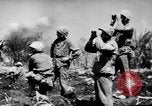
American troops use flamethrowers to burn out the Japanese hidden behind underbrush on the Mariana Island.
The joint force assault by the American Army, Navy, Marines and Air Force against the Japanese on the island of Saipan, Guam and Tinian in the Mariana Islands. American troops look through binoculars. U.S. troops use flamethrowers to burn out the Japanese hidden behind underbrush. The enemy is blown out of there pillboxes. (World War II period).
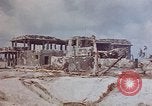
Marines establish beachhead on Roi-Namur, Marshall Islands during Pacific Campaign against Japanese in World War 2
U.S. 4th Division Marines assault Roi-Namur in Marshall Islands and establish beachhead. Ruins of building on Roi-Namur, Marshall Islands. Wreckage of Japanese G4M plane on airfield. Two marines walk around. Wing of fighter aircraft on airfield. Marines in beachhead area. American flag on coconut tree stub. Fire burns amid coconut trees. Marines in foxholes and taking cover in a ravine. Marines lie in sand under fire. Marines exit ravine and run across knoll during battle. Aircraft overhead. Red ball insignia on side of wrecked Japanese plane. Fire burn amid coconut trees. Marines carry boxes. Troops off load from LCVP (Landing Craft, Vehicle, Personnel). Black smoke rises from explosion. Marines on beachhead as supplies are landed. Beach control flags visible.
U.S. Marines fire guns, blow a cave, and captured Japanese troops walk on the Palau Island during the Invasion of Philippines.
U.S. Marines capture Palau Island during World War II. U.S. Marines advance on the Palau Island. The Marines fire guns. Smoke rises in the background. The Marines load guns and fire the gun. Shells kept in the background. The Marines get off from the landing crafts. The marines fire. A Marine sprays liquid fire in a Japanese foxhole. The Japanese troop runs. The U.S. Marines shoot the troops. The dead Japanese troop. The Marines fire and advance. The Marines blow up a cave. The captured Japanese soldiers walk with their hands up.
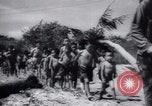
U.S. forces assist native people on Saipan and Guam in the Mariana Islands after capturing them during World War II.
U.S. forces on Saipan and Guam in the Mariana Islands during World War II. Native women and children are liberated by U.S. Marines on Saipan island. American military hospitals provide medical care in Guam. U.S. Navy doctors and native nurses treat the sick. Food is distributed to native children.
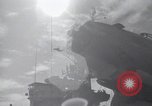
U.S. F4Fs take off from flight deck of escort aircraft carrier off the coast during invasion of Palau Islands in World War II.
U.S. CVE (Escort Aircraft Carrier) off the coast during the invasion of Palau Islands in World War II. U.S. Navy TBF Avenger torpedo bomber warms up on deck of CVE. Island structure in the background. U.S. Navy F4F Wildcat fighters taxi and take off from flight deck of CVE.
CRITICALPAST.COM: About Us | Contact Us | FAQs - How to Order | License Agreement | My Account | My Lightboxes | Shopping Cart | Advanced Search | Featured Collections | Website Terms & Conditions | Privacy Policy ©2026 CriticalPast LLC.
License Agreement |
Terms & Conditions |
Privacy Policy
©2026 CriticalPast LLC.