


 Francais
 Deutsch
 Italiano
Refine Your Search
Waltham Massachusetts 1932 stock footage and images
- Showing 97 to 102 of 893 results more
more Hide
Hide
Scenes of World War 1 and the period between the wars, illuminating career of U.S. Air Force General Henry (Hap) Arnold.
Newspaper headline in Washington post reads 'United States and Germany at War'. Civilians recruited into the army. American pilots of the 103rd Aero Pursuit Squadron, in France, with their Spad aircraft. American airplane production factories in operation, with manny women war production workers seen assembling aircraft. People celebrate in the streets at end of World War I at time of armistice. Airplanes, under command of General Billy Mitchell bomb obsolete warships in demonstration of aircraft power in warfare. 1920s: Postwar flyers and stunt wing walkers perform in the roaring twenties. Developments and improvements in parachutes, and view as stunt men parachute from high buildings and airplanes. Aircraft flying forest fire patrols. Aerial view of burning forest fire below. Lieutenant Colonel Arnold commands emergency airlift and drop of food to snowbound Native American Indians in American Southwest, in 1932. World War I scene of American 103rd Aero Pursuit Squadron Spad airplanes taking off, in France. Lieutenant Colonel Hap Arnold with his family, including two young boys and a young girl (his sons and daughter) and his wife.
World's Champion Horseshoe pitcher, Ted Allen, demonstrates skills, after his win in Moline, Illinois
Approximately 20 contestants, dressed in white, are seen at horseshoe pitching lanes in a fenced enclosure. Spectators are seated in bleachers nearby. A stray dog wanders in the foreground. View of the spectators (mostly men). View of a shoe landing as a ringer. View from the pins as a contestant throws five shoes at four pins. One shoe appears to have landed closed against the first pin. The remaining four are all ringers. In a complete change of scene, Ted Allen, wearing a sweater emblazoned with his name and title: "World's Champion," gives a demonstration. He throws four ringers at one pin, while an intrepid assistant leans over, with his hand atop the pin, confident that he won't be hit by one of the horseshoes. Final view is a closeup of Ted Allen posing with his face framed by a horseshoe. (Note: Ted Allen was born in Kansas. His family moved to Colorado in 1922; to Oregon in 1932; to California in 1933; and finally back to Colorado, in 1936.)
President Ronald Reagan's political career leading to election as California Governor, in the election of 1966
Film opens showing a still photograph of Ronald Reagan and Nancy Davis when they appeared together in the 1957 film, "Hellcats of the Navy." Although they were married since 1952, She was billed as Nancy Davis in the film. View of the newly wed Reagans cutting their wedding cake in 1952. Best Man, William Holden and his wife, Ardis Ankerson (stage name Brenda Marshall) share the moment with them. Closeup of Reagan and his new wife. Still photograph of Ronald Reagan appearing in the television series, "Death Valley Days." Next he is seen in a chair on the set of the TV series,"General Electric Theater," which he hosted from 1953 until 1962. He also toured General Electric plants to talk about the benefits of the free enterprise system. He is seen seated sharing a meal and posing with women employees of General Electric. Film shifts in time to the year 1932, when Reagan was first eligible to vote. Camera focuses on men's feet and they shuffle on a line at a soup kitchen. Views of men receiving food and drink. President Franklin D. Roosevelt is seen, seated in an open car chatting with people surrounding it. Roosevelt sits in the midst of men playing guitars and banjos. On inauguration day, March 4, 1933, he and his Vice President Henry Wallace are seen in the back of an open car. First Lady, Eleanor Roosevelt, sits just ahead of them. President Harry Truman being sworn in by Chief Justice of the United States Fred Vinson, January 20, 1949, for a second term as President. Views of the Republican National Convention in 1952 when the party chose Dwight D. Eisenhower as its candidate for President. He and his wife Mamie, at the podium together. Ronald Reagan addressing a large group. Supporters walking with Republican Presidential candidate, Richard Nixon, whom Reagan favored over Democrat John F. Kennedy in the 1960 national election. In 1962 Reagan officially became a Republican Party member, supported Barry Goldwater and their candidate for President at the Republican National Convention of 1964. Views of Goldwater at the convention and stepping from an airplane during his campaign. Still photo of Goldwater next to Reagan, and then of Reagan defending Goldwater in a nation-wide address. View of Reagan and wife Nancy, and son, Ronald, walking together across field at their ranch in California. They are surrounded by Republican Party leaders who ask him to run for Governor. He and Nancy laughing about it. Billboard advertising Reagan for Governor, and views of him on the campaign trail. Views of Governor Edmond Brown surrounded by his supporters during the campaign. Reagan speaking during the campaign, and then seen with Nancy when he won the gubernatorial election.
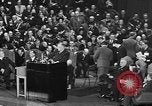
President Franklin D Roosevelt addresses crowd in Philadelphia during 1940 presidential campaign.
President Franklin Delano Roosevelt at the Philadelphia Convention Hall and Civic Center (3517 Civic Center Blvd, Philadelphia, PA 19104, USA) in Philadelphia, Pennsylvania. The President speaks from the podium and gives a political speech responding to what he characterizes as deliberate falsehoods promulgated by the political opposition. He talks about dictators and the practice of repetitions of falsehoods, saying, "Certain techniques of propaganda, created and developed in dictator countries, have been imported into this campaign. It is the very simple technique of repeating and repeating and repeating falsehoods, with the idea that by constant repetition and reiteration, with no contradiction, the misstatements will finally come to be believed. Dictators have had great success in using this technique; but only because they were able to control the press and the radio, and to stifle all opposition. That is why I cannot bring myself to believe that in a democracy like ours, where the radio and a part of the press — I repeat, where the radio and a part of the press-remain open to both sides, repetition of deliberate misstatements will ever prevail. I make the charge now that those falsifications are being spread for the purpose of filling the minds and the hearts of the American people with fear. They are used to create fear by instilling in the minds of our people doubt of each other, doubt of their Government, and doubt of the purposes of their democracy. This type of campaign has a familiar ring. It reminds us of the scarecrow of four years ago that the social security funds were going to be diverted from the pockets of the American workingman. It reminds us of the famous old scarecrow of 1932, 'Grass will grow in the streets of a hundred cities; a thousand towns; the weeds will overrun the fields of millions of farms.' The American people will not be stampeded into panic. The effort failed before and it will fail again. The overwhelming majority of Americans will not be scared by this blitzkrieg of verbal incendiary bombs. They are now calmly aware that, once more, 'The only thing we have to fear is fear itself.' I consider it a public duty to answer falsifications with facts. I will not pretend that I find this an unpleasant duty. I am an old campaigner, and I love a good fight."
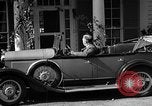
President Roosevelt drives his personal car at Little White House in Warm Springs, Georgia.
President Franklin D Roosevelt during a vacation at the Little White House in Warm Springs, Georgia. President Roosevelt sits in his personal hand-controlled 1932 Plymouth PA Phaeton open car, outside the little White House in Warm Springs, Georgia. He sits in the car as photographers take pictures. U.S. Marine guard stands at attention , in background. A man sitting in back seat of the open car moves to the front and sits next to President Roosevelt, who then drives the car, with the man, smiling beside him. Front view of the car shows a triple A insignia and license plate displaying the single letter "R." A Secret Service agent jumps on the running board as the car comes past him. Other Secret Service Agents follow in another car. The two cars are seen under the entrance sign to "Georgia Warm Springs Foundation." The President is driving with three passengers in his car, followed by the Secret Service car. They proceed out on the public highway, past a gasoline station with "Standard Oil Products" sign in front. A U.S. Marine guard in uniform, stands beside large sign reading: "This is The Little White House." it asks the public not to intrude.
Rise of Hitler and Nazi party in Germany; early footage of Nazi party and figures.
Nazi leaders in the dock at Nuremberg trials, including Hermann Goering; Rudolf Hess; Joachim von Ribbentrop; Alfred Jodl; and others. American prosecutor addressing the court. Image Adolf Hitler overlayed by quote from his book, "Mein Kampf." Views of the brawling streets of Munich during the 1920s. Hitler posing with political associates. A Nazi rally with storm troopers AKA Sturmabteilung (SA). A sign displaying swastika in window of a building identifying it as offices of the N.S.D.A.P.(Nationalsozialistische Deutsche Arbeiterpartei) National Socialist German Workers' Party. Joseph Goebbels in the office, on the telephone. Storm trooper marching band on parade. Goebbels speaking to a crowd early in the Nazi movement. Storm troopers marching on parade and receiving Nazi salutes. Marching storm troopers led by Ernst Rohm. Hitler mingling with the Storm Troopers. Contingent of goose-stepping Storm Troopers. Hitler speaking to a crowd in a forceful and animated fashion. Unrest in streets in Germany. A 1932 newspaper headline reports rumor of a Storm trooper march to Berlin. Nazi Storm troopers set up a machine gun on a sidewalk. Newspaper of January 30, 1933 reports Hitler appointed Reichskanzler (Reich Chancellor) and Goering made Minister of the Interior. View of Hitler together with his cabinet on January 30, 1933, just after Hitler was named Chancellor of Germany. Goering is on his right and Franz von Papen is on his left. Other cabinet members are behind them and around them. Torchlight parade and Hitler saluting to crowd below from the Chancellery window in Berlin on that same night after being named Chancellor. Scene of a Nazi public book-burning.