


 Francais
 Deutsch
 Italiano
Refine Your Search
Waltham Massachusetts 1932 stock footage and images
- Showing 13 to 18 of 893 results more
more Hide
Hide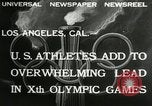
A large crowd gathers to watch the 1932 Olympic games held in Los Angeles, California.
The 1932 Summer Olympics held in Los Angeles, California. Aerial view of the Los Angeles Memorial Coliseum Olympic Stadium as seen from a blimp. Frank Wykoff wins the men's 400 meter relay. Bob Kiesel, Emmett Toppino, Hector Dyer, and Frank Wykoff stand together. Jean Shiley wins the women's high jump. Wilhelmina Von Bremen wins the 400 meter relay. Crowd cheers and applauds. Yasuji Miyazaki wins the 100 meter men's freestyle swimming event. Mickey Riley wins the men's springboard diving contest. Helene Madison wins the women's 100 meter freestyle swimming event. Men line up for the start of the Marathon race. Juan Carlos Zabala wins the marathon. The Americans take a lead in the Games of the X Olympiad.
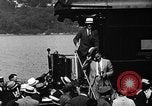
The 1932 Presidential campaign of Franklin D. Roosevelt
Franklin D. Roosevelt in whistle stop campaign for President in 1932. He speaks from rear platform of a rail car, to a crowd of spectators. A bouquet of flowers is handed up from the crowd to Eleanor Roosevelt standing on the train platform. Cheering crowds seen from the moving train, including some sitting on the roof of the train station. FDR and Eleanor Roosevelt each acknowledging recognition from supporters.
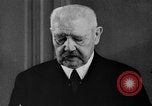
President Hindenburg re-elected in 1932. Freikorps (Free corps) active during unrest in Germany
President Paul von Hindenburg speaking briefly on occasion of his re-election in 1932. Armed elements of a Freikorps (Free Corps) controlling people exiting a building in Berlin. A large contingent of Freikorps marching on a street. Freikorps forming themselves and moving to control people demonstrating in Berlin. A parade on a city street being led by Freikorps, carrying batons. Many spectators line the sidewalk.
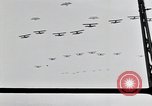
Italian military aircraft; Prime Minister of Italy Benito Mussolini and other officers at Ferrara Airfield circa 1932.
Views of Italian military aircraft circa 1932, and of Prime Minister of Italy Benito Mussolini with other officers at Ferrara Airfield in Italy. Formation of biplanes planes in flight. Larger, slower bombers high in the formation and many smaller, faster, pursuit planes in formation below them. Large number of planes and fuel trucks parked on the airfield. They are all multiwing aircraft, except for one row of hi-wing monoplanes. Mechanics are seen working on the nose and propeller of one airplane. Benito Mussolini stands on a hill with many other staff officers and looks through binoculars. He points and discusses something with one of his Generals. Italian photographer in jacket and tie, wearing knickerbocker trousers, adjusts his camera and comes forward to take photographs. Mussolini continues his observations.
U.S. Army aircraft patrol for forest fires, in 1919, in the United States. Bulldozers and forest plows introduced in 1932
World War I scenes of U.S. Army airplanes in action at the front. A picture of U.S. Army Major Henry A. (Hap) Arnold and California Forester Kurt Dubois, who, together, started the fire patrol practice by United States Army aircraft in1919. Army flyers lined up on a field. Army Curtis JN-4 (Jenny) airplanes in flight as smoke rises from the forests below. Weighted messages with ribbons attached, being dropped by pilots while in flight to inform about a forest fire. Later on after the installation of radios a pilot sends a message on a radio set in case of a forest fire. In 1920s, Crawler tractors used to skid logs out of the forest. In 1925, tractor with a blade was developed and used to build forest roads. In 1932, a Bulldozer being used to create firebreaks during a Southern California fire. A fire plow in operation.
Increase in grants for Indian education and decrease in appropriations for military control in the U.S. from 1886 to 1932.
A film surveys federal provisions for federal schools for education of Native American Indian students in the United States during the Great Depression, and cultural integration of Native Americans into white cultures. An Indian woman holds her baby. An Indian man talks to a woman. Two women in traditional dress pose. Exteriors of a church. A picture depicting increase in grants for Indian boarding school education and decrease in appropriations for military control in the United States from 1886 to 1932.