


 Francais
 Deutsch
 Italiano
Refine Your Search
Wiesbaden Germany 1945 stock footage and images
- Showing 151 to 156 of 10464 results more
more Hide
Hide
Allies demand the unconditional surrender of Japan in World War II. Entry of Soviets and use of atomic bomb ends the war.
Representatives of three nations, seated around table at Potsdam Conference held at Cecilienhof in Potsdam, Germany. British prime minister, Clement Attlee; President of United States, Harry Truman; and representative of Soviet Union, Joseph Stalin at the Potsdam Conference, July 1945. They deliver an ultimatum of unconditional surrender to Japan. Swarms of B-29 bombers and Aircraft Carrier Task Forces destroy Japanese homeland. Planes on carrier decks.Navy Grumman carrier-based TBF aircraft dropping bombs.. Destruction of ships at sea. Mushroom cloud due to atomic bombing. Chart depicts the power of one atomic bomb. Britain's 'grand slam' bomb, most destructive conventional bomb ever produced. Doctor Ernest Orlando Lawrence, inventor of the cyclotron (atom smashing machine). A man works at the Cyclotron at the University of California, Berkeley. General Leslie Groves, head of the project speaks. He is seated with Dr Vannevar Bush, government director of science and research, and Dr Richard Tolman, technical expert. Quantities of uranium shipped from Alberta, Canada are used in bombs. The atomic bomb process (Manhattan Project) is developed in widely separated areas; scenes from Hanford Project plant in Richmond, Washington. Project personnel exit cars and enter into the search area before starting their work day. Lieutenant colonel Franklin T Matthias with the army corps of engineers, appointed to the Hanford Project. Sign of 'Oak Ridge' in Tennessee. Largest of the three atomic bomb plants located near the Tennessee Valley Authority (TVA) dam. Employed personnel in atomic bomb plants are seen going to work. Man and woman employees at the plan read and smile at a Knoxville Journal newspaper in August 1945 with news headline "Power of Oak Ridge Atomic Bomb hits Japs" after the atomic bomb was dropped in Hiroshima. View of dense prefabricated home communities to house large number of Oak Ridge plant workers. View of families setting up their houses in trailer towns after the prefabricated homes were full. People come out from the Henebry's Jewelers and supermarket, among stores setup to meet the needs of the quickly built city. Scenes changes to show view of Soviet leader Joseph Stalin at conference. Russian artillery and troops in a parade at Red Square in Moscow, Russia (these parade scenes are from the May 1, 1945 May Day parade, just days before Germany's surrender). President Harry Truman reports on the latest developments regarding the war with Japan. He states that the United States is prepared to destroy every productive enterprise in Japan and the U.S. shall completely destroy its power to make war. He warns of an attack by the U.S. due to the rejection of the July 26th ultimatum at Potsdam. He warns that Japan "should expect a rain of ruin from the air; the like of which has never been seen on this earth." Truman notes that it will be followed by an unprecedented sea and land invasion of Japan.

Portion of Trial of Nazi war leaders during Nuremberg Trials in Nuremberg Germany. Audio only.
Audio only. Nazi war leaders on trial in Nuremberg Germany. Coverage on how the charges will be grouped. The speaker focuses on three major issues: international situations and aspirations for expansion of Germany between 1943-1945; conquering of Austria and Czechoslovakia, and improvement of military and political positions.
British Wartime General Election gives control to the Labor party in 1945
Opening slate of this film reads" Churchill Defeated." It goes on to show Winston Churchill attending his last meeting with wartime allied leaders at Podsdam, Germany in July, 1945. He shakes hands with Soviet Foreign Minister Vyacheslav Molotov. His replacement, Clement Attlee who is also there. View from above of Soviet leader, Joseph Stalin greeting the new British Prime Minister, Clement Attlee, who is accompanied by Foreign Secretary Anthony Eden and U.S. President Harry Truman, accompanied by Secretary of State James F. Byrnes. The wartime leaders gather around a large round table. Closeup of Marshal Stalin and Soviet Foreign Minister Molotov. Closeup of U.S. President Harry S. Truman at the conference table. View from above of the principals at the table. Film shifts to scenes of Major Attlee campaigning for votes. People in street listening to Ernest Bevin campaigning. Views of Winston Churchill being given a hearty farewell by a crowd, as he rides through on an open vehicle. Closeups of him he picks up a microphone to address the throng. Scene shifts to views of British voters casting their ballots. King George VI strolls with new Prime Minister Attlee and Winston Churchill. He poses with the new Prime Minister (Attlee) and Ernest Bevin on his right. At his left is Winston Churchill and Anthony Eden. Closeups of Clement Attlee.
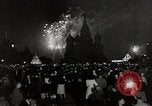
Fireworks in Red Square. Tehran, Iran, conference in 1943. Potsdam conference, 1945.
A crowd enjoys fireworks in Red Square, Moscow, Soviet Union, at night. Past events show Soviet Premier Joseph Stalin, U.S. President Franklin D. Roosevelt and Prime Minister Winston Churchill of the United Kingdom in Tehran, Iran for the Tehran Conference of 1943. U.S. President Harry S. Truman in Germany during the Potsdam Conference of 1945. The Grand Kremlin Palace in Moscow, Soviet Union. Soviet people along a street in Moscow. Foreign Minister of the Soviet Union, Vyacheslav Molotov with others applauding at the Bolshoi theater, in Moscow. Anti-soviet disorders. Street cars being overturned. (Hungary?).
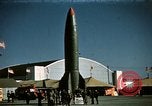
U.S. Army Air Forces Fair at Wright Field in October, 1945
Views of the U.S. Army Air Forces fair hosted at Wright Field, near Dayton, Ohio, in October, 1945.The highlights of the event were exhibits of captured German and Japanese aircraft, rockets, and equipment. A German V-2 Rocket Motor on display. Soldiers observe the rocket. A German Junkers Ju 388 Störtebeker multi-role aircraft on display. A German Messerschmitt ME-262 Schwalbe fighter on display. A German pilot's victories recorded on the side of a plane. Two soldiers take a look at a Japanese Kamikaze bomb. One of them gets into the bomb seat. American officers and soldiers view the exhibits. 'Alles Kaputt' written on the side of a German Junkers Ju-290 bomber (one of the candidate aircraft, with further development, in Germany's Amerika Bomber project for a long-range bomber capable of striking the United States). Soldiers walk under the plane. 'Transient Aircraft' written on the control tower building in the background. (World War II period).
Funeral of United States General George Patton and key moments and accomplishments during his life.
On the life of U.S. General George S Patton Junior (with narration by Ronald Reagan). Fight at the Siegfried Line during World War 2. U.S. 3rd Army cross the Siegfried Line. General Patton with his officers. Patton's troops cross the Rhine. American soldiers in the streets of Germany. Patton presents the Medal of Honor to a soldier. Patton sees dead people at a concentration camp in Germany. Patton's army moves towards Denube Valley. Civilians in the streets. Patton with officers. Written on a wall 'Hitler is kaput'. Trucks loaded with soldiers. A gun thrown on a pile of guns on the ground. Patton in a barge. A welcome ceremony for General Patton on his return to US: A parade along Broadway in Los Angeles on June 9, 1945, as over 1 million citizens welcome General Patton home and cheer. Shops and offices on Broadway in Los Angeles. Patton waves at the people from an open jeep. Patton and General Doolittle in Los Angeles. General Doolittle makes a speech at a ceremony and introduces General Patton. Patton addresses the gathering and talks about the war and the accomplishments of the Third Army. He notes that from aerial view, Germany and Austria "look like hell from the top." And "that's what any place that the 8th Air Force and the Third Army worked on looks like." Also Patton says, "You must remember this. That from Brest, to various towns in southern Germany and Austria whose names I can't pronounce, but whose places I have removed," (laughter in crowd), "the trail of the Third Army and the 19th Tactical Air Command and the 8th Air Force is marked by more than forty thousand white crosses; forty thousand dead Americans." View of a military cemetery graveyard. General Patton lays flowers at the grave of one of his soldiers. Patton watches a race at Soldiers Field Academy. He shakes hands with the winners. Soldiers carry Patton's coffin wrapped in American flag. Patton's grave with flowers on it. Two soldiers stand beside it. Patton's statue at the West Point Military Academy.
CRITICALPAST.COM: About Us | Contact Us | FAQs - How to Order | License Agreement | My Account | My Lightboxes | Shopping Cart | Advanced Search | Featured Collections | Website Terms & Conditions | Privacy Policy ©2026 CriticalPast LLC.
License Agreement |
Terms & Conditions |
Privacy Policy
©2026 CriticalPast LLC.