


 Francais
 Deutsch
 Italiano

Refine Your Search
Wiesbaden Germany 1945 stock footage and images
- Showing 253 to 258 of 10473 results more
 Hide
Color Sound
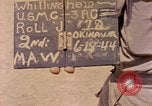
Wounded U.S. Marines being loaded aboard Stinson L-5B Sentinel ambulance aircraft in Okinawa , June 1945.
Air evacuation of wounded United States Marines in Okinawa, Japan during World War II. Marines unload a litter patient from an ambulance and load it aboard U.S. Army Air Forces L-5B aircraft of the 163rd Liaison Squadron. Aircraft taxis for take off. A signalman with flags with numerous Marine and Air Force L-5 aircraft in the background. Marines unload a wounded marine on a stretcher from the ambulance and load it aboard L-5B aircraft. Another litter patient being loaded aboard the L-5B aircraft. Identifiable aircraft serial numbers: 44-16995, 163rd Liaison Squadron
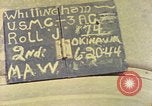
Wounded U.S. Marines being unloaded from Stinson L-5B aircraft on Okinawa in June 1945.
Air evacuation of wounded United States Marines on Okinawa by U.S. Army Air Forces Stinson and Marine Corps L-5B during World War 2. Various shots of wounded Marines on stretchers being unloaded from the aircraft. Medics carrying the wounded to a medical hut. More L-5B's land. A wounded Marine on a stretcher in L-5B talks with men standing outside the aircraft. Marine on a stretcher being released from harness. Stretcher being carried to a medical tent. L-5B aircraft lands and a litter case being loaded aboard Red Cross ambulance. Ambulance pulls away from the area with tents in the background. A shark-mouthed Marine Corps OY-1 (Stinson L-5) with the name "Budie" painted on nose taxis in front of camera. Identifiable aircraft in this clip: 44-16952 and 44-17164, both of the 163rd Liaison Squadron.

Vampire Jets of Italian Squadron taxi and take off at Wiesbaden Air Force Base during Project Cirrus
A U.S. Air Force airman holds a slate for the camera. Among other things, it identifies "Project Cirrus." Active scene following shows a line of Vampire Jet planes from the Italian 6th Inter Squadron. Italian airmen gather around one and then its engine starts showing flames to its rear momentarily. Next, the Vampire jet is seen taxiing past the line of aircraft, on its way toward the active runway. Two more Vampire jets leave their parking places and follows the first. Two ground crewman stand and watch as the three Italian Vampire jets take off.
Allied victories over Nazis in European Theater in 1944 and 1945 during World War 2
Eastern Front battle of Soviet army as it repels the German Wehrmacht from a Soviet city, and captures German POW's. The German prisoners are marched into Soviet camps in winter snow covered landscape under guard of Russian Army soldiers. Aerial view of massive invasion force in English Channel on D-Day for the the Invasion of Normandy. View from landing craft of American infantry going ashore. Allied soldiers taking fire from German enemy during D-Day beach landings. Allied armies moving inland through France seen in combat with Germans in French villages and towns. Many German prisoners rounded-up and seen marching toward prison camps under British and U.S. Army guard.
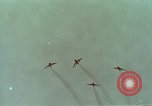
U.S. President John F Kennedy on visit to West Berlin, Germany
President Kennedy's first day started with aerobatic demonstration by planes. Airplanes are ready to take President to the visits most important stop, West Berlin. President's plane takes off from Wiesbaden Air Base. At Military Airport, West Berlin U.S. President Kennedy arrives. The welcome ceremony begins by Allied Troops as the President steps down. He came here to discuss the political problem of divided Berlin.President Kennedy addresses gathering. 26 June 1963.

Republic F-84E Thunderjet aircraft of the 86th Fighter-Bomber Wing, being refueled at Neubiberg Air Base near Munich, Germany.
A straight-wing Republic F-84E Thunderjet of the USAF 86th Fighter-Bomber Wing landing at Neubiberg Air Base near Munich, Germany. A USAF C-47 is holding short on the taxiway. Next, a crash truck is seen stationed on the taxiway.Across the field, Two C-47s, a B-17, and a C-54 are parked. Scene shifts to closeup of a tank truck carrying JP-3 fuel, parked next an 86th Wing F-84. An airman sits on the plane's left tip tank. The fuel truck operator and another airman pull two refueling hoses from the truck and carry them to airmen sitting on the aircraft's tip tanks. The aircraft is parked on Marsden Matting aka pierced steel planking. Closeup of the airman on the plane's right wing takes his hose and inserting it into the right tip tank. Views of him filling the tank. Two airmen are behind the fuel truck. One watches the fuel gages. Scene shifts to two airmen mechanics atop the aircraft. They are assembling and installing an avionics component. Closeup of the aircraft's crew chief, TSgt G. Cavert, sitting on the wing , next to a painting on fuselage of the 527th Fighter-Bomber Squadron logo: a black crow holding a bomb over its head ready to throw it. The names: Col. G. Laven and TSgt G. Calvert are painted above and below the logo, respectively. (This aircraft is F-84E-30-RE Thunderjet number 51-624 flown by the commander of the 86th Fighter Bomber Group, Colonel George Laven Jr. who flies with the 527th Fighter-Bomber Squadron.) Next several of the 86th Wing's aircraft are seen parked, and one airman is seated near an anti-aircraft gun, while another plays catch with someone, unseen.
CRITICALPAST.COM: About Us | Contact Us | FAQs - How to Order | License Agreement | My Account | My Lightboxes | Shopping Cart | Advanced Search | Featured Collections | Website Terms & Conditions | Privacy Policy ©2026 CriticalPast LLC.
License Agreement |
Terms & Conditions |
Privacy Policy
©2026 CriticalPast LLC.