


 Francais
 Deutsch
 Italiano

Refine Your Search
Wiesbaden Germany 1945 stock footage and images
- Showing 3823 to 3828 of 10473 results more
 Hide
Color Sound
Railway bridges repaired in Germany, and trucks manufactured at the Citroen plant in Paris, France during World War II.
Germany and German occupied France during World War II. Germany: German engineers repair a railway bridge. The men weld and assemble parts. German officers inspect the bridge. A train crosses the bridge. The German officers watch. In Paris: Trucks are assembled at the Citroen automobile plant. Men assemble truck engines. A woman works on a truck. Trucks on the assembly line.
Scenes depicting social activities in Germany, Hungary, and Austria, before World War I.
Social life of wealthy in Germany, Hungary, and Austria before World War 1. Kaiser Whilhelm II of Germany and his wife, Empress Augusta, in Berlin. The Empress The enters their open back limousine, followed by the Kaiser, who is dressed in military uniform with Prussian style helmet. They drive off while German Officer salutes. Complete change of scene shows well-dressed crowd of spectators gathered in Budapest, Hungary, to watch a horse race. Some spectators use binoculars. View of horses in final stretch and crossing finish line. Next scene shows "Flower Day" in Vienna Austria. Wealthy citizens crowd shopping area and contribute to help the poor. Finely dressed pedestrians walking in shopping and commerical areas. They receive flowers as token of contribution. Some men wear flowers in their lapels. Little girls with baskets of flowers participate in the activities, standing in front of the Cafe Scheidl and "Zum Fenstergucker" house near corner of Kaerntner Strasse and Walfischgasse next to the Opera House. A street car decorated with garlands of flowers is a center of the activity. Women on the top deck of the street car reach down with small nets on long poles to retrieve contributions from passersby.

Delegates of the 7th assembly of the League of Nations vote on the admission of Germany.
Shows 7th assembly meeting of the League of Nations in Geneva, Switzerland. The delegates vote on the admission of Germany. President of Assembly Eduard Benes open the 7th Assembly of the League. President of the 7th Assembly Mr. Ninchich addresses the assembly. Shows a telegram which is sent to the German Government by the Secretary General Eric Drummond. A reply to the League by Gustav Stresemann of Germany. Shows arrival of German delegation at Geneva. Press and public gather at the event.
A-20 "Boston bombers" and B-25 bombers with other heavy bombers attack German-occupied Northern France and Wuppertal Germany
Bombing campaigns in German-occupied Northern France and in Wuppertal, Germany. Two aviators from free French squadrons stationed in England climb into A-20 "Boston Bombers". View of bombers in flight low over water and then over towns of northern France. A-20s along with B-25 bombers bomb industrial areas over northern France. Views of smoke clouds, destroyed targets and impact of bombing. Dutch squadrons in B-25 aircraft attacking Nazi harbor installations. Aerial view of Wuppertal Germany being bombed at night. (World War II period).
Germany concludes armistice with France in Compiegne, France during World War II.
The Armistice at Compiegne, France on 22nd June, 1940 between France and Germany during World War II. German officers including General William Keitel, accompany Chancellor Adolf Hitler as they walk past a German honor guard lined up, while a band plays the German National Anthem. French General Charles Huntziger and another officer arrive and enter a railway carriage (the same one in which Germany signed the 1918 armistice). Interiors of carriage showing French General Huntziger signing the documents. Adolf Hitler has left and is chatting with German officers outside. General Keitel presents the document to Hitler for countersigning. Hitler asks for a pen, and they drop it as Keitel hands it to Hitler. Keitel quickly retrieves it and Hitler signs. French General Huntziger steps down from the rail car and is escorted away with others of his party. Hitler expresses pure delight in chatting with members of his staff.
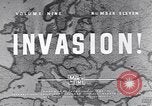
News media military analysts discuss the problems of Allies invading Europe to defeat Germany in World War II
Map of Europe and label "Invasion." Westbrook Van Voorhis leading a panel discussion about the problems arising from the Allied invasion of Europe in World War 2. He introduces panelists: Hanson Baldwin (military editor of the New York Times) Dewitt MacKenzie (Associated Press military analyst), and Paul Schubert (of Mutual Radio Network). He asks Mr. Baldwin about the importance of aerial bombing campaigns. Baldwin also stresses importance of a land invasion of Europe. Relief map of Europe highlighting major German cities. Asked about the merit of invading Italy on the way to Germany, Mr. Schubert cites the problem of the Alps and suggests other more effective invasion routes. Van Voorhis asks Mr. MacKenzie about best route into fortress Germany. He considers the criterion of ease of supply as most important, and suggests the Atlantic coast, near a good port and not far from England. Animated map shows this idea. When asked about this, Mr. Baldwin agrees completely, calling the conflict "a quartermaster's war." He adds, "The problem of victory is the problem of supply."
CRITICALPAST.COM: About Us | Contact Us | FAQs - How to Order | License Agreement | My Account | My Lightboxes | Shopping Cart | Advanced Search | Featured Collections | Website Terms & Conditions | Privacy Policy ©2026 CriticalPast LLC.
License Agreement |
Terms & Conditions |
Privacy Policy
©2026 CriticalPast LLC.