


 Francais
 Deutsch
 Italiano

Refine Your Search
Wiesbaden Germany 1945 stock footage and images
- Showing 4561 to 4566 of 10473 results more
 Hide
Color Sound

German villagers are forced by Allied troops to exhume Polish and Russian dead bodies at the Arnstadt Concentration Camp.
Arnstadt Concentration Camp in Germany immediately after World War II. German villagers are forced by Allied troops to remove Polish and Russian dead bodies from graves. Scattered dead bodies on a field after exhuming them.

Anti-Nazi protesters parade carrying picket signs, along a sidewalk in New York City, prior to World War II.
Protest against Nazi Germany held in New York City in the weeks after the Kristallnacht attacks on Jews in Germany. A sign reads "German Exposition Christmas Market Now Open." Anti-Nazi protesters march carrying picket signs along a sidewalk in front of the exposition of German goods. One of the signs reads "Boycott Nazi Goods." Another sign reads "German Exposition Christmas Market Dec 16-24". American and Nazi flags fly from the building.
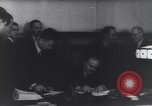
Signing of the German-Soviet Border and Commercial Agreement, by German Friedrich Werner von Schulenberg and Soviet Vyacheslav Molotov.
German diplomat Friedrich Werner von Schulenberg, of Nazi Germany, and Vyacheslav Molotov, of the Soviet Union meet together in Moscow, Russia, to sign the German-Soviet Border and Commercial Agreement. View of the two men and other representatives from each country at the signing ceremony. Narrator indicates that the agreement document covers expanded trade and commerce between the countries, establishes the northern border, and covers repatriation of Germans from republics including Lithuania and Estonia. View of the German and Soviet leaders each signing the document. Wax seals are added and a close-up of the signature page of the agreement is shown. (The Agreement also included the third set of secret protocols of the Hitler-Stalin Act or German-Soviet Treaty of Nonaggression. It followed the German-Soviet Frontier Treaty, which was the second secret protocol. Despite the pact, Germany attacked the Soviet Union 6 months later.) (World War II period).
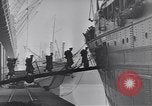
U.S. Army Service Forces transporting troops and supplies worldwide during World War II.
U.S. troops board a large troop transport ship via a gangplank. Troops on an intermediate deck of the ship. Some are sprawled out relaxing. View from above of more troops boarding a ship. Men and equipment on the pier below. American forces at various far flung places where the U.S. Army Services Forces facilitated their transport and logistic support. Fleeting glimpses of troops in: Ireland; Alaska; Trinidad; and South America. Troops jam the upper deck of a transport ship. Army Service Forces officers in a planning meeting. Naval officers on deck of a ship look through binoculars as U.S. Naval ships bombard the coast of Solomon Islands and landing craft carry marines in an amphibious assault. Next, a man is seen annotating a map of North Africa. Secret maps pertaining to Allied landings in Tunisia and Algeria. Animated map illustrates amphibious landings on North African coast, highlighting Casablanca, Oran, and Algeria. Landing craft carry troops and supplies that are piled up in the sand beach. Soldiers moving military supplies ashore, in fire brigade fashion. Soldiers working at desks in Offices of the Army Service Forces. Filing cabinet in background. Trucks on the move in remote locations. Supply ship being loaded at a terminal. Fuel drums and army vehicles a being loaded aboard ships. Officers seated at a conference table. Ordinary American enlisted soldiers in a griping session at an Army post in the United States. Camera pans over large formation of soldiers. Animated chart shows more than half of servicemen who are part of Army Service Forces (ASF), are unaware of that. Troops marching in review at a tropical location, where reviewing officers wear pith helmets. Chart illustrates lack of unit pride in ASF. Images of various ASF logos. Chart shows results of polling data from soldiers and service members. Signal Corps and Engineers elements of ASF have the greatest unit pride. But most think better of other branches of the Army. More troops marching, in steel helmets and carrying rifles with bayonets affixed. Troops marching overlaid by "50%" indicating that half don't believe their contributions to the war effort are significant. Troops lined up (for pay?). More charts expressing concern about low morale. A heavy gun firing. German paratroopers jumping from a formation of Junkers Ju 52 aircraft. Charts expressing prevailing U.S. troops view that Germany wouldn't be too hard to defeat. Chart showing lack of understanding about why the U.S. is fighting Germany. Image of President Franklin D. Roosevelt and Prime Minister Churchill seated in front of their key military officers at Casablanca Conference in World War 2. Chart shows U.S. soldiers believe that the greatest war effort is expended by the U.S. followed by Russia, with China and Britain providing little. Chart illustrates that only half U.S. troops want to get overseas and fight. Chart shows U.S. War Department films can correct this problem.
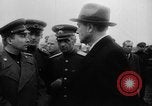
8th Air Force and 15th Air Force personnel are briefed in the European Theater for their first shuttle bombing run.
A film on U.S. shuttle bombing operations 'Operation Titanic' over Germany from bases in Great Britain, Italy and Russia during World War II. Personnel of the U.S. 8th Air Force in Great Britain. The U.S. 15th Air Force personnel in Italy. The are briefed about the first shuttle bombing run to new Russian airfields. United States Army Air Force General Nathan Farragut Twining addresses the personnel and bids them farewell. United States Army Air Force B-17 Flying Fortresses led by General Ira Clarence Eaker take off. USAAF B-24 Liberators take off from Great Britain. P-51 Mustangs and P-38 Lightning fighter airplanes escort the bombers on their way. The bombing forces bomb the targets in Germany. They return after their mission. Crew and officers look at the aircraft as they fly overhead. The officers look through binoculars. The crew waves towards the aircraft.
Otto Von Bismarck, Prince of Wales, Tsar Nicholas II and Kaiser William II at the turn of the 20th century.
Earliest motion pictures captured at the turn of the 20th century in Europe. Berlin 1895: Otto Von Bismarck, Chancellor of Germany, addresses Germans about the need for 'blood and iron'. Large crowd gathered at a Berlin square to hear him. Next scene is in England, United Kingdom, in 1903: The young boy future Prince of Wales and future King Edward VIII plays with his brother Albert (the future King George VI) and his sister, Mary (Princess Royal and Countess of Harewood) on the grounds of Windsor Castle. The two boys hold toy guns and march. Next images are in Moscow, Russia, in 1907: Nicholas II, Tsar of Russia, at a gathering with military officials and other dignitaries. A large crowd outside the palace. Germany, 1910: Kaiser Wilhelm II along with other military officials at an orphanage. Children put up a show for the German Emperor. Orphan children posing with the Kaiser.
CRITICALPAST.COM: About Us | Contact Us | FAQs - How to Order | License Agreement | My Account | My Lightboxes | Shopping Cart | Advanced Search | Featured Collections | Website Terms & Conditions | Privacy Policy ©2026 CriticalPast LLC.
License Agreement |
Terms & Conditions |
Privacy Policy
©2026 CriticalPast LLC.