


 Francais
 Deutsch
 Italiano

Refine Your Search
Wiesbaden Germany 1945 stock footage and images
- Showing 481 to 486 of 10473 results more
 Hide
Color Sound
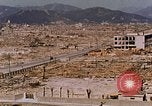
Buildings destroyed on an island between Motoyasu and Tenma rivers in Hiroshima, Japan as a result of the atomic bomb explosion.
Physical damage caused due to atomic bomb explosion in Hiroshima, Japan on August 6, 1945. Bridge across a river as vehicle moves over the bridge. Island between Motoyasu and Tenma rivers. Rubble spread all over the area with wooden huts. Buildings partially damaged by the atom bomb explosion. (World War II period).
Farmers work on field,Henry Gurney visit people and British soldiers, check ID cards of people in Malaysia
The film titled 'How to fight a guerrilla war' about guerrilla war for independence fought between Commonwealth armed forces and Malayan Communist Party in Malaysia. Soldiers wade across a stream. Soldiers advance through a jungle. An aircraft in flight drops bombs. A helicopter takes off. 1945: jungle on a mountainous area. Aerial view of a sea coast. Houses on the coastal area. Farmers work on field. Women use mortar and pestle to crush. Chinese men smoke pipe. A woman works on a sewing machine. Children sit on ground. Farmers work on field. European people carry water through poles on their shoulders. A woman takes out rubber from a tree. Rubber sacks pile up. Water being sprayed on field by a pipe. Equipment hooked in a crane. Animation of a map shows Malaysia. Burning houses and jungles. Men inspect area near a derailed train. Dead bodies in water. Burned tin mines and other plants. Workers outside their houses. A girl stands on doorway. A child cries. A family evacuates the place on a truck. A man puts a light on pole. A soldier near a power grid. A soldier on guard atop a hill. Soldiers walk through a jungle. Men carry water containers. People get themselves registered. Identity cards of people on table. A soldier puts mark on nail of a woman. A soldier signs on an ID card. British High Commissioner in Malaya Henry Lovell Goldsworthy Gurney disembarks a vehicle. He meets people. People come out of a truck. People get registered. People take oath. They learn military tactics.
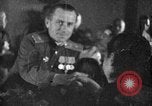
Russian officers speak and Korean people exchange gifts with Soviet soldiers in Korea.
Two years before the Korean War: Russian soldiers are honored before leaving Korea. Officials at a mass meeting. The wall behind the speaker's stand is decorated with pictures of Kim II Sung and Joseph Stalin with dates 1945-1948. Russian officers speak and receive gifts from the people of Korea. Korean boys exchange gifts with Russian girls. Girls present flowers to Soviet fliers. Two Soviet aviators hold Korean children. A line of Soviet Yakovlev Yak-3 interceptor aircraft. A pilot prepares and takes off in one of the Yak-3 aircraft. The girls wave to the fliers. Soviet Yak-3 aircraft in flight.
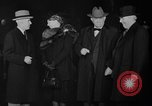
Activities of Eleanor Roosevelt in post-World War II period
December, 1945, former First Lady, Eleanor Roosevelt, now appointed by President Truman, as a delegate to the United Nations, is seen with other members of the U.S. Delegation. She is seen speaking while serving as chairman of the UN Committee Three, dealing with human rights. She recognizes the delegate from the Soviet Union, as the committee addresses issues of refugees. (The USSR insists that displaced persons be returned to their original homelands.) As chairman, Mrs. Roosevelt, rules a USSR proposal out of order, causing the USSR representatives to leave the room. A glimpse of Eleanor Roosevelt at a microphone during debate over the issue with the USSR, before the full General Assembly, where she successfully argues to allow refugees to make their own decisions about repratriation. She is seen sitting next to delegate,Senator Arthur Vandenburg, at the forum. Eleanor Roosevelt being greeted by U.S. Army officers as she steps from an airplane in Europe. She is seen mingling with persons in Europe, displaced by World War II. Back in the UN forum, she extols the International Declaration of Human Rights as an "International Magna Carta of men everywhere," and goes on to compare it with similar charters of history. She is seen at a Pan American World Airways terminal, preparing to board a flying boat (unseen). Several scenes show Eleanor Roosevelt visiting with people in various parts of the world, with particular attention to children. She speaks of her candid nature in a broadcast.
Russian advisers with Nationalist Chinese (KMT) military during 2nd Sino-Japanese War (WW2)
Passengers jam a train at an open air railway platform in China. Many sit, together with their belongings, on roof of the train. Some persons on the station offer to sell food to occupants of the train. Change of scene shows Soviet Lieutenant General Vasily Chuikov, advisor to Chinese Generalissimo Chiang Kai-Shek, having an amicable conversation with a Chinese Major General and his aide in World War II.(The latter has injury to his nose.) Next, several Russian troops are seen standing guard in unkempt town square, containing a monument. They appear unsettled by the presence of the cinematographer. Building in background flies Soviet flag and has large picture of Stalin on it. Views are shown of a modern building with drive up ramp to entrance (airport terminal?) and then of a stylish train station displaying Chinese (KMT) and Soviet flags and pictures of Lenin and Stalin. ( Glimpse of a tall white monument with a Soviet T-34 tank on top, followed by another view of the train station.) Next a corner building in the city is seen with Armed Chinese guards protecting sacks of food supplies piled up next to it. A Chinese officer walks past the guards and into the building. View of car and pedestrians on a dusty city street. More views of the Chinese guards and foodstuffs. (Note 1: The images seen here are mixed in place and time, including 1941 and 1945..) (Note 2: Soviet Lieutenant General Vasily Chuikov was recalled from China at end of 1941, and placed in command of the Soviet 62nd Army responsible for the defense of Stalingrad.)
Czechoslovakia and Soviet relations after World War 2; Dubcek liberalization during Prague Spring; Soviet occupation in 1968
History of Czechoslovakia from 1919 to 1968 depicts lives of its people and various crisis. Clip shows combination of still images and moving images, with background of Czech musical soundtrack. A burning Nazi plane shot by Soviet military during World War II. Soviet Red Army marches in Prague, Poland in May 1945 to rescue from German occupation and atrocities. People destroy Nazi emblems and symbols from buildings. People assemble in large numbers on roads and cheer for the incoming Soviet troops and tanks. Civilians of Czechoslovakia during normal life after World War 2. Workers in mines, farmers in field and women work in houses. Spread of communism and communists make a star formation during a rally in Prague (sometimes called the Prague Spring). President Edvard Benes in 1948 signs pact with Soviet government. Photos of Soviet General Joseph Stalin and other Soviet leaders in his office. Various Presidents and leaders of Czechoslovakia during the 1950s. Military and civilian communist groups march on streets in 1956. Czech Skoda automobile production factory scenes in mid 1960s. Workers work in factories and shops till night hours. A Czech textile factory scene. Czech men and women in 1960s fashions enjoying mugs of beer. Several scenes with Alexander Dubček, (Alexander Dubcek), then Soviet leaders Nikita Khrushchev and Nikolai Brezhnev arrive for meeting with Dubček. Smiling Czech people walk in cities and at a cafe during liberalization measures. Soviet and Warsaw Pact tanks, armored vehicles, infantry and aircraft start their occupation ending the Prague Spring in Prague, Bratislave and other cities in August 1968. Civilians protest, demonstrate, and argue with Soviet troops and demonstrate in streets. Some approach tanks and attempt to damage the tanks. Large crowd of civilians watch the retreating Soviet forces from Czechoslovakia in 1968. Red Army met with agitation and resistance on streets by civilians. Soviet troops fire at some demonstrating civilians.
CRITICALPAST.COM: About Us | Contact Us | FAQs - How to Order | License Agreement | My Account | My Lightboxes | Shopping Cart | Advanced Search | Featured Collections | Website Terms & Conditions | Privacy Policy ©2026 CriticalPast LLC.
License Agreement |
Terms & Conditions |
Privacy Policy
©2026 CriticalPast LLC.