


 Francais
 Deutsch
 Italiano
Refine Your Search
Wiesbaden Germany 1945 stock footage and images
- Showing 5515 to 5520 of 10464 results more
more Hide
Hide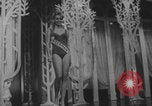
Reita Faria of India is crowned Miss World 1966
The 1966 Miss World pageant, held at the Lyceum Theatre Ballroom (Lyceum Theatre, 21 Wellington St, London WC2E 7RQ, United Kingdom) in London, United Kingdom. Women beauty pageant contestants seen on the stage include contestants from Germany, New Zealand, Sweden, Syria, Venezuela, USA, France, Yugoslavia, and India. Miss India, Reita Faria, sits on the throne while Miss World 1965, Lesley Langley of United Kingdom, crowns her as Miss World 1966. Italian artist and director Beni Montresor is seen as one of the judges. Reita Faria walks the stage carrying scepter and wearing crown.
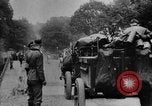
German forces occupy Warsaw, Polish resistance fighters print leaflets and paint graffiti during WW2
Arrival of Nazi military vehicles with soldiers in Warsaw after its capture by Germany during World War 2. German soldiers patrol the besieged streets of Warsaw as citizens watch. Destroyed city blocks in smoke after German bombing. A bomb crater in middle of destroyed city blocks in Warsaw after German bombing. Woman cries over dead relative as gravedigger digs a grave in Warsaw cemetery. Graves in Warsaw cemetery. View of the highest Polish military decoration, the Virtuti Militari. Coat of arms of Warsaw. Warsaw Castle Square (plac Zamkowy01-195 Warszawa, Poland), with Baroque column of Polish King Sigismund III Vasa, in ruins after being shelled, burned and looted by German forces. Graffiti in Polish. Polish resistance fighter crawling in underground tunnel. Collection of guns and grenades. Polish resistance documents and pistol. Man prepares printing press. Man prints more Polish resistance leaflets. Polish resistance fighter proofreads a document. Printing press prints more leaflets. Piles of leaflets. Man carefully wrap reams of leaflets. Polish men walking in Warsaw street. German document announcing daily execution of Poles in Lublin. Two Polish men glues a resistance leaflet in wall. Polish man writes “pawiak pomścimy” (“We will avenge Pawiak” in Polish) on the wall. Man paints graffiti saying “Verloren” (“Lost” in German). Wall displays anti-Nazi graffiti speech and symbols such as “HYCLER”, a hanged Swastika in gallows, a turtle, and the “PW” Kotwica emblem of the Polish Underground State. Writing on the ground says “Polska Walcząca” (“Fighting Poland” in Polish).
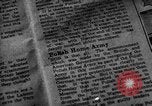
Warsaw bombed by Germans in retaliation to 1944 uprising, various scenes of Warsaw before WW2
Newspapers around the world reporting on the bombing of Warsaw by Nazi Germany as retaliation for the Warsaw Uprising during World War 2. Newspaper headlines read, "Poles Fighting Inside Warsaw," and "Warsaw Being Razed by Hitler's Order," and "Warsaw's Plight" and "Warsaw Poles Fight Tanks in Streets." Scenes of Warsaw in flames as buildings are being bombed by German forces. Montage depicting Warsaw on fire. Scenes of Warsaw before WWII, including scenes such as the Warsaw Old Town Market Square (rynek Starego Miasta, 00-279 Warszawa, Poland), the column of Sigismund III Vasa (plac Zamkowy, 00-001 Warszawa, Poland), the Royal Palace (plac Zamkowy 4, 00-277 Warszawa, Poland) and the Lazienki Park, before World War 2. Statue of King Jan III Sobieski in Lazienki Park. Men strolling near a palace. Baroque gates in park.
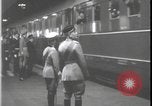
Adolf Hitler meets King Victor Emmanuel III, Benito Mussolini, and Foreign Minister Count Galeazzo Ciano during visit to Rome, Italy
Adolf Hitler arrives by train in Roma Ostiense station in Rome, Italy (Partigiani Square, - 00161 Rome). King Victor Emmanuel III of Italy greets Adolf Hitler with a military salute. Italian Premier Benito Mussolini and Foreign Minister Count Galeazzo Ciano greet Adolf Hitler with Roman Salute upon arrival. Adolf Hitler shakes hands with King Victor Emmanuel III, Benito Mussolini and Count Ciano. Adolf Hitler addresses cheering Italian crowds from the Bernini balcony of the Quirinial Palace, the royal residence of the King of Italy (Piazza del Quirinale - 00187 Roma (RM)). In Rome’s Roma Termini Station (Piazza dei Cinquecento - 00185 Rome), Adolf Hitler says goodbye to Benito Mussolini and Count Ciano before he boards the train heading for Florence and Germany. Adolf Hitler waves at crowd from train window.
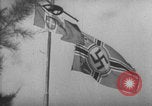
Jagdgeschwader 53 Luftwaffe officers play with dog, paint planes in Sicily, WW2
Jagdgeschwader 53, also known as "Pik As" (Ace of Spades) Geschwader German Luftwaffe in Sicily, Italy during World War 2. Flags of Italy and Nazi Germany together. German officers play with a fox terrier dog, passing him to each other as he doggedly hangs on to a shoe while biting it. Nazi pilot, wearing a flight vest and an Iron Cross, plays cards with comrades. The "Pik As" (Ace of Spades) symbol on an airplane. German Luftwaffe pilot painting another of many Abschussbalken symbols of air victory on the tail of a plane. Mechanics fixing the engine of a fighter, likely a Messerschmitt Bf 109. A crane lifts a Daimler Benz 605 engine. Man spray paints “3” on a plane. A sign in German saying “Die an “dicke Luft” gewöhnten Jöge sind dem Pressluft rausch verfallen” (“Boys, who got used to “Thick Air”, are addicted to the high of compressed air” in German). A man picks up a fox terrier dog by the scruff of its neck and carriers it away.
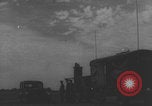
Vickers Wellington No. 149 Squadron RAF takes off during WW2
Period dramatization: British Royal Air Force (RAF) station groundcrew assist Vickers Wellington No. 149 Squadron RAF during taxiing and take off from RAF Mildenhall airfield during World War 2. A ground control crew member salutes to an officer, the air controller, entering the control room of a portable ground controlled approach radar equipment (GCA) room. Air controller stands on a wooden stool to look through a bubble window in the control room’s ceiling. Air controller tests his radio, saying, "ground control, are you receiving?" View of air direction indicator on air field. Engines running on Vickers Wellington bomber at sunset along with "OC" on fuselage. “You may taxi out and take off!” the air controller says after a pilot asks for clearance on the radio. A Vickers Wellington bomber taxiing. Evening view of lighted bubble window of air control trailer as air controller inside watches the Vickers Wellington bomber taking off. Vickers Wellington bomber flying over RAF Mildenhall airfield. “C for Charlie airborne sir! Nineteen hours thirty-five minutes!” a RAF officer says as he enters air control trailer. Air controller standing in control room dome relays information, saying, "C Charlie took off 19:35." Inside air control headquarters at RAF Mildenhall as RAF officer smokes a pipe while another RAF officer writes flight information on the blackboard. More Vickers Wellington bombers taxi and take off from the airfield one by one. Vickers Wellington OJ-F 'F for Freddie' kicking up dust as groundcrew watches. Vickers Wellington OJ-F 'F for Freddie' taking off as the last Vickers Wellington bombers in No. 149 Squadron departs for Germany at night. View of pilot in Vickers Wellington as he radios to crew, "OK chaps, here we go!" RAF officer writes down the last aircraft’s departure time as “19:51”.
CRITICALPAST.COM: About Us | Contact Us | FAQs - How to Order | License Agreement | My Account | My Lightboxes | Shopping Cart | Advanced Search | Featured Collections | Website Terms & Conditions | Privacy Policy ©2026 CriticalPast LLC.
License Agreement |
Terms & Conditions |
Privacy Policy
©2026 CriticalPast LLC.