


 Francais
 Deutsch
 Italiano
Refine Your Search
Worms Germany 1945 stock footage and images
- Showing 10369 to 10374 of 10469 results more
more Hide
Hide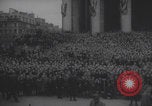
Cross of Liberation parade at Rue Royale, Place de Madeleine and Palais Garnier (WW2)
A parade celebrates the awarding of Cross of Liberation (Croix de la Libération) to the city of Paris (World War II). A huge crowd gathers outside the L'église de la Madeleine (Place de la Madeleine, 75008 Paris, France). French soldiers holding flags march down Rue Royale from Place de la Concorde (Place de la Concorde 75008 Paris, France) as crowds watch the parade on the sidewalks. Throngs of French civilians crowd Rue Royale and Place de la Madeleine to watch a parade. Two crowd marshals salute to marching soldiers. Young French people perch on top of a newspaper stand to watch the parade. More people watch the parade from their windows. French children holding signs that read “Vive la France” and “Vive Paris”. Crowds clapping. Crowds gathered outside the Hotel Scribe in Paris (Now known as Sofitel Le Scribe Paris Opéra- 1 Rue Scribe, 75009 Paris, France). From Place de la Madeleine, soldiers turn to march in Boulevard des Capucines, marching past the Palais Garnier (Place de l'Opéra, 75009 Paris, France) with more crowds watching from the sidewalk and in front of the opera house.
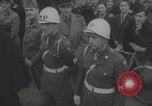
General Charles de Gaulle presents flags to soldiers during an Easter parade ceremony celebrating the liberation in Paris, France (WW2)
General Charles de Gaulle presents regimental colors and standards to soldiers as a symbolic reconstruction of the French Army during liberation ceremony in Paris (World War II). Two stern United States military police stand in the crowd. French troops attend the ceremony in Place de la Concorde (Place de la Concorde 75008 Paris, France). General Charles de Gaulle presents flags with regimental colors that had been hidden from Germans during the war to French soldiers at the Place de la Concorde. Soldiers go down the stage after receiving their standards. Close up of an elderly soldier. Soldiers salute to General de Gaulle after going on stage. Soldiers receive their standards from General de Gaulle. Words seen on flags include "Honneur et Patrie (Honour and Fatherland) and "Republique Francaise" (French Republic.)
United States soldier finds and destroys a Japanese Shinyo suicide motorboat (WW2)
A Japanese suicide boat near the Kerama Islands (32 kilometers south-west of Okinawa Island), Japan during World War 2. A coast in the Kerama Islands. A Shinyo-class suicide motorboat is found covered with foliage as camouflage. A United States soldier throws a phosphorus grenade into the suicide boat. Suicide boat in flames. Scattered remains of a suicide boat after its destruction. Motor parts are scattered in the jungle. A soldier inspects remains of suicide boat.
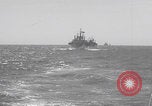
United States APA ships sailing towards the Kerama Islands, Japan (WW2)
United States attack transport ships (APA) sailing toward the beach at Kerama Islands (Japan) during World War 2. A group of APA ships sailing on choppy waters in the Pacific Ocean. View of an APA ship.
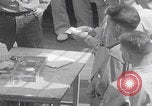
U.S. soldiers receive wages from a Naval Supply Officer while sailing to Okinawa (WW2)
United States soldiers receive their salary from the U.S. Navy supply officer while sailing to Okinawa during World War 2. Naval Supply Officer sits behind a small desk with a cash box. Naval Supply Officer gives soldiers’ wages in cash as B type military scrip. Soldiers line up to receive their wages. An officer hands out a document (likely a pay slip) to soldiers after receiving their salary. Soldiers watching as the Naval Supply Officer disburse wages in cash. A soldier inspects a 20 “B Yen” note (United States B type military scrip currency in Japan).

U.S. soldier drives a Japanese Shinyo suicide motorboat found in the Kerama Islands (WW2)
A United States soldier climbs down into a Japanese Shinyo suicide motorboat found in the Kerama Islands during World War 2. Soldier begins to drive the retrieved Japanese motorboat. Motorboat driven by an American soldier underway circling along the beach of Kerama Islands at high speed. United States soldiers docking Shinyo suicide motorboat after testing.
CRITICALPAST.COM: About Us | Contact Us | FAQs - How to Order | License Agreement | My Account | My Lightboxes | Shopping Cart | Advanced Search | Featured Collections | Website Terms & Conditions | Privacy Policy ©2026 CriticalPast LLC.
License Agreement |
Terms & Conditions |
Privacy Policy
©2026 CriticalPast LLC.