


 Francais
 Deutsch
 Italiano
Refine Your Search
Worms Germany 1945 stock footage and images
- Showing 1069 to 1074 of 10469 results more
more Hide
Hide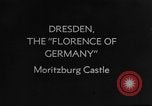
The Moritzburg Castle, the Opera House and the Zwinger Museum in Dresden, Germany.
Famous tourist destinations and architecture in Saxony, Germany, before World War 2. Views of the Moritzburg Castle (Schloss Moritzburg, Schloßallee, 01468 Moritzburg, Germany) and the Semperoper Opera House building (Semperoper Dresden Schinkelwache Theaterplatz 2 01067 Dresden) in Dresden, Germany. View of the world-famous Zwinger Museum (Zwinger Theaterplatz 1 01067 Dresden). Trains passes by on a track. Buildings in the background.

The Alster River, the Chile Haus, Hamburg Airport and St. Pauli in Hamburg Germany.
Famous tourist destinations and architecture in Hamburg, Germany, before World War 2. The Alster River in Hamburg. A train runs on a bridge over the river. Trees in the background. People row boats in the river. Buildings seen on either side of a stream in Hamburg. View of the Chilehaus (Chile House Fischertwiete 2A, 20095 Hamburg, Germany) in the modern Kontorhaus District, Hamburg. People walk outside the modern Hamburg Airport (Flughafenstr. 1-3, 22335 Hamburg, Germany). Flags on either side of the airport. A Zepellin airship seen. Scenes of St. Pauli, the entertainment district of Hamburg, during the night. A Hamburg American line steamer seen.
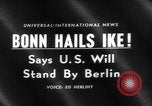
U.S. President Dwight D. Eisenhower visits Bonn, Germany during his European Tour.
United States President Dwight D. Eisenhower visits Bonn, Germany. President Eisenhower arrives at Cologne Bonn Airport during his European Tour. Flags of the United States and Germany. German Chancellor Konrad Adenauer and other dignitaries welcome Eisenhower as he disembarks from a United States Military Air Transport Service (MATS) aircraft. Eisenhower greets Chancellor Adenauer and the officers in Cologne Bonn Airport (Cologne Bonn Airport Kennedystraße, 51147 Köln, Germany). Secretary of State Christian Herter hears Eisenhower’s speech. During his speech, Eisenhower declares that the United States will stand by West Berlin. 315,000 civilians wave and greet Eisenhower as his motorcade passes through a street. “We like Ike and Conny” banner (pertaining to Eisenhower and Adenauer).
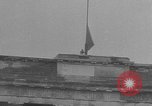
The Soviet Army suppresses uprising of 1953 in East Berlin and other cities in East Germany
The Soviet Army suppresses uprisings in East Germany during worker strike and civilian protest of 1953. Demonstrators haul down a red flag atop the Brandenburg Gate in East Berlin. Crowds at Potsdamer Platz disperse as gunfire breaks out. A wounded demonstrator is assisted by comrades during the protest. Soviet tanks rumble through the streets. Martial law is declared and orders of the Military High Command are posted in East Berlin. Demonstrators throw rocks at Soviet tanks on the street. Soviet tanks and troops block demonstrators. A map shows East German cities with uprisings: Dresden, Magdeburg, Frankfurt, Schwerin, Leipzig, Rostock, Erfurt, Chemnitz, and others. A poster dated 18 June, 1953 announces the execution of Willy Goettling as a leader of the uprising. A newspaper announcement reports the condemnation of Alfred Diener, of the city of Jena, as a provocateur. Konrad Adenauer, Chancellor of West Germany, presides over a public funeral for Germans who lost their lives in the Soviet suppression of East Berlin. Leaders of East Germany are seen and East German proceedings against alleged ringleaders of the uprisings. East German refugees fill a large open building. They carry belongings and sleep on the floor.
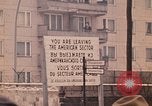
U.S. President Richard Nixon visits Berlin, Germany and receives warm welcome from the civilians during official visit to Europe.
United States President Richard Nixon visits Berlin, Germany and receives warm welcome from the civilians during his visit to Europe. A sign denoting border of American sector is seen at Checkpoint Charlie (Friedrichstraße 43-45, 10117 Berlin, Germany). Press reporters and large crowd of civilians surround and cheer for President Nixon and party. Nixon, German Chancellor Kurt G Kiesinger and party wave for the crowd from a high scaffold. Nixon gives autographs to people. Views of dilapidated East Berlin and some west Berlin buildings as seen from moving vehicle in Nixon's entourage. The damaged Kaiser Wilhelm Memorial Church (Breitscheidplatz, Berlin, Germany). A large crowd gathered at Kurfürstendamm boulevard to witness the visit of President Nixon and his party.
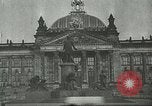
Militarization of Germany under Adolf Hitler's rule in mid 1930's, prior to World War 2
During the trial of Nazi leaders for war crimes at Nuremberg, Germany Hans Gesevius, former official of Berlin Police department testifies regarding his investigation of Reichstag fire. Scenes immediately following burning of Reichstag building -- destroyed as a result of fire. Firemen direct water hoses on smoldering Reichstag ruins. 1933 meeting where German representatives leave the League of Nations and Germany thereafter begins remilitarization and war production of armaments contrary to Treaty of Versailles. General Werner Edward Fritz Von Blomberg announces universal military conscription. Drafted and mobilized German men receive military training and goosestep on a training field with a Junkers 52 airplane in background. The new German soldiers goosestep while walking bicycles. German troops march to invade Rhineland. Mobilized Nazi German soldiers seen crossing Hohenzollern Bridge over the River Rhine, with Cologne Cathedral in the background. Nazi official announces March 7, 1936 invasion of Rhineland at a Nazi party gathering with Hitler present. Nazi German troops march at a parade in Nuremberg, Germany. Nazi military officers observe the parade and Adolf Hitler gives a Nazi salute to the German forces.
CRITICALPAST.COM: About Us | Contact Us | FAQs - How to Order | License Agreement | My Account | My Lightboxes | Shopping Cart | Advanced Search | Featured Collections | Website Terms & Conditions | Privacy Policy ©2026 CriticalPast LLC.
License Agreement |
Terms & Conditions |
Privacy Policy
©2026 CriticalPast LLC.