


 Francais
 Deutsch
 Italiano

Refine Your Search
Worms Germany 1945 stock footage and images
- Showing 133 to 138 of 10479 results more
 Hide
Color Sound

Japan's possible shortages of material for clothing in World War 2. Japanese domestic production of cotton, wool, and silk
Illustrated discussion of Japan's limitations in natural resources prior to World War II. Workers shown in textile mills which employed more than half of Japan's factory workers prior to the war, satisfying domestic and export needs. Analysis of the natural resources. Cotton thread is rolled on the spindles in the Textile mills in Japan. Textile mills produce fabric in Japan. Japanese women work in the textile mills. Bales of raw cotton imported from Japanese possessions in Korea and Formosa, and from the United States,India, Brazil and China. They are transported via horse carts and manually pushed on small rail carts to storage buildings for stockpiling. People cultivating some of the small amount of cotton grown in Japan. Horses and cattle used to pull plows in rice paddies. Pigs used as scavengers. Woolen fabric is produced from wool. Some of Japan's very few sheep being sheared for wool. Women working in fields of mulberry trees where silk worms flourish on their leaves. Views of the silk being spun onto spindles in a factory. Silk fabrics being stacked. Illustrated summary highlights Japanese domestic shortages of cotton, wool, and leather needed for clothing.

Emperor Karl I of Austria and Empress Zita in exile in Madeira Island, Portugal. Views of exile residence.
HMS Glow Worm of British royal Navy seen docked at Funchal, Madeira Island. Salute from ship guns is fired. At the Funchal wharf , Austro-Hungarian Emperor Charles I (Charles I of Austria or Charles IV of Hungary) and his wife Zita, Empress Consort, are seen arriving from the ship during their exile. Police manage crowd of onlookers as Emperor Charles Zita leave a church with a Catholic Priest, and enter a waiting automobile. Views of the Austrian emperor's exile residence exterior and interior, including an ornate living room. Guard on duty outside the residence. Emperor Charles and Zita exit an automobile and walk together as onlookers watch.
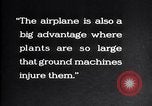
Men dust poison in the field with the help of one mule drawn duster in United States.
Man on one mule drawn duster in field, United States. Another man stands nearby. Man dusts poison in the field. Flea hopper, louse and leaf worms are the other insects harmful for the plants. Insects on the leaf. It destroys the leaf.

U.S Department of Agriculture Scientists conduct research on DDT in a laboratory
A U.S. Navy training film titled 'DDT' about the usage and importance of DDT as a disinfectant in the United States. Swarms of worms and insects. A sign on a box reads 'DDT' . A sign reads 'US Department of Agriculture' A woman inside a lab. Man and woman conduct research. They look at a tin of DDT (Dichloro-Diphenyl-Trichloroethane). A woman pours a golden liquid in a flask to dilute DT. DDT emulsion being produced. A mixture with a creamy layer in a flask. Woman stirs the mixture.

Postwar field Testing of German Armor, by Allies, 1945
Postwar Allied testing of German Armor at secret Henschel tank testing grounds (Henschel Panzerversuchsstation) in Haustenbeck, a village in the center of the Sennelager training area, West of Oesterholz and Schlangen, and East of Lager Staumühle, Germany. Seen are Valentine tank, Tiger II (AKA King Tiger, or Royal Tiger) Tank and Self-propelled Gun mounted on Valentine chassis tank. The Royal Tiger Tank with broken gun barrel moves on the ground and breaks through a grove of small trees. The tanks circle a Tiger E, chassis number 250001, which has been abandoned and stripped after years of testing. The seventy-six mm antitank gun mounted on a Valentine chassis fires shells at the Tiger E. (Note: These tests could provide data affecting future Allied tank designs.They were organized by Major-General Sir Percy Cleghorn Stanley Hobart, a renowned pioneer in motorized mobile warfare. Paradoxically, his ideas influenced German tank development and tactics before World War 2. Also present was Dr. Arnold from the Henschel and Sons Company that manufactured tanks at its Mittelfeld Works.)

U.S. and German troops in German village after end of WWII hostilities in 1945
German soldier prisoners moving in Tannenbergsthal, Germany after end of hostilities in World War II German trucks and buses proceeding on village road. American soldiers in jeep in the foreground. American soldiers talk with a German officer. Jeep turns around and is driven down a village road. Buildings in the background. German soldier dips food from a large container into a smaller one. German soldiers eat in fields. German officer sleeps on ground. German soldiers stand beside an automobile.
CRITICALPAST.COM: About Us | Contact Us | FAQs - How to Order | License Agreement | My Account | My Lightboxes | Shopping Cart | Advanced Search | Featured Collections | Website Terms & Conditions | Privacy Policy ©2026 CriticalPast LLC.
License Agreement |
Terms & Conditions |
Privacy Policy
©2026 CriticalPast LLC.