


 Francais
 Deutsch
 Italiano
Refine Your Search
Worms Germany 1945 stock footage and images
- Showing 283 to 288 of 10469 results more
more Hide
Hide
Destroyed B-29, its parts and scattered debris viewed the day after it crashed on Tinian in the Northern Marianas Islands.
Remains of United States Army Air Forces B-29A Super fortress that crashed on March 30, 1945, at North Field, Tinian,in the Northern Mariana Islands, during World War 2. Scattered debris on ground. Remaining piece of tail section displays serial number 265283 indicating it is B-29 number 42-65283, nicknamed "Big Wheel," from the 9th Bomb Group, 99th Bomb Squadron. Reportedly, it experienced mechanical problems during a mission to drop mines in Japanese waters. After jettisoning its munitions, it returned to Tinian, but crashed on the shore. Of the 12 crew, only the radar operator survived.
Remains of a United States Army Air Forces B-29 Super fortress that crashed on Tinian in the Northern Mariana Islands., during World War II
Remains of USAAF B-29 number 42-65283 from the 9th Bomb Group, 99th Bomb Squadron, that crashed, 30 March 1945, in World War 2, on Tinian, Northern Mariana Islands. All crew members were immediately killed in the crash, except tail gunner, Sgt. Joseph C. Trullo, Jr., who initially survived but died of his injuries, five days later, and the sole survivor, Radio Operator, Sgt. James Langraf who was injured but eventually recovered. Air Force personnel inspect debris that is scattered across the crash site in sand dunes close to the ocean in the background.
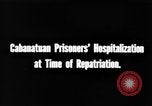
Hospitalization of American prisoners of war (POWs) liberated from Japanese prison camp near Cabanatuan City, in the Philippines, during World War II.
Film opens with slate reading: "Cabanatuan Prisoners' Hospitalization at Time of Repatriation." Brief view of a tent-like field hospital where former POWs were being treated, behind American lines, with rescued American POWs in beds and several Army nurses attending them. After that is an extended view of several ambulatory patients engaged in conversations at a hospital behind American lines. At TC:01:35, the scene reverts to earlier time, and a patient is seen lying in the ruins of the prison camp on the day of the rescue raid (Jan 30, 1945). He is being tended to by another soldier, with whom he converses. Two former prisoners are seen in a straw-lined cart prepared for transport back to the American lines, by water buffalo. The remainder of the film shows the former POWs and their rescuers leaving the Cabanatuan prison, on their way back to the American lines. Some non-ambulatory former prisoners are seen lying on straw- covered ground.
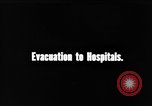
Evacuation to hospitals of American prisoners of war (POWs) liberated from Japanese prison camp near Cabanatuan City, in the Philippines, during World War II
Film opens with slate reading: "Evacuation to Hospitals." Next, on January 30, 1945, the day of the "Cabanatuan Raid" (Mission to rescue prisoners of war from the Japanese prison camp at Cabanatuan) rescuers are seen carrying a former POW from a building, on a litter. Local Filipinos and others are standing on the porch of the prison building. An ambulatory former prisoner comes down the steps unaided. Several rescued prisoners are seated on chairs, conversing. Closeups of some of them. Two weakened and bandaged former prisoners help each other up some steps. Slate states: "Man with Cane afflicted with Beri-Beri." A severely disabled former prisoner, with a cane, makes his way unaided across the grass. Rescuers and Filipinos are in the background, along with some carts used to evacuate disabled former prisoners back behind American lines.
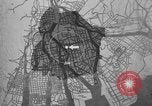
Damaged Hiroshima Castle, City Hall, and Yorozuya Bridge after atomic bomb attack during World War 2 in Hiroshima Japan.
Damage in Hiroshima, Japan after the atomic bomb attack in August 1945. A map shows the explosion range with in 1/6 miles. Buildings in Hiroshima after the atomic bomb strike. The wooden structure of Hiroshima Castle is demolished due to bombing. Less damaged Hiroshima City Hall. A soldier inspects the floor and railing of Yorozuya Bridge located 0.6 miles from the explosion zero point. Burn shadow marks from posts on the bridge indicate direction of the explosion. The soldier stands on a shadow area created by the stride of a pedestrian who had been crossing the bridge at the time of the explosion. The soldier marks in chalk the shoes prints from the shadow of the person who had been crossing the bridge at the moment of the blast.
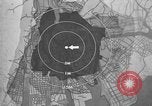
Damage in the range of 1 mile to 6 miles from impact in Hiroshima, following atomic bomb attack in Japan.
Damage in Hiroshima, Japan after the atomic bomb attack in August 1945. Views within 1 mile to 1.5 miles from center and 1.5 to 2 and 2 to 6 miles. Damaged wooden buildings in the 1.5 mile range. Damaged Hirosaki railway station. Damaged buildings. A steel beam twisted out of shape and a center wall stand undamaged. Building of a school with its north wall specially damaged. The school building is not damaged. A bent high school wall. Shattered glasses of a chapel on a hill 4 miles away from the center. (World War II period).
CRITICALPAST.COM: About Us | Contact Us | FAQs - How to Order | License Agreement | My Account | My Lightboxes | Shopping Cart | Advanced Search | Featured Collections | Website Terms & Conditions | Privacy Policy ©2026 CriticalPast LLC.
License Agreement |
Terms & Conditions |
Privacy Policy
©2026 CriticalPast LLC.