


 Francais
 Deutsch
 Italiano
Refine Your Search
Worms Germany 1945 stock footage and images
- Showing 331 to 336 of 10469 results more
more Hide
Hide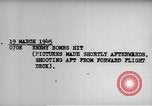
Violent explosions and fire fighting as Japanese bombs hit USS Franklin (CV-13) in Pacific Ocean during World War II.
Opening Slate reads: 19 March 1945, Enemy bombs hit (pictures made shortly afterwards shooting aft from forward deck). It refers to Japanese bombs striking the American Aircraft Carrier USS Franklin (CV-13). Heavy billowing smoke obscures the view for a moment. Then sailors are seen on the flight deck of the Franklin fighting a fire with hoses. More fire breaks out and smoke billows from the deck. Fire fighters continue efforts with hoses. New fire breaks out near the edge of the deck opposite the ship's island superstructure. View from other direction shows sailors all over the deck near the island trying to contain the fire. A slate appears reading: A series of violent explosions begin (made from USS Hickok - DD-673). This refers to filming from the USS Hickok. The USS Franklin is seen consumed by fire and covered by dense black smoke rising high into the sky. The smoke turns more white. A new view from the Hickok shows fire and smoke coming from the area of the carrier's island and blowing aft. A different view shows both white and dense black smoke enveloping the Franklin. Next, firefighters are seen again, on the Franklin's flight deck, forward of the island, continuing to battle the fires that see concentrated amidship. Slate reads: USS Miller alongside (refers to the destroyer, USS Miller, DD-535).View of the USS Miller close-by. Another view of sailors fighting the fire on the Franklin's flight deck. Brief view, from a parapet on the island, shows smoke. Also seen are water intakes stretched out from the ship, presumably providing water for firefighting. Back on the Franklin's flight deck, firefighters work against a backdrop of white smoke. a closeup shows portions of the flight deck broken and tilted into the hangar deck. More views of sailors on deck, forward of the island, fighting the fires. Glimpse of hangar deck below, where large section of flight deck has fallen. Firefighters with hoses working there.
U.S. Navy Task Force 58 defends against Japanese Kamikaze attacks and bombards Okinawa during Operation Iceberg
A glimpse of Navy gunners firing Bofors anti-aircraft guns from battle station on a U.S. aircraft carrier is how this film begins. Next, black flak clouds fill the sky and tracer rounds are seen in a nighttime battle as ships of U.S. Task Force 58 (TF-58) battles attacks from Japanese aircraft, including Kamikazes dispatched from Mainland Japan, during World War 2. View of Japanese attacking aircraft subject to relentless tracer bullet fire, until is is hit. It continues toward a target ship, but misses and crashes into the sea. A flaming Japanese aircraft moving overhead in daylight, amidst many black flak clouds. It crashes into the sea. Another nighttime scene shows numerous tracer rounds flashing through the darkness as hundreds of land--based Japanese warplanes attack ships of Task Force 58. Explosions are seen in the air as attacking planes are hit by anti-aircraft fire. View of a Japanese attacking aircraft diving from overcast skies, banking to its left and crashing into the water. Gun camera views from American aircraft shooting down a Japanese multi-engine bomber from the rear and one from another aircraft shooting a Japanese fighter head-on. It veers off in smoke as the American plane passes to its left. The Japanese plane crashes into the sea with a huge explosion and fireball. Another gun camera view of large Japanese aircraft being shot down from the rear. Scene shifts to column of 5 "old" U.S. battleships underway. Views of guns firing from newer battleships of the line. Glimpse of foreign correspondent Ernie Pyle aboard a warship. The battleship USS Pennsylvania (BB-38) seen silhouetted against moonlit sky. (She was damaged by hit from Japanese aerial torpedo, off Okinawa on April 12th, 1945.) Views of fast battleships and other ships of TF 58,firing their naval guns. View on Okinawa as their shells explode, supporting advance by U.S. Army and Marine advancing forces. The U.S. troops running across fields as they advance. Burning buildings on Okinawa. US troops advancing through rice paddies. A soldier calling for close air support on a field radio. View of two Escort carriers providing air support. View air control officers aboard the Command ship, heavy cruiser USS Indianapolis (CA-35), as they order air strikes in support of the troops. F4F fighter planes carrying bombs take off from a carrier. Formations of U.S. aircraft in flight overhead. Their bombs exploding on Okinawa. frontal view of an F4F firing rockets. Wider views of F4Fs firing rockets.
Japanese delegates reach Ie Shima, Ryukyu Islands and then advance towards Manila, Philippine Islands in the South East Asia.
Japanese surrender in Southeast Asia during World War II. Airplanes in formation flight. Two Japanese Mitsubishi G4M-1 'Betty' twin-engine bombers painted white with green crosses on their wings, fuselage and tail land at Ie Shima Ryukyu Islands near Okinawa carrying Japanese delegates. The planes land at Nichols Field at 1813 hours. The planes are dubbed 'Bataan number 1' and 'Bataan number 2.' Lt. Gen. Torasirou Kawabe, the vice chief of the Japanese Army's General Staff and his surrender party disembark from the airplanes. Members of the surrender party include Rear Admiral Ichiro Yokoyama Representative, Imperial Japanese Navy Staff., Colonel Yashima Terai General Staff, Colonel Orato Yamoto General Staff, Mr. Morio Yakawa Secretary, Japanese foreign office. Kawabe leads the surrender party. Army C-54 transport airplanes parked. Japanese surrender delegates board the airplanes which take off for Manila, Philippines. United States Army General Douglas MacArthur speaks to his troops from a balcony at the war damaged Manila City Hall (Padre Burgos Ave, Ermita, Manila, 1000 Metro Manila) on 20 August 1945. He notes that he is hopeful that they will all be able to return home soon.
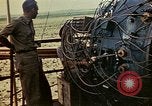
Views of wire connections to detonators on nuclear device 'Gadget' used in the Trinity nuclear test, Alamogordo, New Mexico
Views of the nuclear test device nicknamed, "Gadget", showing network of wires going to detonators surrounding core. The first ever atomic bomb device is in position at the top of its test tower, the day before it produced the first nuclear detonation in history. This device was detonated in the early morning of the next day, July 16, 1945. The detonation test event was named Trinity. (World War II period).
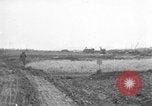
77th Infantry Division soldier looks at sign board at the commemorating spot in the Pacific Theater during Ryukyu Campaign.
U.S. Army 77th Infantry Division soldier looks at sign board in the Pacific Theater during Ryukyu Campaign of World War II. Soldier walks on field towards the commemorating spot. He looks at sign board which reads 'at this spot the 77th Infantry Division lost a buddy,Ernie Pyle,18 April 1945'.
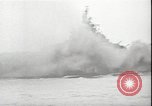
Aircraft Carrier, USS Hancock, struck by a Japanese Kamikaze in World War II
A series of views filmed from the USS Essex (CV-9) of the USS Hancock (CV-19) after she was struck by a Japanese Kamikaze aircraft on April 7, 1945, off the coast of Okinawa, during World War 2. Opening scene shows the Hancock almost completely enveloped by smoke. Camera pans across the ship. Subsequent scenes show smoke abating somewhat. View from flight deck of the Essex, of the Hancock steaming away, from the Essex. Brief view of four Japanese aircraft in flight, low overhead, and seven more at high altitude. Sailors line edge of the Essex flight deck looking at black objects in the water. Scene shifts to earlier sight of the Hancock burning., as viewed from a position on the island of the Essex, occupied by an officer and some sailors, wearing headsets. It shows heavy black smoke rising from the Hancock. The Battleship, USS North Carolina (BB-55) appears briefly in the background, upwind of the Hancock. Another view shows the Essex flight deck where sailors watch as the Hancock maneuvers. More scenes fairly closeup of smoke enveloping the Hancock.
CRITICALPAST.COM: About Us | Contact Us | FAQs - How to Order | License Agreement | My Account | My Lightboxes | Shopping Cart | Advanced Search | Featured Collections | Website Terms & Conditions | Privacy Policy ©2026 CriticalPast LLC.
License Agreement |
Terms & Conditions |
Privacy Policy
©2026 CriticalPast LLC.