


 Francais
 Deutsch
 Italiano
Refine Your Search
Worms Germany 1945 stock footage and images
- Showing 3871 to 3876 of 10470 results more
more Hide
Hide
Allied Army vehicles in front of the Platterhof Gasthaus near the Berghof (WW2)
View of Hitler's famous mountain Eagle’s Nest residence, the Berghof, in the Obersalzberg of the Bavarian Alps near Berchtesgaden, Bavaria, Germany. View of the snow covered Berghof as seen below the mountain. Snowcapped Bavarian Alps behind alpine trees. U.S. Army vehicles in front of the Platterhof Gasthaus, known as the General Walker Hotel after World War II, in Obersalzburg, Germany. Some vehicles come and go in front of the Platterhof Gasthaus. 101st Airborne Division soldiers perform a changing the guard ceremony. An officer inspects the troops.
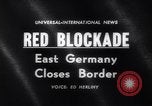
East German refugees in Marienfeld Refugee Reception Center in West Berlin, and scenes of divided East and West Berlin.
During mounting Berlin Crisis, view of map of Germany with separated East and West Germany. East Berlin refugees gathered and on streets with their luggage at Marienfeld Refugee Reception Center in West Berlin. They are among the last to escape East Berlin before the Soviets close the border. Refugees in queue to be processed entering West Berlin. Old woman refugee smiles as she helps a young boy drink from a cup. Refugees at airport with their children to be flown to other cities in West Germany. They board plane and it takes off. People at railway station to see off their relatives as they flee East Germany. East German soldiers digging emplacements in roadway near Brandenburg Gate to erect blockade (the beginning of what became the Berlin Wall). They unload a truck filled with poles. Soldiers wire the border. People watch soldiers running barbed wire enclosing East Berlin territory; the beginning of the Berlin Wall. Willy Brandt, mayor of West Berlin, with others on street. Communist soldiers on the closed border. A Russian soldier on the East side of the road divided with barbed wire fence. Tanks and people on road.
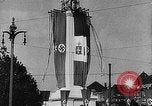
Italian fascist leader Benito Mussolini arrives by train at Munich Central Station where he is welcomed by Adolf Hitler
Italian fascist leader Benito Mussolini visits Munich, Germany. Flags of Nazi Germany and the Kingdom of Italy hang in the streets of Munich. Nazi flags hung from buildings. A Bundesadler eagle metal plate adorns a wall. Cars move along the roads. Italian leader Benito Mussolini arrives at Munich Central Station (München Hauptbahnhof, Bayerstraße 10A, 80335 München, Germany). He shakes hands with Adolf Hitler. Benito Mussolini and Adolf Hitler walk on the railway platform, the officers follow them. Military troops in formation on the platform. The two Axis leaders review formations of soldiers and sailors as military brass band plays the German and Italian national anthems (“Marcia Reale Italiana” and “Deutschlandlied”). Spectators line the streets. Benito Mussolini and Adolf Hitler enter open cars. Nazi banners and decorations adorn the Munich New Torn Hall and Marienplatz (Marienplatz 8, 80331 München, Germany). Hitler and Mussolini in Marienplatz. Crowds cheer and wave, as their cars drive down the streets of Munich, which are festooned with Nazi and Italian banners.
British prosecutor Shawcross presents crimes by Nazi leaders during Nuremberg Trials; scenes from Molotov-Ribbentrop Pact signing
Trial of Nazi leaders for war crimes in Nuremberg, Germany soon after the end of World War 2. British Chief Prosecutor Hartly W Shawcross presents count no 2, crimes against peace involving wars of aggression in violation of international treaties and agreements. A document reveals Adolf Hitler's plans to occupy Poland. Footage showing Soviet Leader Joseph Stalin and Germany's Joachim Von Ribbentrop as they sign non-aggression pact between Russia and Germany on August 23, 1939 (also called the Molotov-Ribbentrop Pact). Germany prepares to occupy Poland as Pope Pius XII and President Franklin D Roosevelt appeal for peace just before start of World War II.
Russian chief Prosecutor, Roman A Redenko charges Nazi leaders with commitment of war crimes during the Nuremberg Trials.
Nuremberg Trials in Germany. Russian Chief Prosecutor Roman A Redenko presents count 3 and 4 charging Nazi leaders with commitment of war crimes in Germany and in other countries occupied by Germany. Prisoners of war searched for weapons, starved, made to march and abused by Nazis. A General and Kenaris testify before the tribunal in Nuremberg, Germany
Eisfeld-Valier rocket propulsion system tests using simple chassis with steel wheels running on narrow gauge railroad.
July 17, 1928, Friedrichshohe, Harz, Sachsen-Anhalt, Germany. Trial run of an Eisfeld-Valier propulsion system on a simple rail car (chassis mounted on steel wheels) running on the Harz Narrow Gauge Railway ,in central Germany. A man fits rocket boosters in the chassis. A flag marks the start point. The car leaves the start point and attains speed of over 100 Km per hour. Spectators stand near the track. July 25, 1928. Another trial run of the rocket-propelled rail car. Men near Eisfeld-Valier-Rak-1propelled rail car on tracks. Men fit rocket boosters in the car. The boosters are ignited. The car attains a speed of 180 Km per hour. July 26, 1928. Official speed run of the Eisfeld-Valier-Rak 1rail car at Stiege, Germany. On this third run, the car reached 180 km / hr but continues its strong acceleration, causing it to derail and fly off the track at a speed estimated to be 300 Km per hour.
CRITICALPAST.COM: About Us | Contact Us | FAQs - How to Order | License Agreement | My Account | My Lightboxes | Shopping Cart | Advanced Search | Featured Collections | Website Terms & Conditions | Privacy Policy ©2026 CriticalPast LLC.
License Agreement |
Terms & Conditions |
Privacy Policy
©2026 CriticalPast LLC.