


 Francais
 Deutsch
 Italiano
Refine Your Search
Worms Germany 1945 stock footage and images
- Showing 4069 to 4074 of 10470 results more
more Hide
Hide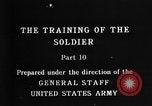
U.S. Army training film on poisonous gas, flamethrowers, gas cylinders and gas artillery shells used by Germany in World War I.
A training film titled 'Gas and Gas Mask' shows how lethal gas is disseminated from gas cylinders and artillery shells in Europe by Germany during World War 1. German soldiers wearing gas masks move out from a trench through a screen of smoke or gas.The soldiers in prone positions advance through poisonous gas smoke and carry square shields. American forces demonstrate use of liquid fire (flame thrower) like that used by German troops to spray liquid fire in the trenches. Condensed gas in a cylinder. The cylinder lying on the ground in a horizontal position. A U.S. Army soldier wearing a gas mask opens the knob of the cylinder. The gas comes out. A gas cloud is formed and moves in the direction of the wind. A soldier holds a German gas shell. A large number of gas shells are exploded. A U.S. soldier demonstrates two different forms of gas masks. The first is a basic scarf which holds a small pad of cotton soaked in soda solution. He puts on the scarf mask. Next he puts on a more advanced "Gas helmet" (early gas mask).

The relatives of Isidor Fisch arrive from Germany to testify at Hauptmann trial in Flemington, New Jersey.
Trial of a German carpenter Bruno Richard Hauptmann for the kidnapping and murder of Charles Augustus Lindbergh Jr. son of pilot Charles Lindbergh in Flemington, New Jersey. A ship underway at sea. The relatives of Isidor Fisch, a German Jewish friend and business associate of Hauptmann aboard a ship. They walk up a gangplank to board a boat. A view of the city. A close up of the relatives of Isidor Fisch arrive from Germany to testify at Hauptmann trial. The relatives come out of a building and get in a bus. The bus leaves. Cars and bus drive on a road. A man works at his home as the woman had gone for the testimony. A man peals vegetables. He cooks food. The women seated for the hearing. The man sits on a table and eats food. He plays with his dog. The man washes plates.
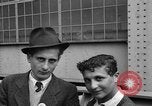
Refugees and displaced persons arriving in New York from aboard the SS Marine Flasher, arriving from Bremerhaven Germany
Arrival of displaced persons and refugees of World War 2 in New York, after the war. Men, women, and children arriving at New York City on May 20, 1946 after a voyage that departed Bremerhaven Germany on May 11, 1946. People greet relatives at the dock in New York. Two young men and a girl stand together and show the concentration camp tattoos on their arms. The tattoo numbers are A9496 on the young man with the hat, A13889 on the girl, and B3073 on the young man without a hat. The young man with tattoo B3073 is Berel Gola (later called Bernard Gola) a 20 year old Jewish man from Poland. He had been imprisoned by the Nazis at Treblinka and at the Auschwitz Concentration Camp, where he received the tattoo. A woman and a man holding a young girl stand. Women holding children stand by. A man holding a young child. People debarking from the ship. People crowd at the dock. They meet their relatives. People stand behind a fence. A woman greets her relative. An emotional woman cries when reunited with relatives.
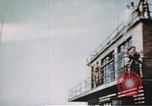
U.S. 351st Bomb Group B-17s take off on mission to Germany, from their base at RAF Polebrook, England, in World War II
Flare is fired from control tower and B-17s of the U.S. 351st Bomb Group begin taking off from their base at RAF Station Polebrook, England, on a mission to Germany during World War 2. The B-17 aircraft fly off in formation. View inside one B-17, as crew goes on oxygen, as they climb through 10 thousand feet. Sky filled with formations of B-17s. U.S. P-47 fighter escort aircraft of the U.S. 487th Fighter Squadron (352nd Fighter Group) at RAF Station Bodney, take off to accompany the B-17s part way. Gunners inside a B-17 are alerted to German fighters at 3 O'clock low. They are identified as the American P-47 escorts. Squadron of U.S. P-47s seen in flight. B-17s and escorts pass over the enemy coastline. They being to encounter flak which can be seen as Black clouds.
A USAAF B-26 Marauder bomber takes off from England to bomb targets in Germany during World War II.
A USAAF (United States Army Air Forces) B-26 Marauder medium bomber at an airfield in England during World War II. A pilot and a copilot board the bomber. The aircraft taxis on an airstrip and takes off. The B-26 Marauder in flight to bomb targets in Germany.
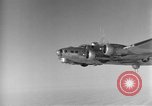
Smoke rises from burning oil storage tanks as B-17s drop bombs on Heligoland island in Germany.
U.S. Army Air Force Boeing B-17 Flying Fortresses bomb Heligoland island in Germany during World War II. B-17s in flight. Several aerial views of the island and another island next to it. Smoke rises from burning oil storage tanks on Heligoland island. A runway on the island in the background. Heavy flak. German coastline: Heligoland and Friesian islands. Bomb craters and smoke from burning oil storage tanks. Bombs are dropped from Allied aircraft. The aircraft are in formation over clouds.
CRITICALPAST.COM: About Us | Contact Us | FAQs - How to Order | License Agreement | My Account | My Lightboxes | Shopping Cart | Advanced Search | Featured Collections | Website Terms & Conditions | Privacy Policy ©2026 CriticalPast LLC.
License Agreement |
Terms & Conditions |
Privacy Policy
©2026 CriticalPast LLC.