


 Francais
 Deutsch
 Italiano
Refine Your Search
Worms Germany 1945 stock footage and images
- Showing 4099 to 4104 of 10470 results more
more Hide
Hide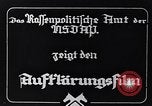
Nazi film shows various men, women, and children in German mental and physical care institutions, contrasted with average Germans
NSDAP (Nazi) German film on hereditary diseases opens by showing German boys and girls playing outside houses and children in the streets of Germany. Some of the children are dirty and poor, and living in meager tenement areas. Prior scene is then contrasted with exteriors of numerous hospitals and clinics with well kept grounds and facilities. Doctors and nurses in white uniforms stroll the grounds. A group of boy patients are shown in an outdoor area. Scene shifts to show a German farmer with a boy working on a farm. The boy watches geese. The farmers build a rock embankment beside water. A fishing boat on water and a German fisherman working with his nets. A German woman wrings out wet laundry. German workers in an office perform clerical work and typing. German laborers working hard and constructing new buildings. Construction scenes. A man planes a long piece of wood. Other workers lay stones, work on overhead wires, and work at a steel molting factory. German farmers harvest wheat and horses pull carts bearing harvest. A windmill turns. Scene shifts to outdoor grounds of an institution housing mentally and physically handicapped German boys, girls, women, and men. Disparaging views of various mentally disabled and physically disabled men, women, boys, and girls are shown. Some are physically deformed patients, others are insane patients, or violent patients in strait jackets. Jewish patients are separately identified, shown, and disparaged (seeds of anti-Jewish sentiment and the holocaust to come). Nurses and doctors seen observing and working with patients. Patients eat, many exhibiting difficulty eating. Some patients are spoon fed. Others are fed by nasal tube. The scenes shown appear designed to show the patients in the most denigrating way. Diagrams depict mental illness transmitting through defective genes (part of theories espoused by Nazi Germany in support of its eugenics programs, sterilization, and euthanasia programs such as Aktion T4, before and during World War 2).
Hermann Wilhelm Goering represents Hitler at Heroes' memorial day ceremonies in 1938
The opening scene depicts Heldengedenktag (Heroes' memorial day) in Berlin, March 13,1938. It shows the spartan interior of the Neue Wache (New Guard) World War One memorial on Unter den Linden. A cross stands above masses of flowers and a flame burns next to it. A sentry stands outside the building. View of the equestrian statue of Frederick the Great, nearby in the center of Unter den Linden. Camera pans back across the front of the New Guard building showing soldiers in formation on either side. Accompanied by two officers, Hermann Goering in uniform, including steel helmet, walks behind soldiers as they carry a large floral wreath across the square and into the New Guard building. View from inside as they enter and place the wreath. Closeup of the wreath shows a ribbon with words: "Adolf Hitler." The two officers render a Nazi salute and Goering salutes with his Luftwaffe Field Marshal's baton. Throughout the sequence,the war song, "Ich hatt' einen Kameraden," is softly played as a slow dirge in the background. Scene shifts completely to a hall at night, in Vienna, Austria, as Goering gives a speech referring to Adolf Hitler. View of St. Stephen's cathedral and scenes from several days prior, as crowd of German people cheer in Heldenplatz about the Anschluss (annexation of Austria by Germany). Animated map showing the territorial annexation. Slate displaying the slogan: "Ein Volk; Ein Reich; Ein Fuhrer" (One people; one nation; one leader.) (Note: Regarding the New Guard, in Berlin: Since 1993, it has been the Central Memorial of the Federal Republic of Germany for the victims of war and tyranny. The eternal flame was replaced by a Four- times-enlarged copy of the bronze sculpture, "Mother with Dead Son,"by Kaethe Kollwitz, on a slab of black granite in the center of the room underneath the oculus. Her original small bronze made in 1937, resides in the Kaethe Kollwitz Museum in Charlottenburg.)
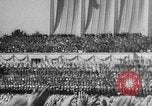
Growth of the German Nazi party and military might (German remilitarization) during the 1930s leading up to World War II
Nazi rally in Nuremberg, Germany ca.1934. Massed Storm troopers and spectators salute Hitler. An artillery piece is fired. Hitler personally recognizing loyal Storm troopers. Animated map of Asia, showing Japanese occupation of Manchuria, and Italian occupation of Ethiopia. Newspaper headlines describe Britain and France hesitating to support League of Nations oil sanctions against Italy; and U.S. increasing its oil exports to Italy by 600% (ca. 1935). Hitler and Hermann Goering looking pleased in Hitler's private railroad car. Adolf Hitler at a planning table covered with maps. German citizens traveling abroad and Joachim von Ribbentrop visiting London, as ambassador to Great Britain, in 1936. View of Léon Degrelle and his Catholic-fascist, Rexist party in Belgium (ca. 1936). View of Colonel Francois de la Rocque speaking at a Cross of Fire (Croix-de-Feu) party night rally in France. Konrad Henlein, leader of the Sudeten German Party in Czechoslovakia. Arthur Seyss-Inquart, Austrian National Socialist official, seen in an automobile during a parade. Sir Oswald Mosley addressing followers and defending Hitler. Street scenes of public disorder attributed to Nazi sympathizers in France and Belgium. Mass meeting of the German American Bund in Madison Square Garden, New York City,1939. U.S. flags and picture of George Washington decorate stage. Fritz Julius Kuhn addresses the gathering and members rough up a protester. Views of heavy industry in Germany, especially steel manufacturing for remilitarization. Persons working at a German concentration camp. Dramatized execution by machine gun. View of Heinrich Himmler. German President Paul von Hindenburg. German national conscription of 1935 during military mobilization efforts. German youth training pilots with gliders. German paratroopers, Junkers 52 aircraft, German soldiers goosestep, views of German tanks. Ju 87 Stuka plane. German invasion of Rhineland, 1936. Construction of Siegfried Line. Antitank barriers, bunkers, dragons teeth. Hitler visiting Westwall. German military parade.
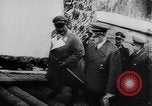
Adolf Hitler's plans and actions for conquest of Austria and Czech Sudetenland; events leading up to and through Munich Pact
Film opens showing Adolf Hitler ascending stairs to the Bergfhof, accompanied by Marshal Hermann Goering, and followed by other high ranking Nazi officers. Inside, General staff officers begin briefing Hitler about plans for German expansion Eastward. Finger points to Austria on map. Next, on March 12, 1938, Border Guards are seen dismantling barriers at the border as German troops march into Austria. German aircraft fly overhead. Hitler stands in his open touring car as it drives into Vienna, where local people line the sidewalk, and welcome him with the Nazi salute. Maps depict the fall of Austria and illustrate the anticipated conquest of Czechoslovakia. Brief overlay image of Bismark as narrator quotes him about Bohemia being key to control of Europe. German troops advancing up steep mountainous terrain. German soldiers on horseback and wagons passing road sign pointing to cities of Karlovy Vary and Cheb, in the west Bohemia region of Czechoslovakia. Czech troops marching in formation with shouldered arms. View of Czech Avia B-534 warplanes at an airfield. Interior of a Czech Skoda works munitions factory. President of Czechoslovakia, Edvard Beneš, signing papers at his desk. French lancers marching in formation, on parade. (Narrator comments on French military alliances with Czechoslovakia and Great Britain.) View of warships in British fleet. Hitler outdoors, surrounded by German military officers, looking over large maps. Animated map highlights the "Sudetenlands" bordering Germany, including districts of Bohemia, Moravia, and parts of Silesia inside Czechoslovakia, where use of German language was common. Street scene from that area showing some youths in uniforms, marching. Hitler giving speech about bringing the German people together again. The uniformed youth marching at a camp. Sign erected on stone wall at the camp reads: "Die Faune ist mehr als der..."(the flag is more than ...) Youth in Naval garb march on a street with a Nazi flags. Spectators give Nazi salutes. Young men in Khaki uniforms march with Nazi symbols. Scenes shift to similar parades in Norway, Sweden,China,and the United States. Back in Czechoslovakia, Hitler reaches down from his podium to shake hands with parading youth. Images of Admiral Chester Nimitz, Lieutenant General Walter Krueger, Senator Robert Wagner, Wendell Wilkie, Henry J. Kaiser, and American military members, superimposed on American flags. Sudentenland Nazi supporters marching. Konrad Ernst Eduard Henlein, Sudeten German politician, with a Nazi officer. More views of Sudeten Nazi supporters. Nazis in an office showing blackjacks. Hospitalized Czechs who suffered at hands of Nazi supporters in street fights. Hitler speaking before the Bundestag. Closeup of Joseph Goebbels.Foreign minister Maxine Lichtenhof speaking to League of Nations meeting announcing Russia's readiness to back action against Germany. Czech borders being closed. British Prime Minister Neville Chamberlain arriving by plane in Munich. Benito Mussolini, Adolf Hitler, and Hermann Goering with Chamberlain, at the meeting to sign the Munich Agreement. View of protests by people in the streets of Czechoslovakia. French Prime Minister Edouard Daladier and Chamberlain, both being praised by countrymen upon their respective returns from Munich. (Chamberlain seen arriving just before giving famous "peace for our time" speech.)
Analysis of the German labor force from 1939 to 1943 (WW2)
Analysis of the Germany's labor force, military strength and effects of World War II on manpower. Soldiers march. Men work in factory on equipment and machinery. Women work in factory. A map points Germany, Sudetenland and Austria. Graphs examine labor force by sex, age and military replacement availability; compare the labor force according to sex from 1939-1943; detail the increase of work force through the women part time workers and the veterans. Women weld equipment in a factory. Men do mining work. They work on a field. They also work on the rail road station. Graphs compare the labor force in agriculture, industry, trade services, transport and government.
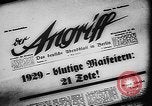
German people during Beer Hall Putsch on the streets to oppose KPD; and later scenes including Adolf Hitler speaking at May Day celebration
Unrest in Germany in decade following World War I. Rally and demonstration in Munich in Marienplatz area, between Communist KPD members, police, and NSDAP brownshirts. This was known as the Beer Hall Putsch or Munich Putsch in November 1923. Crowds opposing the Treaty of Versailles. Trucks and jeeps loaded with policemen at the riot place. Buildings in the background. Scene shifts to a Nazi rally at the Lustgarten in Berlin on May Day (May 1, 1938). A tall May Pole is seen decorated with Nazi flags and streamers. Adolf Hitler addresses a large crowd from a dais on the steps of the Altes Museum. Swastika sign on panels on either side. German biplane aircraft fly in formation overhead, demonstrating German military buildup, re-militarization, and rearmament of Germany leading up to World War 2.
CRITICALPAST.COM: About Us | Contact Us | FAQs - How to Order | License Agreement | My Account | My Lightboxes | Shopping Cart | Advanced Search | Featured Collections | Website Terms & Conditions | Privacy Policy ©2026 CriticalPast LLC.
License Agreement |
Terms & Conditions |
Privacy Policy
©2026 CriticalPast LLC.