


 Francais
 Deutsch
 Italiano
Refine Your Search
Worms Germany 1945 stock footage and images
- Showing 4219 to 4224 of 10470 results more
more Hide
Hide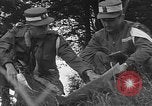
U.S. 7th Army infantry participate in NATO "Exercise Monte Carlo" in Germany
Two U.S. Army officers are seen wearing white-banded caps, identifying them as "umpires" during NATO "Exercise Monte Carlo." war games. They refer to a large map. One, a field grade officer, points in a direction. Scene shifts to U.S. Patton tanks parked in a field. Closeup of gunner atop a tank. Infantry riflemen lie prone at edge of a field. One fires his rifle. Scene changes to a soldier firing a Browning M1917 heavy belt-fed water-cooled machine gun. Infantrymen proceed along a tree-lined road. Others dig in to make defensive positions. Two soldiers dismantle a Stokes mortar to move it. Soldiers camouflage positions with netting and use pickaxes and other tools to "dig in."
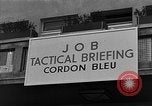
NATO forces engaged in exercise "Cordon Bleu" in Germany
Sign reads: "JOB, Tactical Briefing Cordon Bleu." Marshal Alphonse juin of France, Commander-in-Chief Allied Forces Central Europe, walks from staff car, followed by several other French officers. German officers assembled in a field. A civilian official converses with a French General in the field. Marshal Juin, relaxed with cigarette in his mouth, smiles and jokes with German soldiers.
Recovery in 1930s Germany reaches the rural agricultural segment of the economy
Film begins showing livestock in stalls eating hay. Next, an auction is seen in progress. The auctioneer signals a final sale by striking a board with a wooden mallet. The new owner leads the animal away on a tether. Adolf Hitler is seen in uniform speaking at a podium, extolling German workers, against a background of waving wheat and farmers using scythes to harvest it. The farmers continue, placing the sheaves of wheat into wagons. Scene shifts fo grains of wheat being smoothed with a shovel. A Nazi guard in black uniform stands before a structure displaying a sign reading: Aldolf-Hitler-Roog. A car carrying Hitler enters a rural village area, where a woman steps in front of it to stop it. She speaks to a smiling Hitler as she points toward her newly built neighborhood of homes.
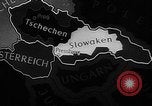
The Sudetenland in an economic crisis followed by the flight of Sudeten Czechs as Germany invades
Animated map shows shows areas of Czechoslovakia constituting the Sudetenland. Scenes of numerous idle industrial plants in the region during period of economic trouble, high unemployment and the Great Depression. Some idle factories and businesses with chains and locks. Views of unemployed workers. More and more views of idle work places. Unhappy jobless persons. Scene shifts to hundreds of thousands of Czech people leaving their homes in the Sudetenland. Some are seen walking along a road carrying their belongings. Some use baby carriages and others use bicycles to carry their belongings. Some lead cattle on tethers. Others have carts. Views of weary refugee Czechs traveling and some at resting places. Many views of evacuees passing a Sudetenland border and moving across roads, fields, and in every imaginable manner as they leave and begin to seek new homes. Many are seen crying and weeping. Then suddenly, the film shifts to October 1, 1938, as German forces enter the Sudetenland and are happily cheered by German-speaking residents. Large formation of German troops marching along a street as spectators render Nazi salutes. A welcoming banner is stretched across the street. Many women wave and throw flowers at the rapidly passing German soldiers in vehicles. View from one of the German vehicles of the people crowding around them and cheering them. During a lull in traffic, a woman walks on the empty street (still surrounded by sidewalks full of spectators) and strews more flowers along the roadway. Crowds cheer with great enthusiasm as Adolf Hitler is seen riding in an open motorcar and entering the German occupied area at the Wildenau crossing on October 3, 1938. The car is mobbed by Sudeten Germans who shake hands with Hitler. A banner thanking Hitler for the occupation hangs across the roadway. Many views of Hitler saluting and waving to the enthusiastic population. At one point he stops the car and walks on the street, accompanied by Marshal Hermann Goering, who also meets and greets people in the crowd, including some children to whom he gives candy. Hitler also greets a small girl and gives her some candy.
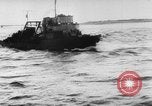
Allied bombing campaign against Germany and Luftwaffe defenses during World War II
German M-Class mine sweeper in waters off France in World War 2. It is armed with quad-mounted 2 cm Flak 38 AA guns (2 cm Flakvierling 38). German Navy sailors look up at contrails from high flying Allied aircraft. Officer sights aircraft overhead and hurries to report it. He records his observation in a log. German radio operator transmits information over wireless telephone by morse code telegraph key. A mass of contrails from Allied aircraft is seen in the sky. Scene shifts to a German airfield in France, where Focke-Wulf FW-190 fighters are lined up. Ground crewman shows motion picture gun camera for an airplane. Men push a Messerschmitt Bf 104 out of a hangar. Closeup of German pilots strapping into Me-104s and taxiing for takeoff. FW-190s and Me-109s taking off from airfield. German civilians entering a Flak tower for refuge as a bomb shelter. View from inside as doors close. Trams stopped on street. Hospital staff moving patients to bunkers (bomb shelters). Massive contrails from Allied bombers. View inside a German command post, where women workers and German officers with headphones plot positions of attacking planes on large maps. Flight of German Me-109 aircraft in formation. Gun camera showing A U.S. B-17 bomber being shot from rear with its wing on fire and explosion in its tail. Glimpse of head-on attack against B-17. Two Messerschmitt Bf 110 aircraft in flight. A lone U.S. B-24 Liberator bomber under attack. B-17 with piece of windshield missing and horizontal stabilizer shot away. B-17 bomber formation under attack from the rear. View of pilot and instruments inside German fighter plane. B-17 being shot to pieces in frontal attack. More attacks on formations of B-17s. German women in command post recording combat information on displays. Parachutes of American B-17 crew in sky. Captured U.S. fliers being escorted under guard, and one, with head bandaged, being questioned by German officers (English conversation is heard.) The flier says he is fine They ask another flier if he is wounded. He says only a twisted ankle. Temporary graves of dead American fliers, with wooden crosses and names on them, including one with name George J.Parker.
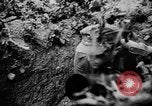
Germany launches V-1 flying bombs against England during World War II
Initial scene shows German soldiers setting up a camera, in a camouflaged location, during World War 2. . Views from the water, of the White Cliffs of Dover, on the English Channel coast. Suddenly, a jet-propelled V-1 flying bomb is seen racing past the camera and disappearing in the distance. Next the camera focuses on another V-1 and tracks it. Its body, wings, and jet engine affixed to its top, are clearly seen. as are pulses of flame from its engine. Another V-1 launches from near the camera and flashes past, disappearing in the distance. The final scene shows a V-1 in flight, even clearer than the earlier views. (Note: The V-1 was also known as a buzz bomb or doodle bug was the first cruise missile used in wartime.)
CRITICALPAST.COM: About Us | Contact Us | FAQs - How to Order | License Agreement | My Account | My Lightboxes | Shopping Cart | Advanced Search | Featured Collections | Website Terms & Conditions | Privacy Policy ©2026 CriticalPast LLC.
License Agreement |
Terms & Conditions |
Privacy Policy
©2026 CriticalPast LLC.